
Genus · Elapidae
Types of taipans
3 species make up the genus Oxyuranus, the snakes commonly called taipans. All of them are venomous.
About taipans
Taipans are large, fast Australasian elapids that include the most venomous land snakes on Earth.
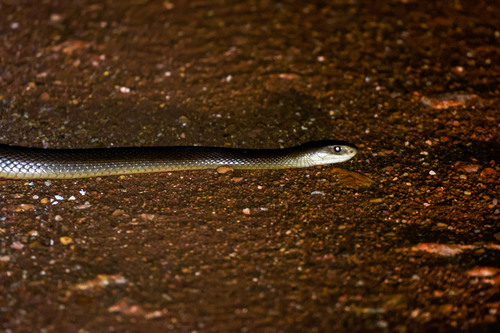
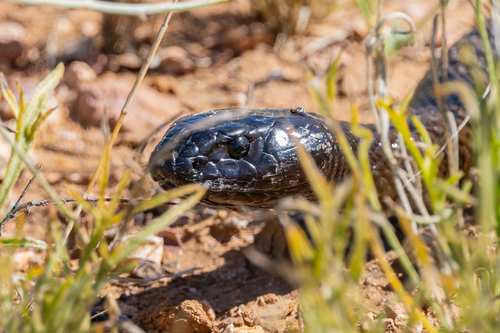
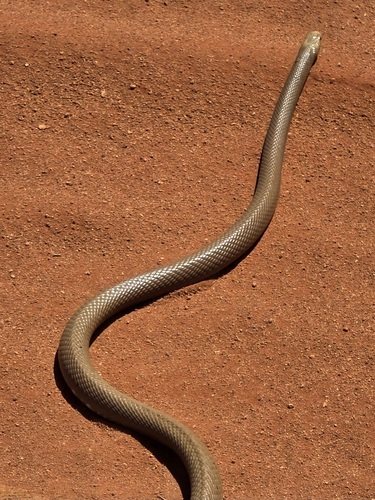
Oxyuranus is a small genus in the family Elapidae, the group of front-fanged venomous snakes that also includes cobras, mambas, kraits, and sea snakes. Its members are the taipans, found in Australia and southern New Guinea. The database holds three species: the Coastal Taipan, the Inland Taipan, and the Western Desert Taipan. As elapids, taipans have fixed front fangs at the front of the upper jaw, smooth scales, and a slender, agile build suited to active hunting by day.
Taipans are large snakes, with the Coastal Taipan among the longest venomous snakes in Australia and capable of exceeding two meters. In general terms, they are long and lean with a narrow, somewhat rectangular head that is distinct from the neck, large forward-set eyes, and coloration that ranges from pale fawn and olive to dark brown, sometimes shifting seasonally. Body identification is difficult and should never be the basis for approaching one; range and habitat are more reliable clues than color, which varies widely within a species.
Habitat tracks the species. The Coastal Taipan favors warm, wetter coastal and subcoastal country of northern and eastern Australia and New Guinea, including monsoon forest edges, cane fields, and grasslands. The Inland Taipan lives in the dry, cracking black-soil floodplains of central eastern Australia, where it shelters in soil crevices and animal burrows. The Western Desert Taipan occupies arid interior regions. Across the genus, taipans are ground-dwelling and rely on speed and acute vision to find prey.
These are highly venomous, dangerous snakes. The Inland Taipan produces the most toxic venom of any land snake measured, and the Coastal Taipan is responsible for serious envenomations in its range; taipan venom contains potent neurotoxins along with components that affect blood clotting. Do not handle, capture, or approach a wild taipan under any circumstances, and do not rely on a snake's reputation for shyness as a safety margin. If anyone is bitten, treat it as a medical emergency: keep the person still, call local emergency services immediately, and in the United States contact Poison Control at 1-800-222-1222. Antivenom and hospital care exist for these bites, so getting to professional help fast is what matters.
Ecologically, taipans are specialist mammal hunters that feed largely on rodents and other small mammals, using a rapid strike-and-release approach so their fast-acting venom subdues prey while the snake avoids retaliation. Like most elapids, they are egg-layers, with females producing clutches whose size can rise when prey such as rodents is abundant. Taipans are typically wary and prefer to flee, but they can defend themselves vigorously if cornered, which is exactly why distance, not handling, is the only sensible response in the wild.
Oxyuranus belongs to the Elapidae family (Cobras, mambas, coral & sea snakes). Front-fanged venomous snakes, many with potent neurotoxic venom. Usually slender with a head barely wider than the neck and fixed front fangs (not the folding fangs of vipers). Coral snakes are boldly ringed; sea snakes have a flattened, paddle-like tail.
Danger: All elapids are venomous and the family is responsible for a large share of fatal snakebites worldwide. Many are shy, but bites can be life-threatening. Treat any bite as a medical emergency.
All species (3)
Keep learning
- Venomous vs Nonvenomous: How to Tell the DifferenceThe folk rules for telling venomous snakes apart, where each one fails, and why location-based identification beats guessing by sight.
- Are Snakes Dangerous? The Real Risk, in PerspectiveMost snakes are harmless and avoid people. Here is the honest picture of snakebite risk worldwide and how to lower your own.
- Snake Venom Explained: How It Works and WhyWhat snake venom actually is, why it evolved, the main venom types, fang delivery, how antivenom works, and why ranking the most venomous snake is hard.
- How Snakes Move, Hunt, and EatHow snakes move without legs, hunt as ambushers or active foragers, kill by constriction or venom, and swallow prey wider than their head.