
Colubridae
Speckle-headed Whipsnake
HarmlessAhaetulla fasciolata
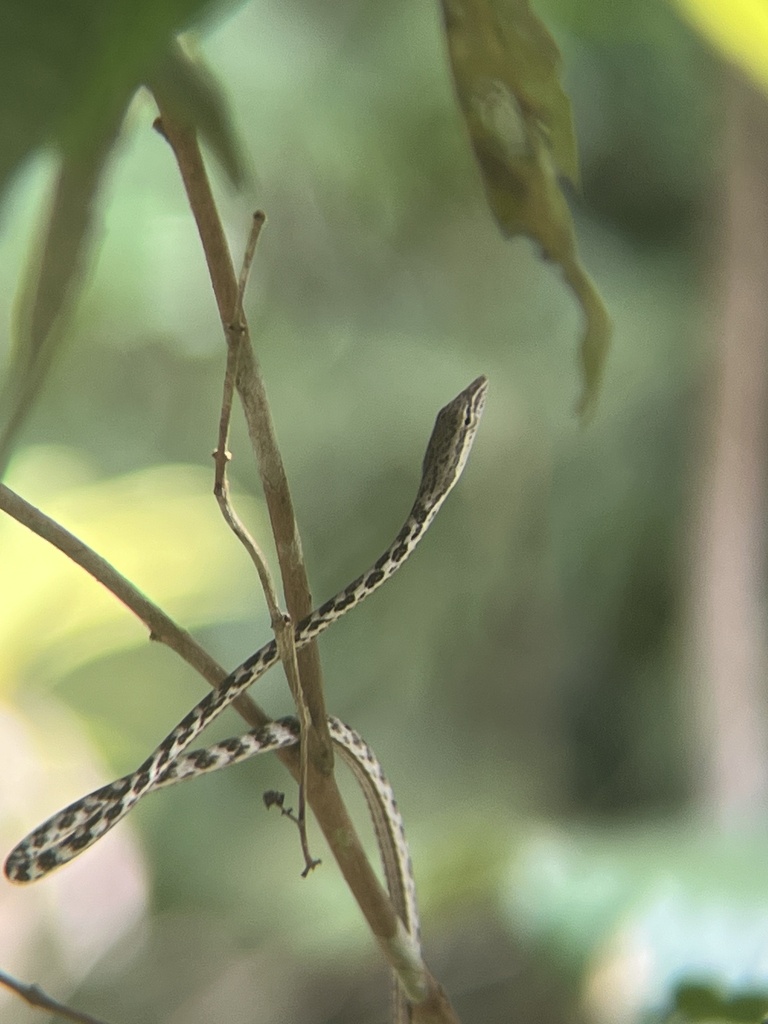
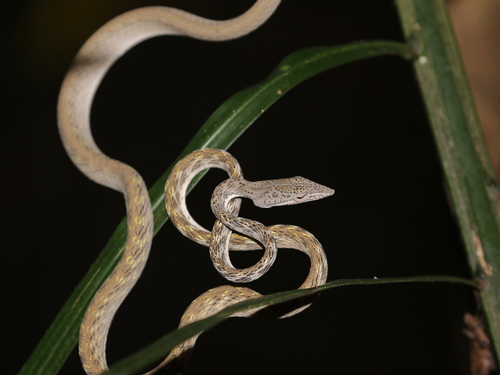
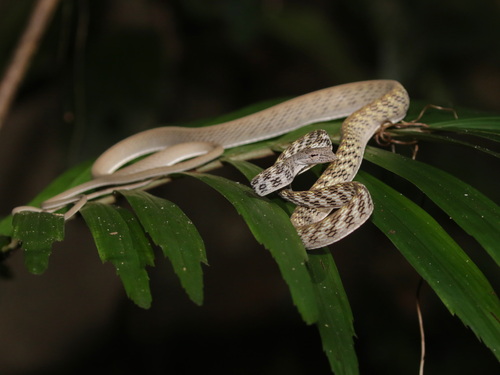
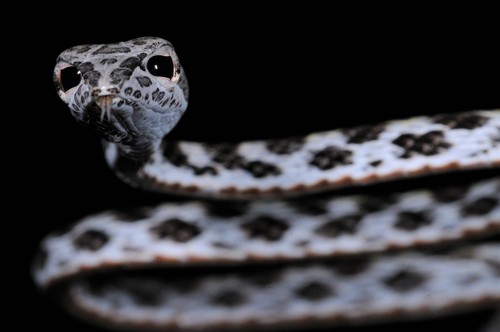
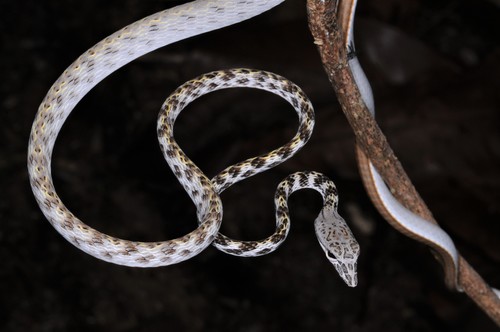
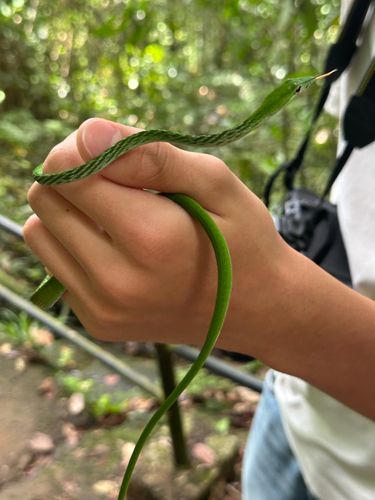
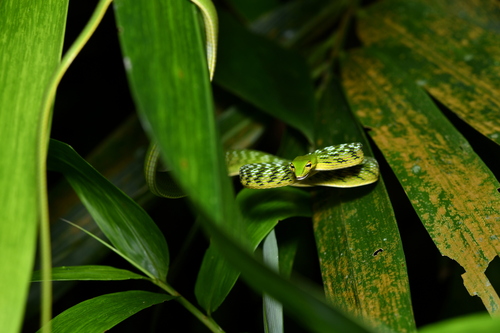
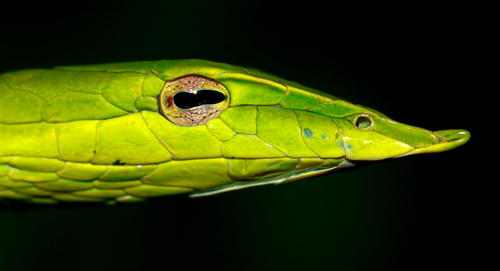
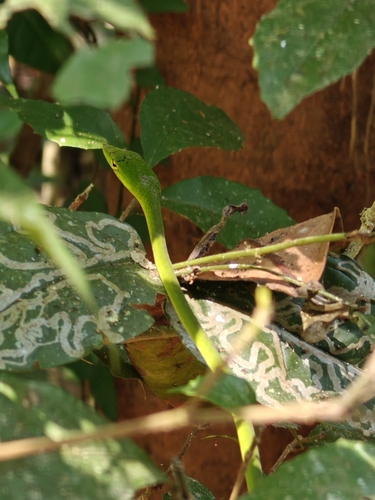
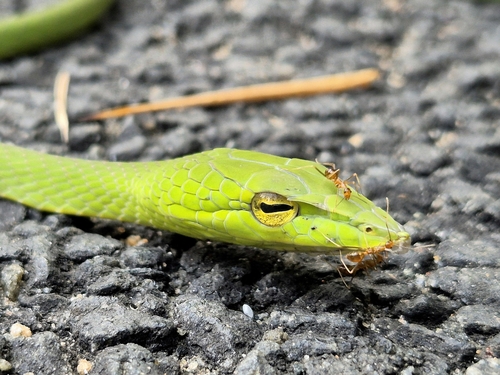
5 photographs of the Speckle-headed Whipsnake. © Gregory LeClair.
The Speckle-headed Whipsnake (Ahaetulla fasciolata) is a rear-fanged, mildly venomous snake in the Colubridae family, recorded in 4 countries.
- Family
- Colubridae
About the Speckle-headed Whipsnake
The speckle-headed whipsnake (Ahaetulla fasciolata) is a species of colubrid vine snake found in Southeast Asia.
Description
It has a thin, elongated body, an extremely long tail and a sharply triangular-shaped head. Adults can measure up to 0.8 m. The upper body is usually brownish-grey, but can vary greatly to yellows, oranges, greens and browns, and may have ill-defined transverse bars on the neck and anterior part of the body, or may be solid in color. The belly is whitish with a black line near the ends of the ventral scales. The head is usually punctuated with dark spots. A thin dark line across the eye separates the darker head from the lighter cheeks. The upper lips and underside of the head are whitish with dark spots.
The scales pattern observed in specimens from Thailand were: ventral 227–238, subcaudal (187–192) + 1 paired, dorsal scales in 15 rows, 9 supralabial, with the 4th to 5th touching the eye, 1 preocular, 2 postocular. The anal scales are entire in this species.
Taxonomy
It belongs to the genus Ahaetulla, one of five genera within the subfamily Ahaetuliinae. The relationships of Ahaetulla fasciolata to some other Ahaetulla species, and to the other genera within Ahaetuliinae, can be shown in the cladogram below, with possible paraphyletic species noted:
Distribution
The snake is found in the Southeast Asian countries of Indonesia, Brunei, Malaysia, Singapore, and Thailand.
Adapted from Wikipedia, available under CC BY-SA.
Frequently asked: Speckle-headed Whipsnake
- Is the Speckle-headed Whipsnake venomous?
- The Speckle-headed Whipsnake (Ahaetulla fasciolata) is rear-fanged and only mildly venomous. It is not considered dangerous to humans (its venom is weak and its fangs sit at the back of the mouth) but a bite can cause local swelling or irritation, so it should not be handled.
- Is the Speckle-headed Whipsnake poisonous?
- Snakes are venomous, not poisonous. "Poisonous" means harmful to eat or touch; "venomous" means injecting toxins through a bite. The Speckle-headed Whipsnake is neither poisonous nor venomous.
- Is the Speckle-headed Whipsnake dangerous?
- The Speckle-headed Whipsnake is not dangerous to humans. It has no medically significant venom and bites only defensively if cornered or handled.
- Where does the Speckle-headed Whipsnake live?
- The Speckle-headed Whipsnake has verified records in 4 countries, including Malaysia, Indonesia, Thailand. See the distribution section below for its full range.
Where it is found
More Colubridae snakes
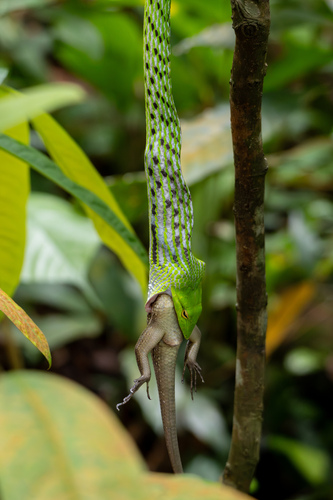 Oriental WhipsnakeAhaetulla prasina
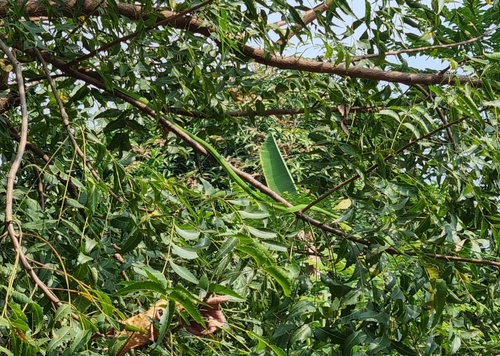 Indian Vine SnakeAhaetulla oxyrhynca
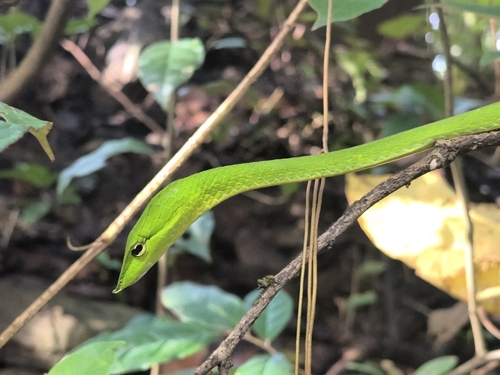 Northern Western Ghats Vine SnakeAhaetulla borealis
 Long-nosed WhipsnakeAhaetulla nasuta
 Malayan WhipsnakeAhaetulla mycterizans
 Indochinese Long-nosed WhipsnakeAhaetulla fusca
 Farnsworth's Vine SnakeAhaetulla farnsworthi
 Malabar Vine SnakeAhaetulla malabarica
Classification
How scientists group this snake, from the broadest category down to the exact species. Each step narrows to its closest relatives.
- OrderThe broad group of scaled reptiles: all snakes and lizards
- Squamata
- FamilyA group of related snakes that share key traits
- Colubridae
- GenusA close-knit group of very similar species
- Ahaetulla
- SpeciesThis exact snake, named in the two-part scientific name
- Ahaetulla fasciolata
Keep learning
- What to Do If You Find a SnakeFound a snake at home or on a trail? Here is how to stay calm, give it space, identify it safely, and know when to call a professional.
- Venomous vs Nonvenomous: How to Tell the DifferenceThe folk rules for telling venomous snakes apart, where each one fails, and why location-based identification beats guessing by sight.
- What Is a Snake? Anatomy and the BasicsA clear overview of what makes a snake a snake: limbless body plan, anatomy, evolution from lizards, species diversity, and why they are ectothermic.
- How to Keep Snakes Out of Your Yard and HomeA practical guide to keeping snakes out of your yard and home using habitat changes that work, plus what to skip and what to do if one shows up.
Distribution from GBIF & iNaturalist. Venom status per CDC. Background: Wikipedia. Informational only. Never handle a snake to identify it.