
Colubridae
Philippine Dryophiops
HarmlessDryophiops philippina
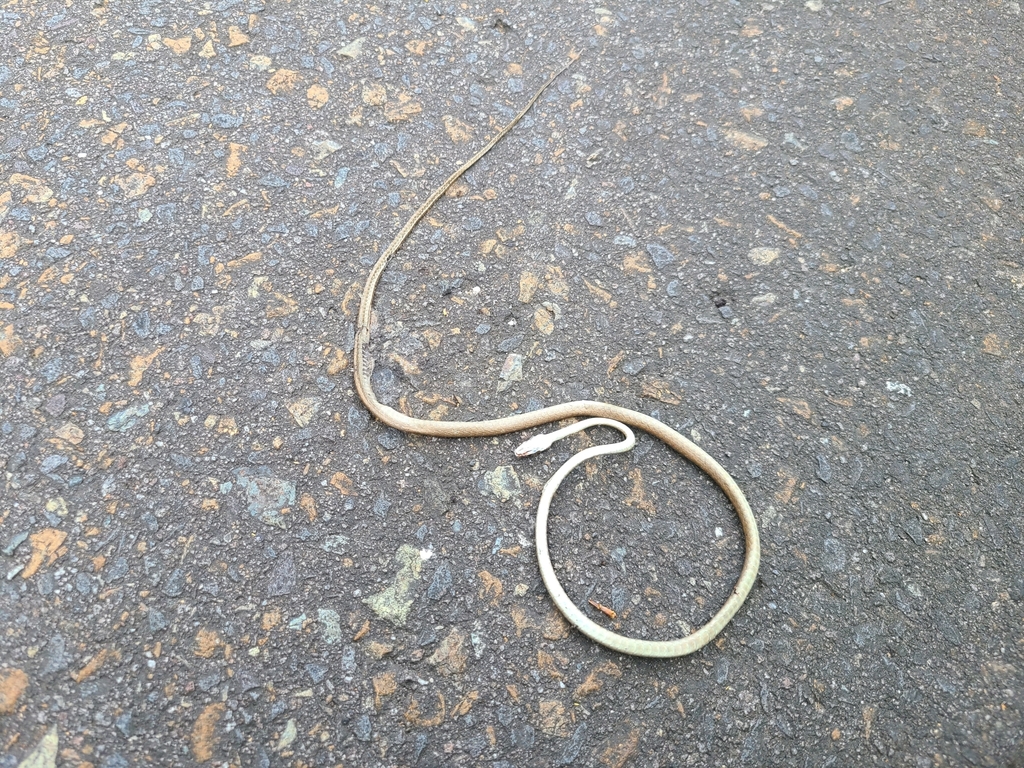
The Philippine Dryophiops (Dryophiops philippina) is a non-venomous snake in the Colubridae family.
- Family
- Colubridae
About the Philippine Dryophiops
Dryophiops philippina, also known as the keel-bellied whipsnake or Philippine whipsnake, a species of rear-fanged colubrid snake that is endemic to the Philippines. One similar species, Dryophiops rubescens exists in Thailand and Malaysia.
Taxonomy
Dryophiops philippina belongs to the genus Dryophiops, which contains only one other species: the type species Dryophiops rubescens of mainland Southeast Asia and Indonesia.
Dryophiops is one of five genera belonging to the vine snake subfamily Ahaetuliinae, of which Dryophiops is most closely related to Ahaetulla and Proahaetulla, as shown in the cladogram below:
Distribution and habitat
Dryophiops philippina is endemic to the Philippines, where it is found in the islands of Luzon (including Bataan), Mindoro, Sibuyan, Panay and eastern Mindanao (Diuata Range). On Panay it has been recorded within primary and secondary lowland tropical moist forests, and in areas nearby. This species might need forest cover for refuge.
Description
Dryophiops snakes, along with their close relatives of Ahaetulla and Proahaetulla, all share an elongated and laterally compressed body plan, with elongated sharp snouts, and large eyes with horizontals pupils specialized for binocular vision.
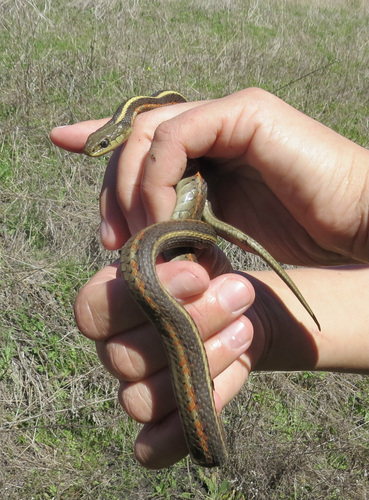
Dryophiops philippina is about 3 to 6 feet (0.91 to 1.83 m) long. Coloration is dark brown or black, sometimes gray above as in the Dryophiops rubescens and often with a light green or pale blue flecks. The tongue is bright red. Cream or white colored lateral stripes on each side are bisected by dark blackish lines, which are nearly continuous along the dorsolateral stripe. It has a broad head, large eyes in proportion to the head, and a slender neck. The dorsal scales are smooth, not keeled. The belly scutes have 15 scale rows at the midsection and have faint dark lines that give the impression that it is keeled. The chin is white but can sometimes be yellow. Its neck down to mid-body is yellow and the rest of the body is brown. There is one small scale on the face called the preocular scale, located in front of the eye and wedged between two other scales, called the upper labials. The scales on the top of the head are large, a feature that distinguishes this snake from Dryophiops rubescens. D. philippina also lacks the keeled belly common to D. rubescens.
Behavior
It is docile but a very nervous snake. If the area where its residing is disturbed, it may spring up to flee, or remain very still. It can remain motionless for extended periods of time but usually it is always on the move. An irate individual may sometimes show aggression by expanding its neck and showing the light colorations underneath, to make itself appear much bigger than it really is, but they will rarely bite. If alarmed, they quickly move in a sidewinding manner on the ground; the only snake besides the Dog-faced water snake, Cerberus rynchops and the sidewinder rattlesnake to do so.
Adapted from Wikipedia, available under CC BY-SA.
Frequently asked: Philippine Dryophiops
- Is the Philippine Dryophiops venomous?
- No. The Philippine Dryophiops (Dryophiops philippina) is non-venomous and is not considered dangerous to humans. Like most snakes, it will retreat rather than bite when given the chance.
- Is the Philippine Dryophiops poisonous?
- Snakes are venomous, not poisonous. "Poisonous" means harmful to eat or touch; "venomous" means injecting toxins through a bite. The Philippine Dryophiops is neither poisonous nor venomous.
- Is the Philippine Dryophiops dangerous?
- The Philippine Dryophiops is not dangerous to humans. It has no medically significant venom and bites only defensively if cornered or handled.
- What does the Philippine Dryophiops eat?
- The keel-bellied whipsnake is a very specialized hunter, actively pursuing its prey that consists primarily of geckos and other lizards. Other prey may also be taken, given the opportunity. Small frogs, fishes and slugs may sometimes be consumed.
More Colubridae snakes
Classification
How scientists group this snake, from the broadest category down to the exact species. Each step narrows to its closest relatives.
- OrderThe broad group of scaled reptiles: all snakes and lizards
- Squamata
- FamilyA group of related snakes that share key traits
- Colubridae
- GenusA close-knit group of very similar species
- Dryophiops
- SpeciesThis exact snake, named in the two-part scientific name
- Dryophiops philippina
Keep learning
- What to Do If You Find a SnakeFound a snake at home or on a trail? Here is how to stay calm, give it space, identify it safely, and know when to call a professional.
- Venomous vs Nonvenomous: How to Tell the DifferenceThe folk rules for telling venomous snakes apart, where each one fails, and why location-based identification beats guessing by sight.
- What Is a Snake? Anatomy and the BasicsA clear overview of what makes a snake a snake: limbless body plan, anatomy, evolution from lizards, species diversity, and why they are ectothermic.
- How to Keep Snakes Out of Your Yard and HomeA practical guide to keeping snakes out of your yard and home using habitat changes that work, plus what to skip and what to do if one shows up.
Distribution from GBIF & iNaturalist. Venom status per CDC. Background: Wikipedia. Informational only. Never handle a snake to identify it.