
Colubridae
Huaping Wolf Snake
HarmlessLycodon cathaya

The Huaping Wolf Snake (Lycodon cathaya) is a non-venomous snake in the Colubridae family, recorded in 1 country.
The Huaping Wolf Snake (Lycodon cathaya) is a slender, nonvenomous wolf snake described in 2020 and known only from the Huaping Nature Reserve in Guangxi, China, though it may also occur in southwestern Hunan and southeastern Guizhou. It is not venomous and poses no significant danger to people, but it looks a lot like the highly venomous banded krait, so any banded dark snake in southern China deserves distance.
- Family
- Colubridae
How to identify the Huaping Wolf Snake
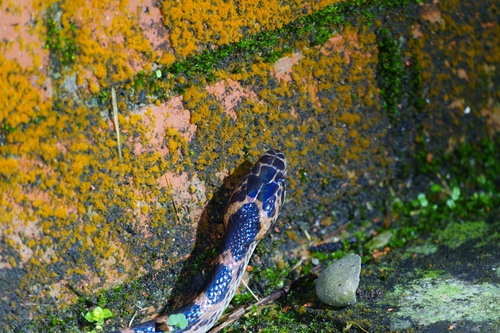
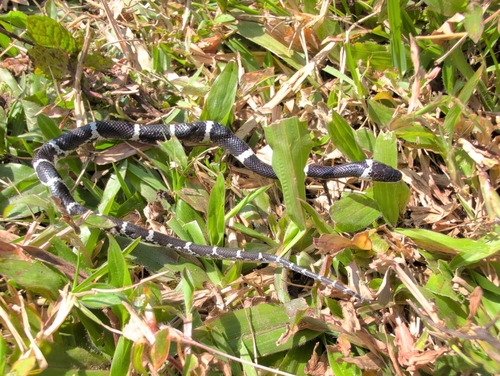
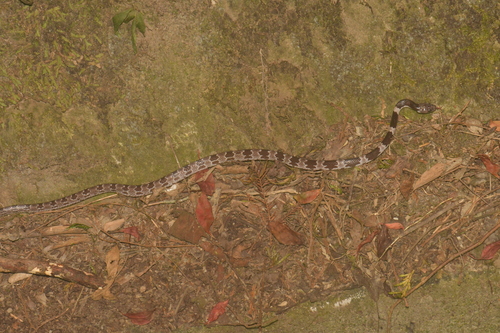
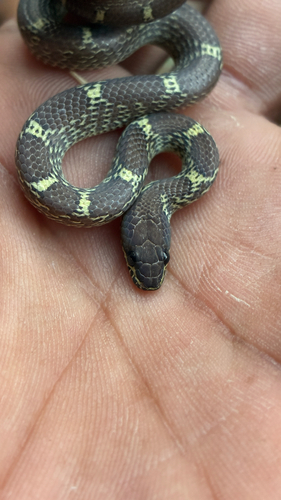
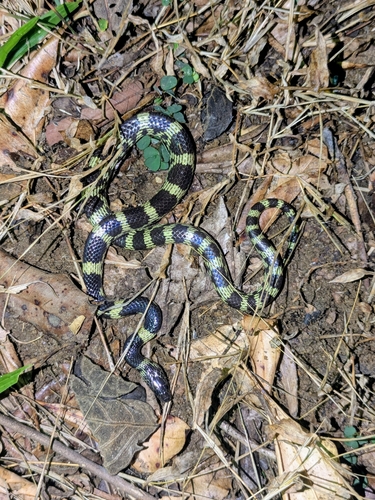
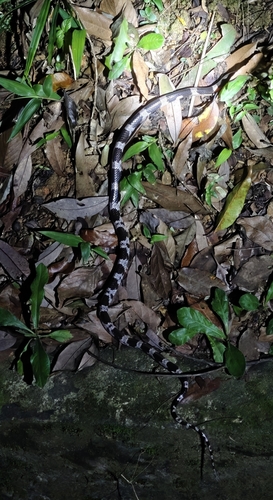
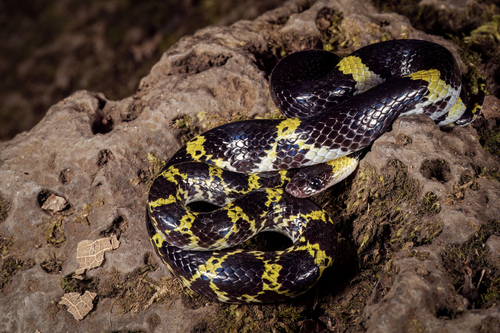
Look for a slender, brownish-black snake with a grey-tinged rose collar behind the head and 31 to 35 matching pale bands that break the dark body into oval patches. Underneath, a dark central strip runs between two greyish-white lines.
- Head
- The top of the head is brownish-black with a clear grey-tinged rose collar band, and the chin and throat are mostly whitish with some dark splotches.
- Pattern
- Grey-tinged rose bands, one to four scales wide, cross the brownish-black back and split it into elliptical dark patches, and the first two bands after the collar are incomplete.
- Sides
- Below each pale band there is a brownish-black blotch on the lower side.
- Belly
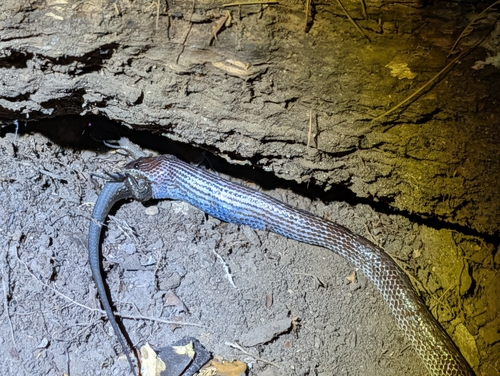
- Irregular brownish-black splotches join into an unbroken dark strip down the middle of the belly, edged by two greyish-white lines.
- Tail
- The tail has 13 to 16 pale bands above and mostly light brown scales below.
- Size
- Adults are slender and measure roughly 56 to 91 cm (22 to 36 in) in total length.
- Age changes
- Older individuals can have a smaller, fainter collar, faint bands and more dark mottling, so the pattern is not always crisp.
Have a photo? Identify it from your photo and location.
Is the Huaping Wolf Snake dangerous?
Not venomous
The Huaping Wolf Snake is not venomous and is not considered a medical risk to people. The real danger is mistaking a venomous krait for it, since kraits share the dark, banded look and are active at night too.
If you find one
- Keep your distance and let it move away on its own.
- Use a flashlight on roads and trails at night in mountain forest, and watch where you step.
- If you cannot be sure it is not a krait, treat it as venomous and do not try to move or catch it.
Habitat and behavior
- Habitat
- It lives in mountainous country with montane evergreen broad-leaved forest or mixed forest at 850 to 1,000 m (2,790 to 3,280 ft) elevation. Records come from roadsides and the ground within the Huaping Nature Reserve.
- Behavior
- It has been seen on the ground and climbing wilted bushes about 0.5 m (2 ft) high beside roads. Little is documented about its temperament. Like any wild snake it may bite if grabbed or cornered, so do not handle it.
- When active
- It is nocturnal and is most likely to be seen at night.
Further reading: Huaping Wolf Snake on Wikipedia.
Frequently asked: Huaping Wolf Snake
- Is the Huaping Wolf Snake venomous?
- No. It is a nonvenomous colubrid in the wolf snake genus Lycodon. A bite from any wild snake can still break skin, so it should never be handled.
- How do I tell a Huaping Wolf Snake from a banded krait?
- This wolf snake has grey-tinged rose bands, a pale collar behind the head and a dark strip down the middle of the belly, while kraits have crisp white bands and a raised ridge along the spine. Patterns can fade or vary, so if you are not sure, assume it is a krait and keep away.
- Where does the Huaping Wolf Snake live?
- It is endemic to China and confirmed only from the Huaping Nature Reserve in Guangxi. It may also occur in southwestern Hunan and southeastern Guizhou, but more surveys are needed to know its real range.
- When was the Huaping Wolf Snake discovered?
- It was formally described in 2020 by Chinese herpetologist Jian Wang and colleagues, based on an adult male collected in the reserve in July 2016. The name cathaya refers to Cathaya, a rare relict pine tree that was also discovered in the Huaping Nature Reserve.
- Is the Huaping Wolf Snake poisonous?
- Snakes are venomous, not poisonous. "Poisonous" means harmful to eat or touch; "venomous" means injecting toxins through a bite. The Huaping Wolf Snake is neither poisonous nor venomous.
- Is the Huaping Wolf Snake dangerous?
- The Huaping Wolf Snake is not dangerous to humans. It has no medically significant venom and bites only defensively if cornered or handled.
Where it is found
More Colubridae snakes
Classification
How scientists group this snake, from the broadest category down to the exact species. Each step narrows to its closest relatives.
- OrderThe broad group of scaled reptiles: all snakes and lizards
- Squamata
- FamilyA group of related snakes that share key traits
- Colubridae
- GenusA close-knit group of very similar species
- Lycodon
- SpeciesThis exact snake, named in the two-part scientific name
- Lycodon cathaya
Keep learning
- What to Do If You Find a SnakeFound a snake at home or on a trail? Here is how to stay calm, give it space, identify it safely, and know when to call a professional.
- Venomous vs Nonvenomous: How to Tell the DifferenceThe folk rules for telling venomous snakes apart, where each one fails, and why location-based identification beats guessing by sight.
- What Is a Snake? Snake Facts, Body Plan and How They Differ From LizardsA clear overview of what makes a snake a snake: limbless body plan, anatomy, evolution from lizards, species diversity, and why they are ectothermic.
- How to Keep Snakes Out of Your Yard and HomeA practical guide to keeping snakes out of your yard and home using habitat changes that work, plus what to skip and what to do if one shows up.
Distribution from GBIF & iNaturalist. Venom status per CDC. Background: Wikipedia. Informational only. Never handle a snake to identify it.