
Nightsnake
Desert Nightsnake
HarmlessHypsiglena chlorophaea
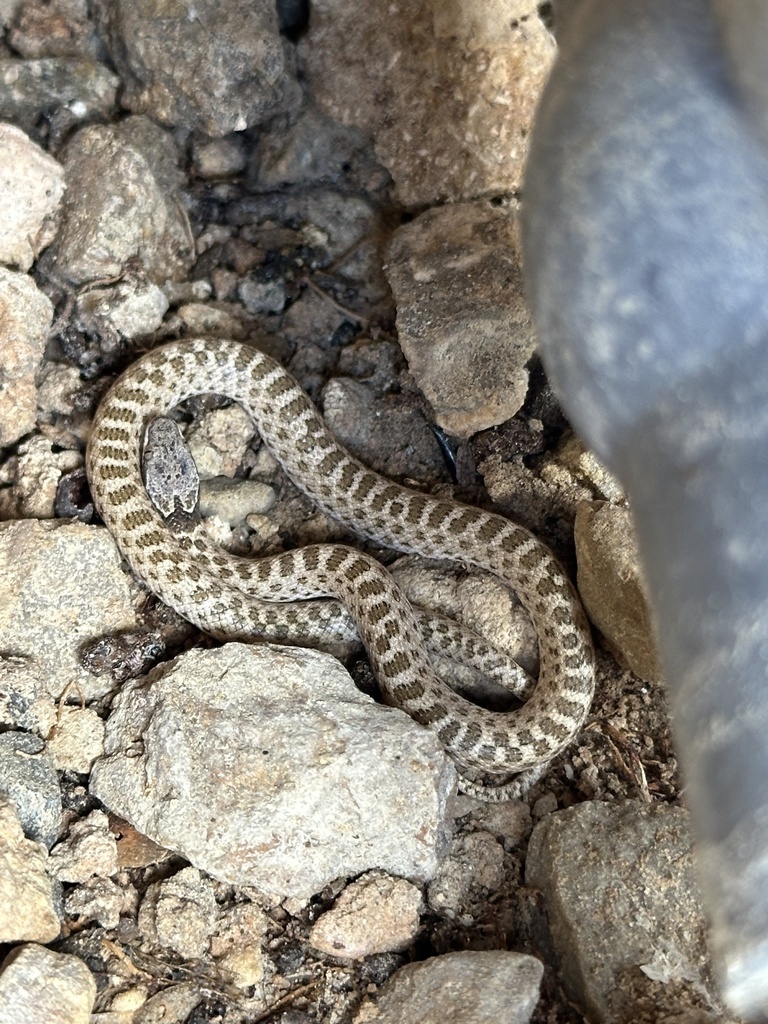
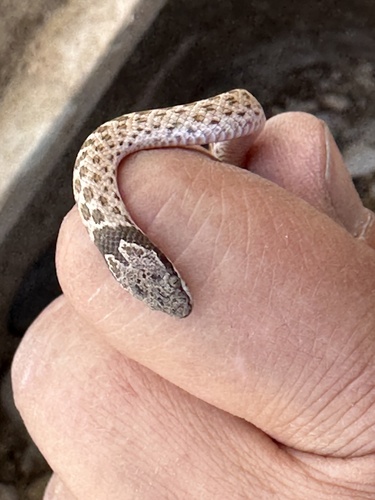
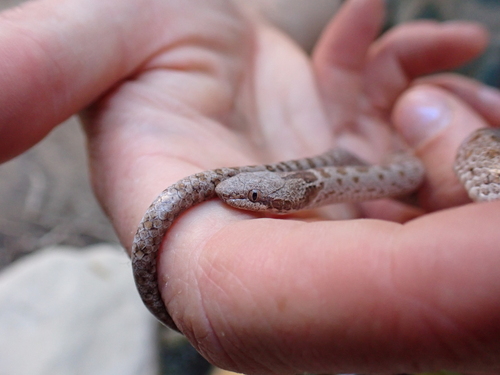
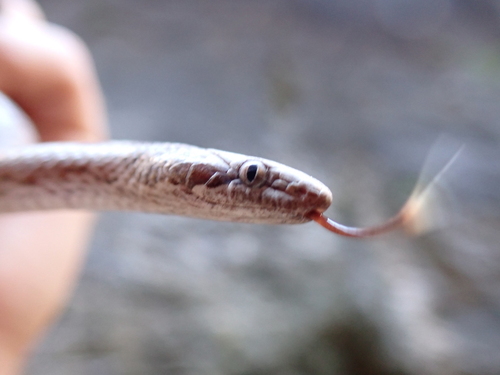
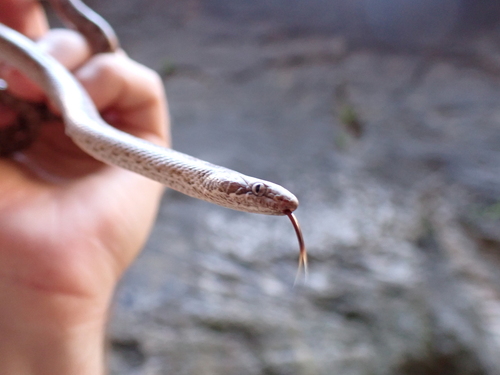
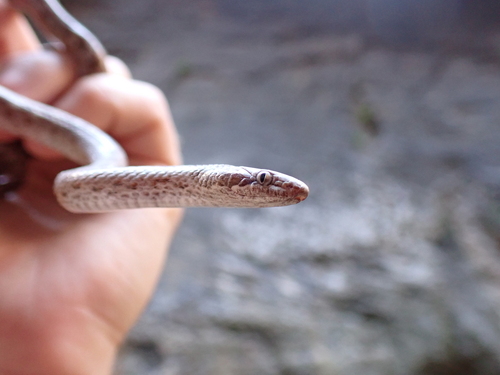
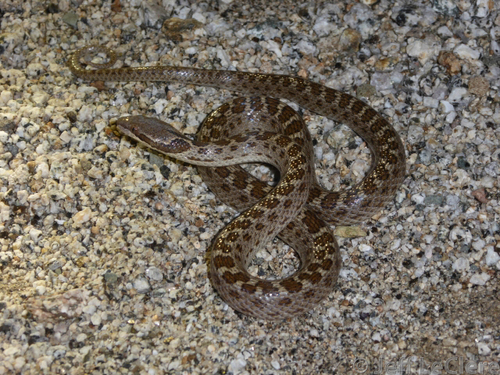
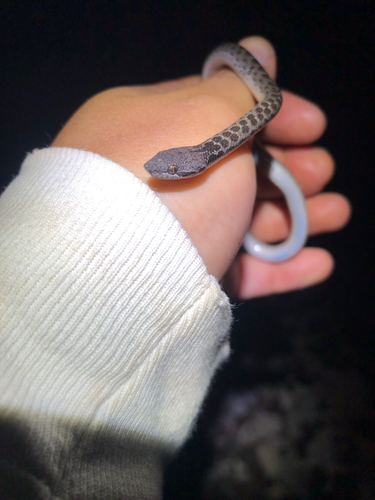
6 photographs of the Desert Nightsnake. © Katrina Smith.
The Desert Nightsnake (Hypsiglena chlorophaea) is a rear-fanged, mildly venomous snake in the Colubridae family, recorded in 3 countries.
- Also called
- Nightsnake
- Family
- Colubridae
- Size
- Small, 12–26 in.
- Habitat
- Arid and semi-arid rocky areas.
- Behavior
- Nocturnal; rear-fanged but harmless to humans.
- Identify
- Pale gray with dark blotches, vertical pupils, and dark neck blotches.
About the Desert Nightsnake
Hypsiglena chlorophaea, commonly known as the desert nightsnake, is a species of rear-fanged colubrid snake native to North America. It is found throughout regions of Mexico, the United States, and in a small, isolated population in British Columbia, Canada. Known for its highly secretive, nocturnal nature, it is a mildly venomous species that poses no danger to humans.
Description
The desert nightsnake is a small, slender snake, typically measuring between 30 and 66 cm (12 to 26 inches) in total length. Females are generally longer and heavier than males. Its base coloration ranges from beige or yellowish to grey, overlaid with dark grey-brown blotches that usually form offset pairs down its back. It has three distinct, elongated dark blotches on its neck and behind each eye.
Because of its triangular-shaped head, vertical pupils, and blotched patterning, it is frequently mistaken for a juvenile rattlesnake. However, the desert nightsnake lacks a rattle and possesses smooth dorsal scales. It is an opisthoglyphous (rear-fanged) snake, meaning its enlarged, grooved teeth are located at the back of the upper jaw to help subdue prey.
Distribution and habitat
The species is widely distributed across the western and southwestern United States (including Arizona, California, Colorado, Idaho, Nevada, Oregon, Utah, and Washington), northwestern Mexico, and reaches its northernmost limits in the Okanagan and Similkameen valleys of south-central British Columbia, Canada.
Desert nightsnakes occupy a diverse range of arid and semi-arid environments. They are commonly found in desert scrub, chaparral, grasslands, oak woodlands, and rocky canyons. They heavily rely on surface cover, spending daylight hours hiding in rock crevices, talus slopes, beneath surface debris, or in abandoned mammal burrows.
Behavior and diet
As its name suggests, the desert nightsnake is primarily nocturnal and crepuscular. It is an ambush predator that uses its mild venom to subdue prey. Its diet predominantly consists of small lizards (such as skinks) and lizard eggs. It will also opportunistically consume small snakes, frogs, salamanders, and insects.
Reproduction
Hypsiglena chlorophaea is an oviparous (egg-laying) species. Mating generally occurs in the spring, and females lay a single clutch of 2 to 9 eggs (usually around 4) between April and July. The eggs are deposited in hidden, secure locations such as rock crevices or abandoned burrows. After an incubation period of 7 to 8 weeks, the eggs hatch in late summer. Hatchlings are typically around 17 cm (7 inches) long.
Conservation status
Globally, the desert nightsnake is classified as a species of Least Concern by the IUCN due to its vast overall range and presumed large population size. However, regional populations face specific threats. In Canada, the species is federally listed as Endangered by the Committee on the Status of Endangered Wildlife in Canada (COSEWIC). The Canadian population is restricted to a very small area and is highly vulnerable to habitat loss and fragmentation caused by urban and agricultural development.
Adapted from Wikipedia, available under CC BY-SA.
Frequently asked: Desert Nightsnake
- Is the Desert Nightsnake venomous?
- The Desert Nightsnake (Hypsiglena chlorophaea) is rear-fanged and only mildly venomous. It is not considered dangerous to humans (its venom is weak and its fangs sit at the back of the mouth) but a bite can cause local swelling or irritation, so it should not be handled.
- Is the Desert Nightsnake poisonous?
- Snakes are venomous, not poisonous. "Poisonous" means harmful to eat or touch; "venomous" means injecting toxins through a bite. The Desert Nightsnake is neither poisonous nor venomous.
- Is the Desert Nightsnake dangerous?
- The Desert Nightsnake is not dangerous to humans. It has no medically significant venom and bites only defensively if cornered or handled.
- Where does the Desert Nightsnake live?
- The Desert Nightsnake has verified records in 3 countries, including United States of America, Mexico, Canada. See the distribution section below for its full range.
- How do I identify the Desert Nightsnake?
- Pale gray with dark blotches, vertical pupils, and dark neck blotches.
- How big does the Desert Nightsnake get?
- Small, 12–26 in.
- What does the Desert Nightsnake eat?
- As its name suggests, the desert nightsnake is primarily nocturnal and crepuscular. It is an ambush predator that uses its mild venom to subdue prey. Its diet predominantly consists of small lizards (such as skinks) and lizard eggs. It will also opportunistically consume small snakes, frogs, salamanders, and insects.
Where it is found
More Colubridae snakes
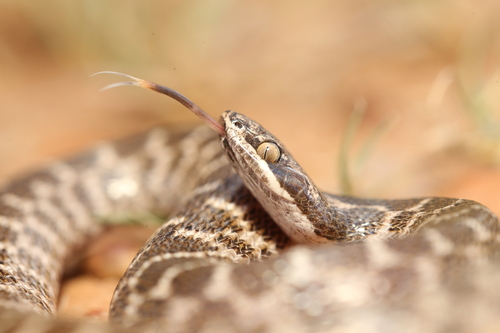 Chihuahuan NightsnakeHypsiglena jani
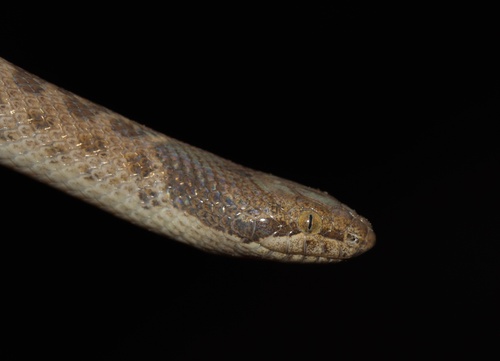 Coast Night SnakeHypsiglena ochrorhynchus
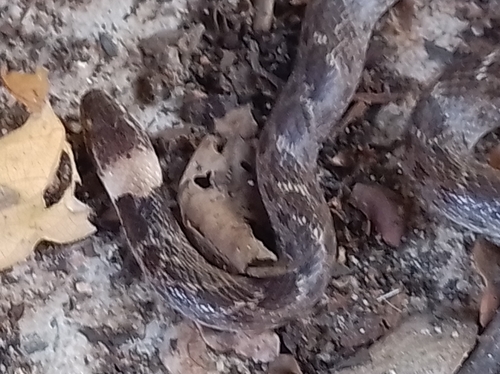 Sinaloan NightsnakeHypsiglena torquata
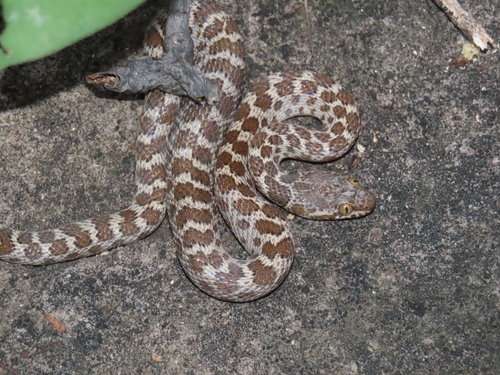 Baja California Night SnakeHypsiglena slevini
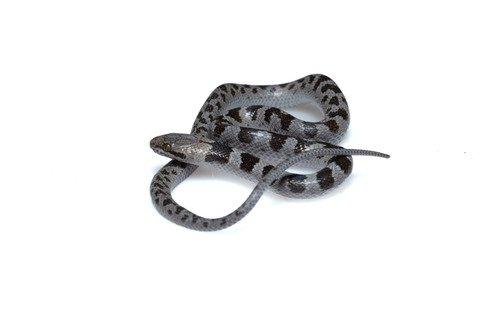 Tanzer’s Night SnakeHypsiglena tanzeri
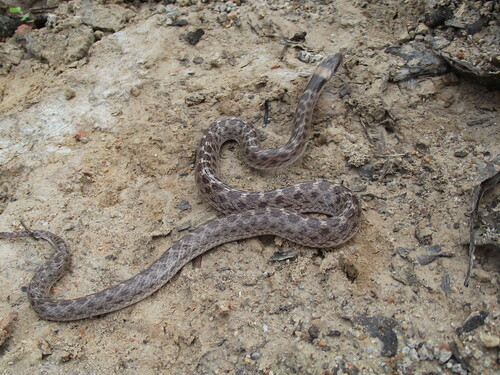 Rio Grande de Santiago NightsnakeHypsiglena affinis
 Isla Santa Catalina NightsnakeHypsiglena catalinae
 Islas Revillagigedo NightsnakeHypsiglena unaocularus
Classification
How scientists group this snake, from the broadest category down to the exact species. Each step narrows to its closest relatives.
- OrderThe broad group of scaled reptiles: all snakes and lizards
- Squamata
- FamilyA group of related snakes that share key traits
- Colubridae
- GenusA close-knit group of very similar species
- Hypsiglena
- SpeciesThis exact snake, named in the two-part scientific name
- Hypsiglena chlorophaea
Keep learning
- What to Do If You Find a SnakeFound a snake at home or on a trail? Here is how to stay calm, give it space, identify it safely, and know when to call a professional.
- Venomous vs Nonvenomous: How to Tell the DifferenceThe folk rules for telling venomous snakes apart, where each one fails, and why location-based identification beats guessing by sight.
- What Is a Snake? Anatomy and the BasicsA clear overview of what makes a snake a snake: limbless body plan, anatomy, evolution from lizards, species diversity, and why they are ectothermic.
- How to Keep Snakes Out of Your Yard and HomeA practical guide to keeping snakes out of your yard and home using habitat changes that work, plus what to skip and what to do if one shows up.
Distribution from GBIF & iNaturalist. Venom status per CDC. Background: Wikipedia. Informational only. Never handle a snake to identify it.