
Ratsnake
Baird's Ratsnake
HarmlessPantherophis bairdi
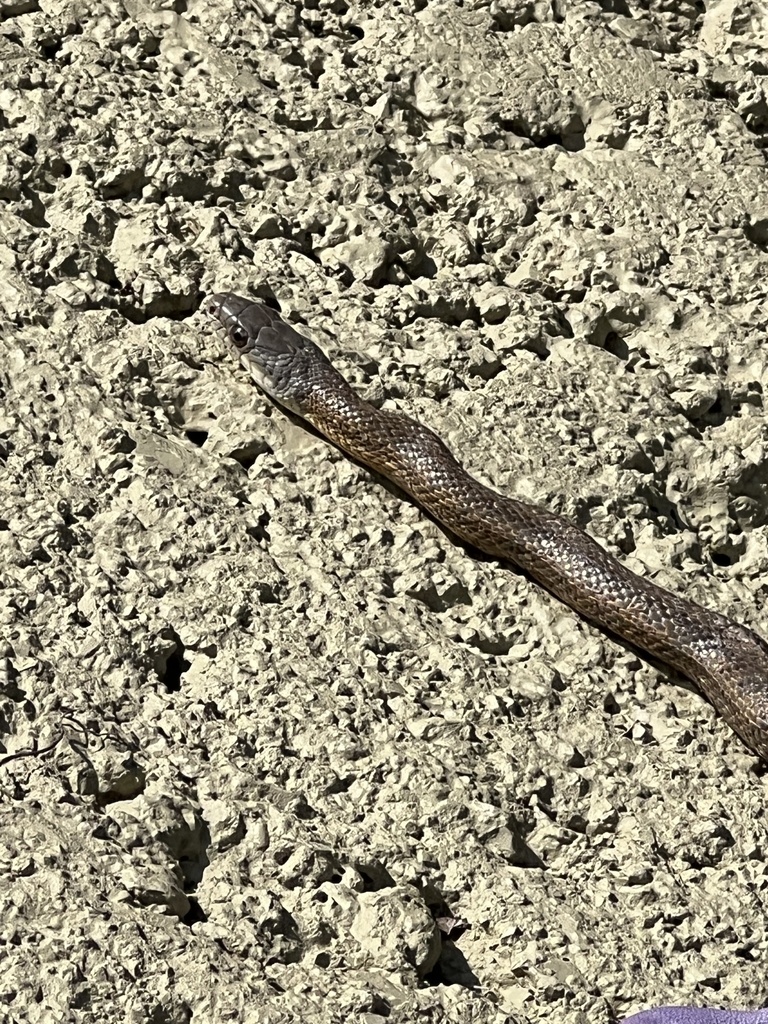
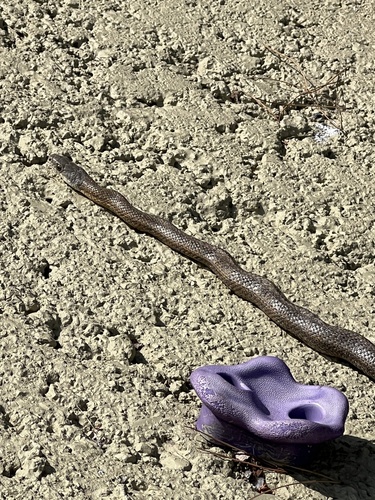
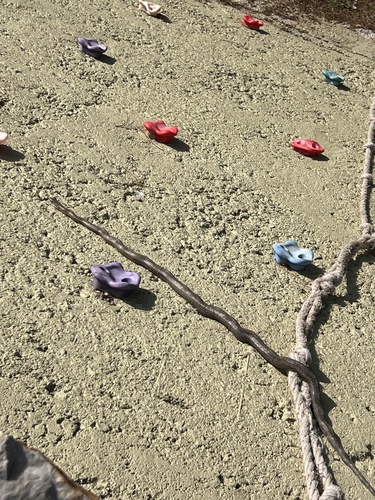
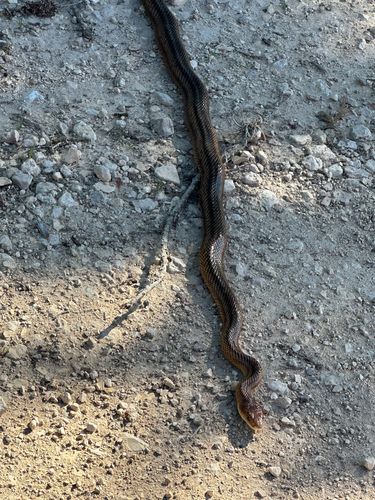
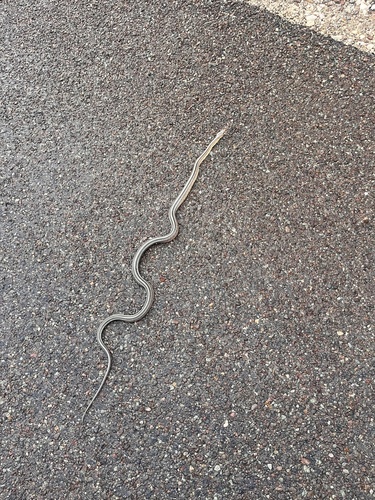
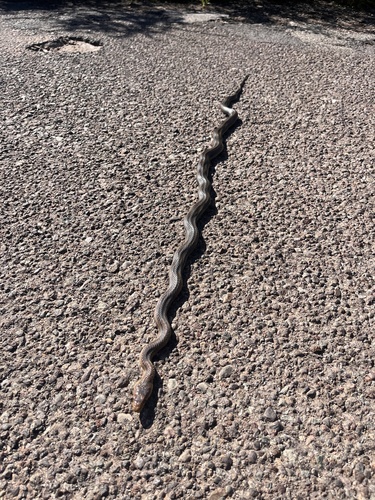
6 photographs of the Baird's Ratsnake. © Masked Lynx.
The Baird's Ratsnake (Pantherophis bairdi) is a non-venomous snake in the Colubridae family, recorded in 2 countries.
- Also called
- Ratsnake
- Family
- Colubridae
- Size
- 3–6 ft — among the largest U.S. snakes.
- Habitat
- Forests, farmland, barns, and suburbs; excellent climbers.
- Behavior
- Constrictors that control rodents; may vibrate the tail in leaves to mimic a rattlesnake.
- Identify
- Long-bodied with weakly keeled scales; blotched, striped, or solid depending on species.
About the Baird's Ratsnake
Pantherophis bairdi is a species of harmless snake in the family Colubridae. The species is native to the southwestern United States and adjacent northeastern Mexico. No subspecies are recognized as being valid.
Geographic range and habitat
P. bairdi is found in the United States in the Big Bend region of western Texas, as well as in northern Mexico in the Mexican states of Coahuila, Nuevo León, and Tamaulipas. It is known to be elusive and hard to find in the wild.
P. bairdi prefers semi-arid, rocky habitats.
Etymology and common names
The specific name, bairdi, as well as several of the common names, are in honor of American zoologist Spencer Fullerton Baird.
Common names include: Baird's rat snake, Baird's ratsnake, Baird's pilot snake, Baird's Coluber, and Great Bend rat snake.
Description
Adults of P. bairdi may reach 64 to 140 cm (25 to 55 in) in total length (including tail). The dorsal color pattern consists of an orange-yellow to bright yellow, or a darker salmon ground color, overlaid with four stripes that run from the neck to the tail. The belly is generally gray to yellow, darkening near the tail.
Biology
The primary diet of P. bairdi consists of rodents, although it will also prey on birds. Juveniles often eat lizards.
Baird's rat snake is typically more pleasantly tempered than other rat snake species.
P. bairdi is oviparous. Adult females may lay a clutch of up to 10 eggs that take about 3 months to hatch.
Taxonomy
P. bairdi has sometimes been considered a subspecies of P. obsoletus, to which it is closely related. P. bairdi was for a long time placed in the genus Elaphe, but phylogenetic analyses by Utiger et al. in 2002 resulted in its transfer to the genus Pantherophis.
Adapted from Wikipedia, available under CC BY-SA.
Frequently asked: Baird's Ratsnake
- Is the Baird's Ratsnake venomous?
- No. The Baird's Ratsnake (Pantherophis bairdi) is non-venomous and is not considered dangerous to humans. Like most snakes, it will retreat rather than bite when given the chance.
- Is the Baird's Ratsnake poisonous?
- Snakes are venomous, not poisonous. "Poisonous" means harmful to eat or touch; "venomous" means injecting toxins through a bite. The Baird's Ratsnake is neither poisonous nor venomous.
- Is the Baird's Ratsnake dangerous?
- The Baird's Ratsnake is not dangerous to humans. It has no medically significant venom and bites only defensively if cornered or handled.
- Where does the Baird's Ratsnake live?
- The Baird's Ratsnake has verified records in 2 countries, including United States of America, Mexico. See the distribution section below for its full range.
- How do I identify the Baird's Ratsnake?
- Long-bodied with weakly keeled scales; blotched, striped, or solid depending on species.
- How big does the Baird's Ratsnake get?
- 3–6 ft — among the largest U.S. snakes.
- Why is it called the Baird's Ratsnake?
- The specific name, bairdi, as well as several of the common names, are in honor of American zoologist Spencer Fullerton Baird. Common names include: Baird's rat snake, Baird's ratsnake, Baird's pilot snake, Baird's Coluber, and Great Bend rat snake.
Where it is found
By U.S. state
Snakes it is confused with
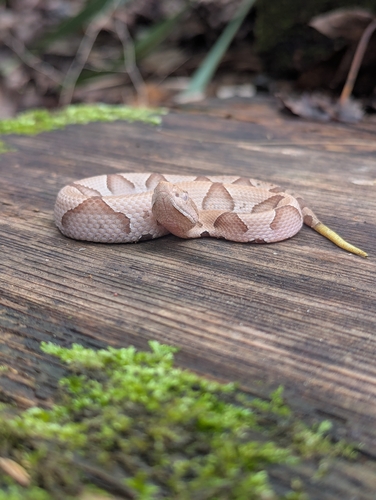 Eastern CopperheadVenomous
Often confused with the venomous copperhead, but this snake is harmless, with round pupils and no facial pit.
Baird's Ratsnake vs Eastern Copperhead→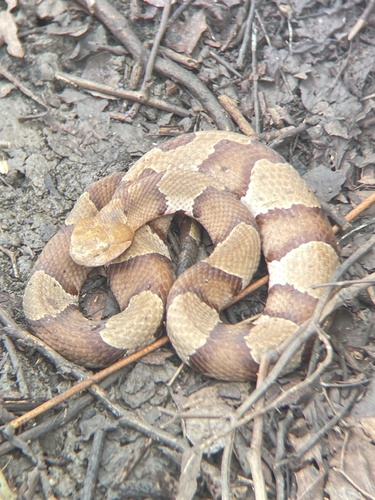
More Colubridae snakes
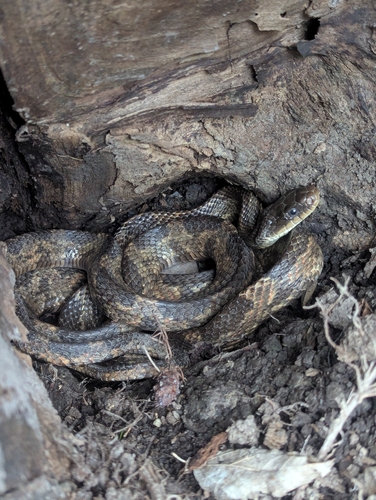 Western RatsnakePantherophis obsoletus
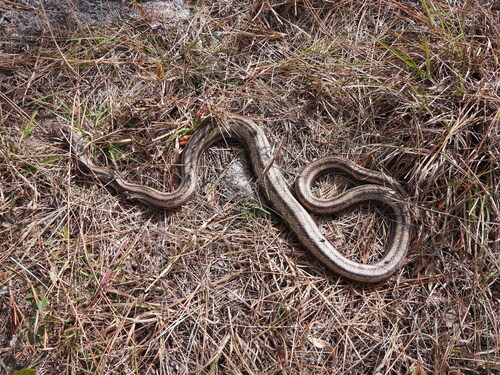 Eastern RatsnakePantherophis alleghaniensis
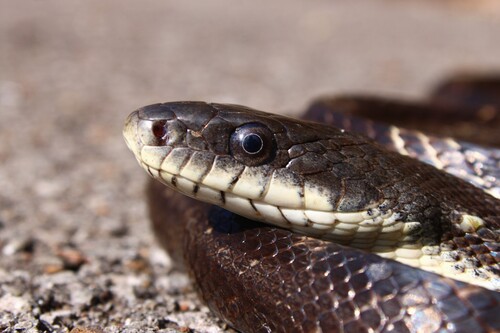 Gray RatsnakePantherophis spiloides
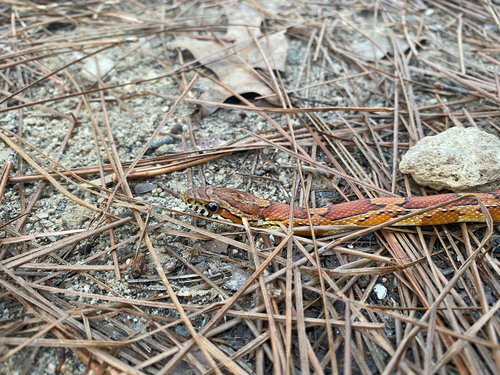 Red CornsnakePantherophis guttatus
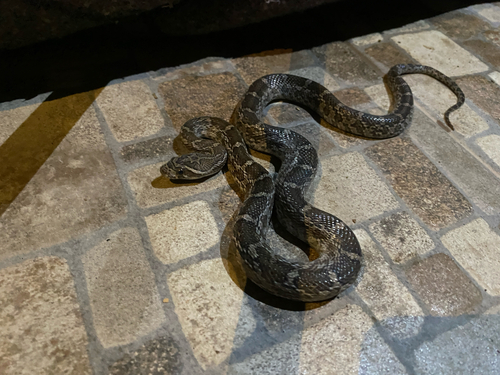 Great Plains RatsnakePantherophis emoryi
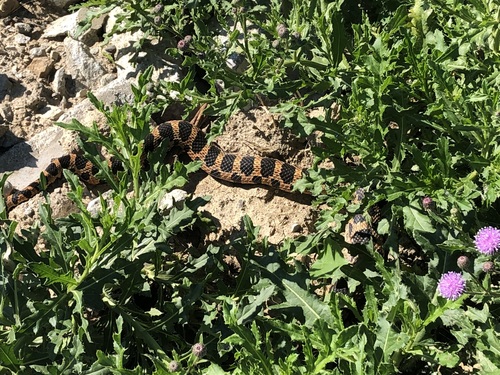 Eastern FoxsnakePantherophis vulpinus
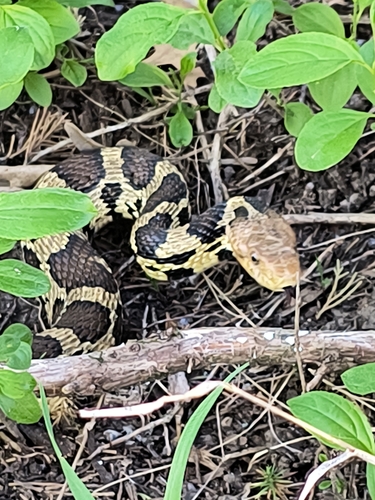 Western FoxsnakePantherophis ramspotti
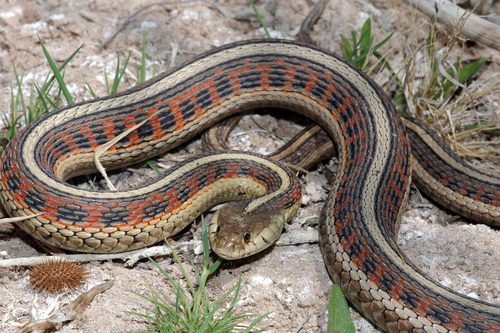 Common Garter SnakeThamnophis sirtalis
Classification
How scientists group this snake, from the broadest category down to the exact species. Each step narrows to its closest relatives.
- OrderThe broad group of scaled reptiles: all snakes and lizards
- Squamata
- FamilyA group of related snakes that share key traits
- Colubridae
- GenusA close-knit group of very similar species
- Pantherophis
- SpeciesThis exact snake, named in the two-part scientific name
- Pantherophis bairdi
Keep learning
- What to Do If You Find a SnakeFound a snake at home or on a trail? Here is how to stay calm, give it space, identify it safely, and know when to call a professional.
- Venomous vs Nonvenomous: How to Tell the DifferenceThe folk rules for telling venomous snakes apart, where each one fails, and why location-based identification beats guessing by sight.
- What Is a Snake? Anatomy and the BasicsA clear overview of what makes a snake a snake: limbless body plan, anatomy, evolution from lizards, species diversity, and why they are ectothermic.
- How to Keep Snakes Out of Your Yard and HomeA practical guide to keeping snakes out of your yard and home using habitat changes that work, plus what to skip and what to do if one shows up.
Distribution from GBIF & iNaturalist. Venom status per CDC. Background: Wikipedia. Informational only. Never handle a snake to identify it.