
Regional field guide
Snakes in Iowa
20+ snake species have verified records in Iowa, including 4 venomous. Pick your county below to see exactly which snakes live near you.
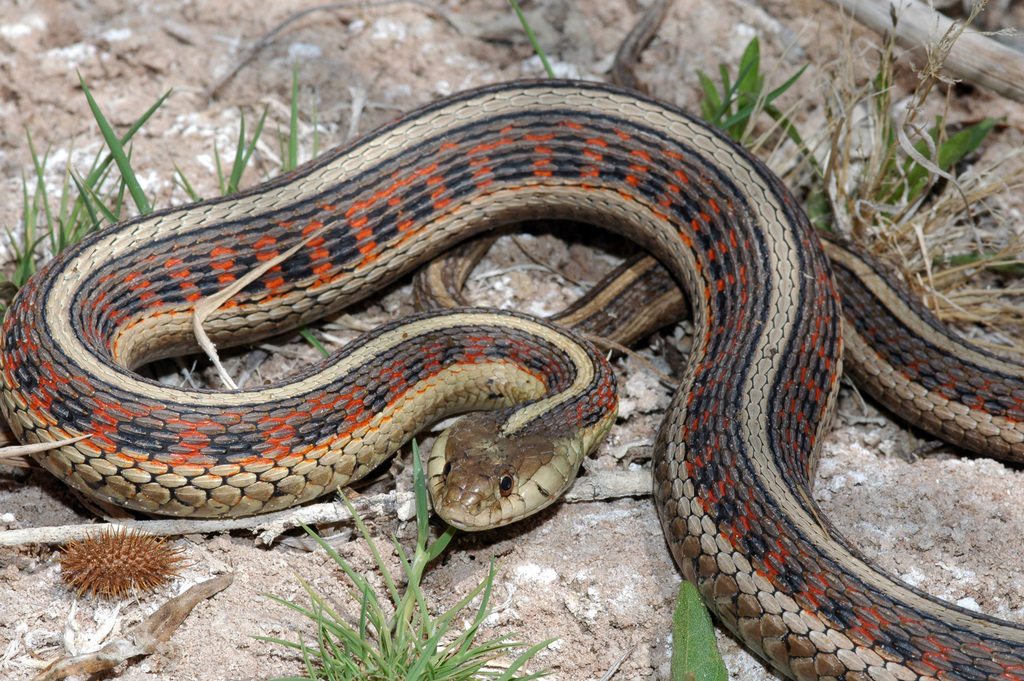
Snakes of Iowa
Iowa has about 30+ species of snakes, and only 4 of them are venomous. The large majority are harmless and beneficial, hunting the rodents and insects that thrive in a state dominated by farmland. Snakes here tend to keep to field edges, prairies, river corridors, and the rocky bluff country, and most slip away long before you get close.
Iowa's landscape is largely converted prairie and cropland, but pockets of original habitat remain. Tallgrass prairie remnants, oak savannas, and sandy terraces hold prairie-adapted snakes, while the Mississippi and Missouri river valleys, along with the rugged Driftless bluffs of the northeast and the Loess Hills of the west, concentrate the most species. Wetlands and oxbows along the big rivers add water-loving snakes to the mix.
Iowa's 4 venomous species split between hills and wetlands. The Timber Rattlesnake lives on the rocky, wooded bluffs of eastern and southern Iowa. The Prairie Rattlesnake just reaches the dry hills of the far western edge along the Missouri River. The Eastern Massasauga and the Western Massasauga are small, secretive wetland rattlesnakes of marshes and wet prairie; both have declined badly and are protected. All four are uncommon, reclusive, and avoid people.
Most snakes Iowans see are harmless. Common garter snakes are everywhere, bullsnakes (gophersnakes) on the prairies hiss and rattle their tails to mimic a rattlesnake and are killed needlessly despite being top-tier rodent hunters, and fox snakes and watersnakes patrol farm ponds and rivers where they are mistaken for something dangerous. Plains hognose snakes put on a hissing, flattening bluff but pose no threat. Bites are uncommon and rarely fatal thanks to antivenom, and most happen when people try to handle or kill a snake. Never assume a wild snake is safe to handle, and if a bite happens, call Poison Control at 1-800-222-1222 or 911.
Venomous snakes in Iowa
Most commonly seen
- Common Garter SnakeCommonly seen
- DeKay's BrownsnakeCommonly seen
- Common WatersnakeCommonly seen
- Plains Garter SnakeCommonly seen
- Western FoxsnakeCommonly seen
- Eastern MilksnakeOften seen
- North American RacerOften seen
- Gopher SnakeOften seen
- Ring-necked SnakeOften seen
- Smooth GreensnakeOften seen
- Western RatsnakeOften seen
- Timber RattlesnakeOften seen
Counties in Iowa
84 listed- Adams5
- Allamakee8
- Appanoose3
- Audubon1
- Benton4
- Black Hawk6
- Boone7
- Bremer6
- Buchanan4
- Buena Vista2
- Butler3
- Calhoun1
- Carroll1
- Cass3
- Cedar3
- Cerro Gordo3
- Clarke1
- Clay4
- Clayton7
- Clinton5
- Dallas8
- Davis1
- Decatur3
- Delaware3
- Des Moines9
- Dickinson3
- Dubuque10
- Fayette1
- Floyd2
- Franklin1
- Fremont4
- Greene4
- Guthrie4
- Hamilton6
- Hancock1
- Hardin4
- Harrison6
- Henry2
- Howard1
- Humboldt1
- Iowa2
- Jackson5
- Jasper6
- Jefferson8
- Johnson12
- Jones5
- Keokuk3
- Kossuth2
- Lee2
- Linn8
- Louisa6
- Lucas7
- Lyon2
- Madison15
- Mahaska6
- Marion6
- Marshall5
- Mills8
- Monona8
- Monroe2
- Montgomery2
- Muscatine10
- Page1
- Palo Alto3
- Plymouth7
- Pocahontas3
- Polk14
- Pottawattamie9
- Poweshiek2
- Ringgold2
- Scott4
- Sioux3
- Story9
- Tama1
- Taylor3
- Union3
- Van Buren7
- Wapello4
- Warren8
- Washington5
- Webster3
- Winneshiek4
- Woodbury12
- Wright1
Snakes in Iowa: FAQ
- Are there venomous snakes in Iowa?
- Yes. 4 venomous snake species have verified records in Iowa, including Timber Rattlesnake, Prairie Rattlesnake, Eastern Massasauga, Western Massasauga. Most snakes in Iowa, however, are harmless.
- How many snake species live in Iowa?
- 20+ snake species have verified records in Iowa, of which 4 are venomous.
- What is the most commonly seen snake in Iowa?
- The Common Garter Snake is the most frequently reported snake in Iowa, based on verified wildlife observations.
- What should I do if I see a venomous snake in Iowa?
- Keep your distance and do not try to catch or kill it. Most bites happen when people handle or corner a snake. If someone is bitten, contact local emergency services or poison control immediately.