
Copperhead / Cottonmouth
Taylor's Cantil
VenomousAgkistrodon taylori
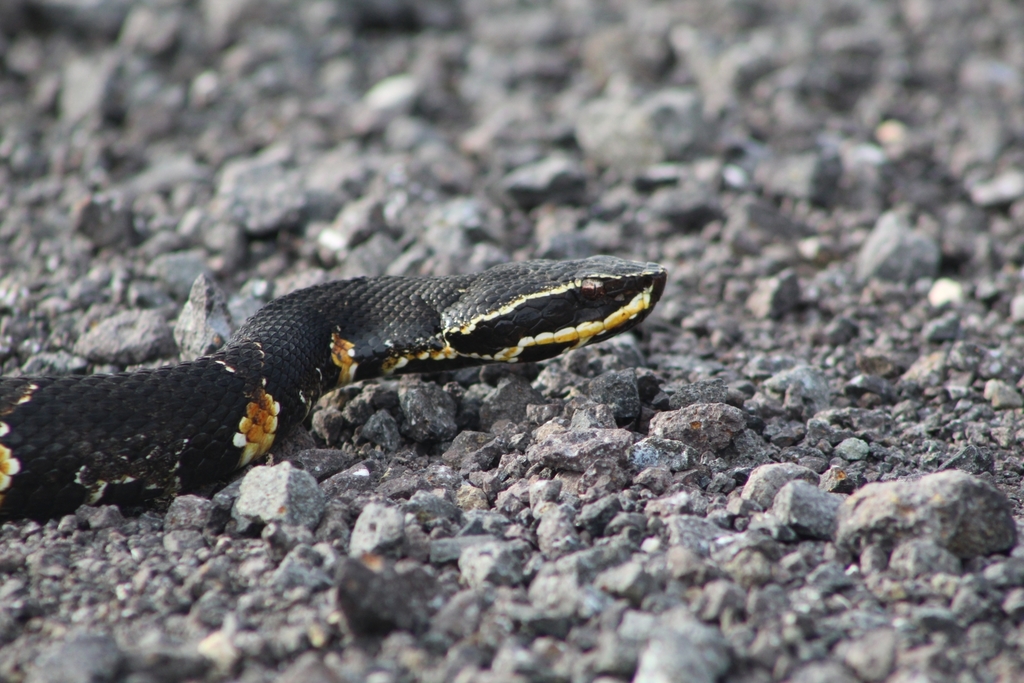
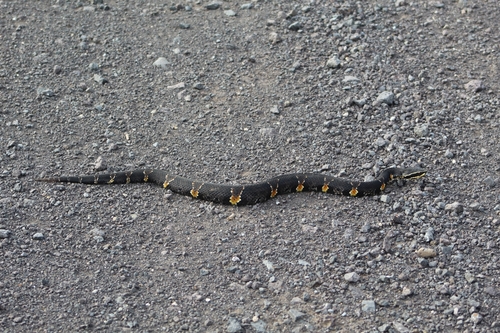
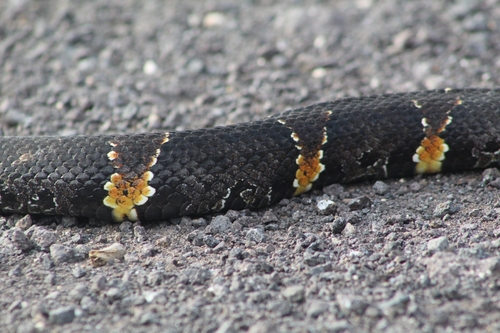
3 photographs of the Taylor's Cantil. © Tereso Hernández Morales.
The Taylor's Cantil (Agkistrodon taylori) is a venomous snake in the Viperidae family, recorded in 2 countries.
If you are bitten
Copperhead and cottonmouth bites are painful and need medical care but are rarely fatal with prompt treatment (cottonmouth venom is the more potent of the two). Stay calm, keep the limb still, remove tight items, and go to an emergency room. Do not use a tourniquet or cut the wound. Call Poison Control at 1-800-222-1222 or 911 in the US, or your local emergency number. (Source: CDC.)
- Also called
- Copperhead / Cottonmouth
- Family
- Viperidae
- Size
- Usually 2–4 ft, heavy-bodied.
- Habitat
- Copperheads favor forests and rocky hillsides; cottonmouths favor swamps, marshes, and slow water.
- Behavior
- Pit vipers that often hold their ground; cottonmouths gape to flash a white mouth lining when threatened.
- Identify
- Heavy body, triangular head, vertical pupils, and a heat-sensing pit between each eye and nostril.
- Danger
- moderate-high
About the Taylor's Cantil
Agkistrodon taylori is a species of venomous snake, a pitviper (Crotalinae) found only in northeastern Mexico. The standardized names are Taylor's cantil (English) and Metapil (Spanish), although it is sometimes called the ornate cantil as well as several other colloquial names. It was named in honor of American herpetologist Edward Harrison Taylor.
It is a stout, medium sized snake, averaging 64–90 cm. in length. Taylor's cantils have prominent light and dark stripes on the head, with a pattern of black and gray-brown bands on the body, accented with white, yellow, and orange. They are sexually dimorphic, with males being significantly darker than females. Some older individuals, particularly males, may grow darker, nearly black with age. It is a viviparous species, with typical litters of 3 to 10 live young. Taylor's cantils are uncommon to rare snakes in the wild and listed as a threatened species in Mexico. It occurs in a variety of habitats on the Gulf Coastal Plain and lower foothills of the Sierra Madre Oriental, including thorn scrub, tropical deciduous forest, and grasslands, sometimes said to prefer ecotones between scrubland and forest in the vicinity of rocky limestone outcroppings. Although not overtly aggressive, it is known to be very defensive with a volatile temper and may be quick to strike when approached, threatened, or restrained. No case reports of human envenomations have been published. Its venom is believed to be similar to its close relative, the cantil Agkistrodon bilineatus, and potentially fatal.
Etymology
The original description states that the specific, or trivial name, was "Named for Dr. Edward H. Taylor in recognition of his many contributions to our knowledge of the Mexican herpetofauna." Indeed, Taylor's extensive publications on Mexico's amphibians and reptiles, culminating with the "Herpetology of Mexico", published in collaboration with his student Hobart M. Smith, is the foundation of modern Mexican herpetology. Taylor's work on Mexico alone would have secured him a prominent reputation in the field of herpetology. However, Taylor made equally important contributions to the study of Philippine land mammals, the herpetofauna of the Philippines, the herpetofauna of the south-central United States, Eumeces (skinks of the world at that time), the herpetofauna of Costa Rica, the herpetofauna of Thailand, and caecilians of the world.
The common name cantil is believed to have its origins in the language of an indigenous people of Chiapas, Mexico, the Tzeltal. The Tzeltal word "kantiil" was given to the snake meaning yellow lips (kan = yellow, tiil = lips). The name is thought to have first entered herpetological literature in the publication of Albert Günther's Reptilia and Batrachia in Biologia Centrali-Americana, and later popularized in the writings of Raymond L. Ditmars. However, later authors questioned that attribution, as the Tzeltal are highland people and unlikely to have had significant contact with the species. Alternatively, "can" or "canti" meaning "viper", and "nil" meaning snake, are used in a more widespread Mayan language that might be the origin of the name cantil.
Taxonomy and phylogenetics
Adapted from Wikipedia, available under CC BY-SA.
Local and regional names
The Taylor's Cantil is known by these names across the regions where it lives:
- Czech
- ploskolebec Taylorův
- English
- Mexican Moccasin, Taylor's Moccasin
- German
- Tamaulipas-Mokassinotter, Taylors Mokassinotter, Taylors Mokassinschlange
- Spanish
- Metapil, cantil tamaulipeco
Frequently asked: Taylor's Cantil
- Is the Taylor's Cantil venomous?
- Yes. The Taylor's Cantil (Agkistrodon taylori) is venomous and belongs to the Viperidae family (copperhead/cottonmouth). Its bite is considered moderate-high risk to people. Treat any bite as a medical emergency.
- Is the Taylor's Cantil poisonous?
- Snakes are venomous, not poisonous. "Poisonous" means harmful to eat or touch; "venomous" means injecting toxins through a bite. The Taylor's Cantil is venomous, delivering venom through a bite.
- Is the Taylor's Cantil dangerous?
- Copperhead and cottonmouth bites are painful and need medical care but are rarely fatal with prompt treatment (cottonmouth venom is the more potent of the two). Stay calm, keep the limb still, remove tight items, and go to an emergency room. Do not use a tourniquet or cut the wound. Call Poison Control at 1-800-222-1222 or 911 in the US, or your local emergency number. (Source: CDC.)
- Where does the Taylor's Cantil live?
- The Taylor's Cantil has verified records in 2 countries, including Mexico, United States of America. See the distribution section below for its full range.
- How do I identify the Taylor's Cantil?
- Heavy body, triangular head, vertical pupils, and a heat-sensing pit between each eye and nostril.
- How big does the Taylor's Cantil get?
- Usually 2–4 ft, heavy-bodied.
- Why is it called the Taylor's Cantil?
- The original description states that the specific, or trivial name, was "Named for Dr. Edward H. Taylor in recognition of his many contributions to our knowledge of the Mexican herpetofauna." Indeed, Taylor's extensive publications on Mexico's amphibians and reptiles, culminating with the "Herpetology of Mexico", published in collaboration with his student Hobart M. Smith, is the foundation of modern Mexican herpetology. Taylor's work on Mexico alone would have secured him a prominent reputation in the field of herpetology.
If you are bitten by the Taylor's Cantil
Do
- Get away from the snake and stay calm. Most bites worsen when people panic or try again to handle the snake.
- Call 911 or Poison Control (1-800-222-1222) right away. Antivenom works best when given early.
- Note the time of the bite and, from a safe distance, the snake's color and pattern, a phone photo is enough. Do not chase it.
- Keep the bitten limb still and at roughly heart level. Sit or lie down and limit movement.
- Remove rings, watches, and tight clothing near the bite before swelling starts.
- Gently wash the bite with soap and water and cover it with a clean, dry dressing.
Do not
- Do not cut the wound or try to suck out the venom.
- Do not apply a tourniquet or ice.
- Do not drink alcohol or caffeine.
- Do not take aspirin or ibuprofen, they can worsen bleeding. Acetaminophen is safer for pain.
- Do not try to catch or kill the snake. A dead snake can still bite by reflex.
First-aid guidance adapted from the U.S. Centers for Disease Control and Prevention (CDC NIOSH), Venomous Snakes. Educational only; always follow the instructions of emergency responders.
Where it is found
More Viperidae snakes
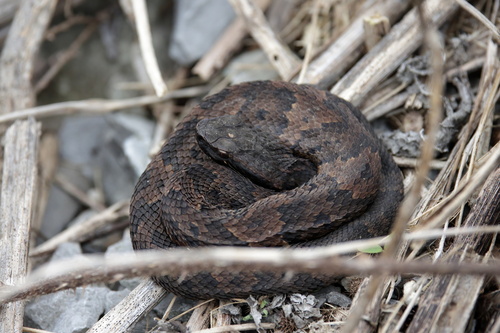
 Eastern CopperheadAgkistrodon contortrix
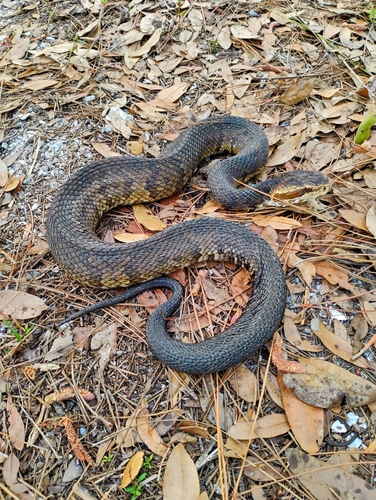
 Northern CottonmouthAgkistrodon piscivorus
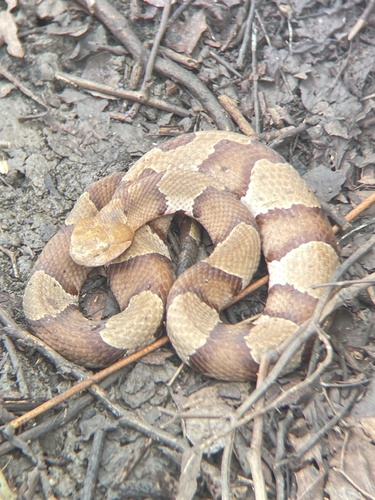
 Florida CottonmouthAgkistrodon conanti
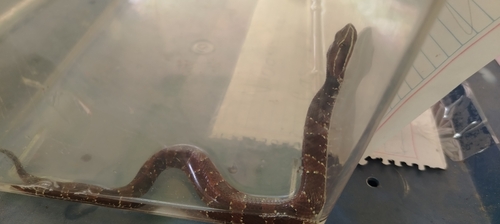
 Broad-banded CopperheadAgkistrodon laticinctus
 Mexican CantilAgkistrodon bilineatus
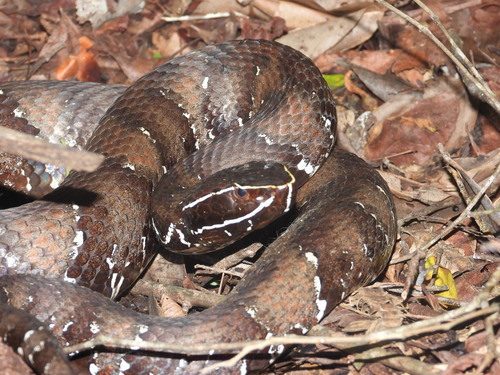 Yucatecan CantilAgkistrodon russeolus
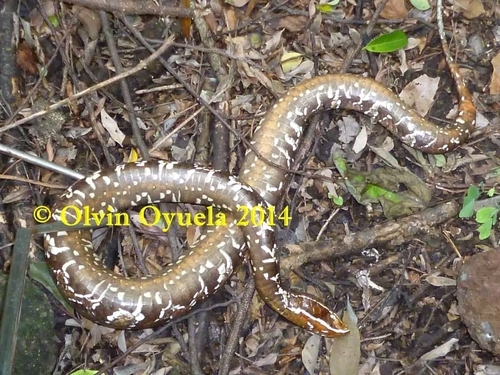 Southern CantilAgkistrodon howardgloydi
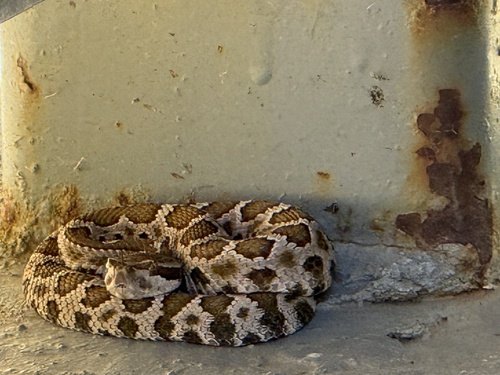 Western RattlesnakeCrotalus oreganus
Classification
How scientists group this snake, from the broadest category down to the exact species. Each step narrows to its closest relatives.
- OrderThe broad group of scaled reptiles: all snakes and lizards
- Squamata
- FamilyA group of related snakes that share key traits
- Viperidae
- GenusA close-knit group of very similar species
- Agkistrodon
- SpeciesThis exact snake, named in the two-part scientific name
- Agkistrodon taylori
Keep learning
- Are Snakes Dangerous? The Real Risk, in PerspectiveMost snakes are harmless and avoid people. Here is the honest picture of snakebite risk worldwide and how to lower your own.
- Snakebite First Aid: What to Do (and What Never to Do)A clear, CDC-based guide to snakebite first aid: the steps that help, the popular myths that hurt, and how to tell a serious bite from a minor one.
- Venomous vs Nonvenomous: How to Tell the DifferenceThe folk rules for telling venomous snakes apart, where each one fails, and why location-based identification beats guessing by sight.
- What to Do If You Find a SnakeFound a snake at home or on a trail? Here is how to stay calm, give it space, identify it safely, and know when to call a professional.
Distribution from GBIF & iNaturalist. Venom status per CDC. Background: Wikipedia. Informational only. Never handle a snake to identify it.