
Coachwhip / Whipsnake
Striped Whipsnake
HarmlessMasticophis taeniatus
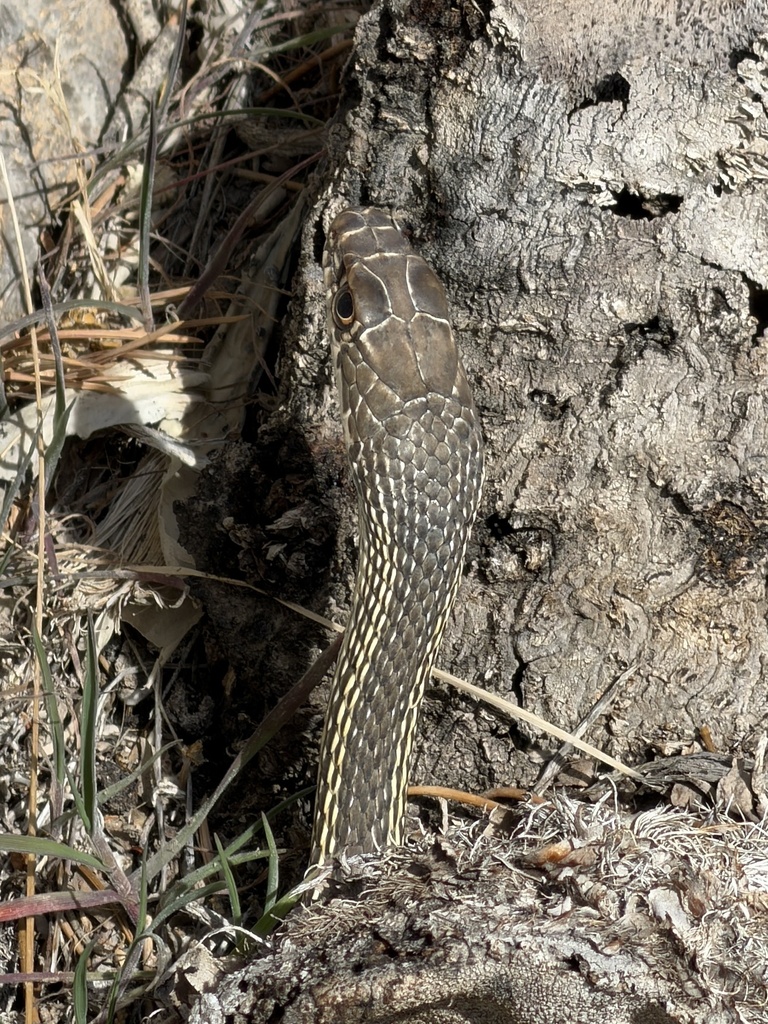
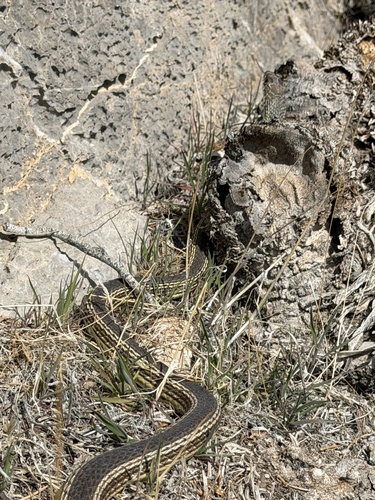
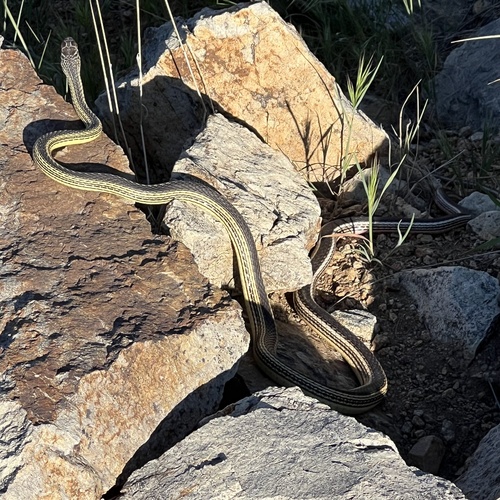
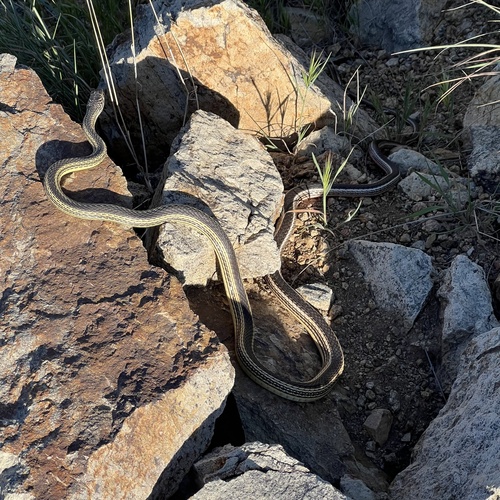
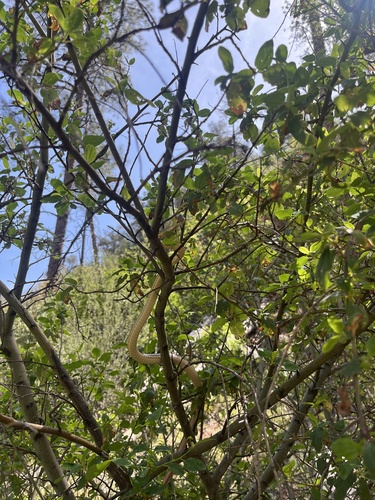
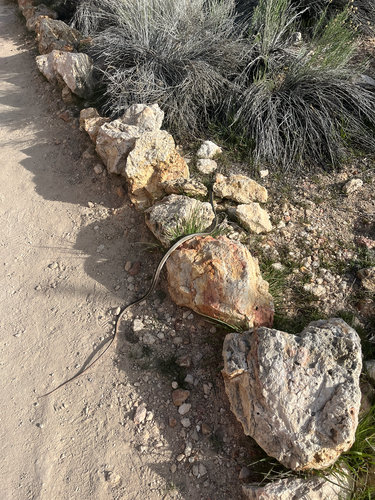
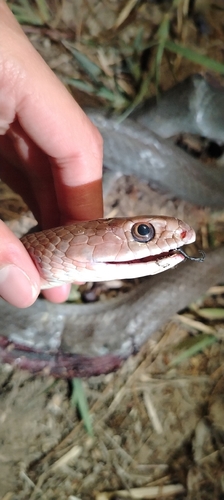
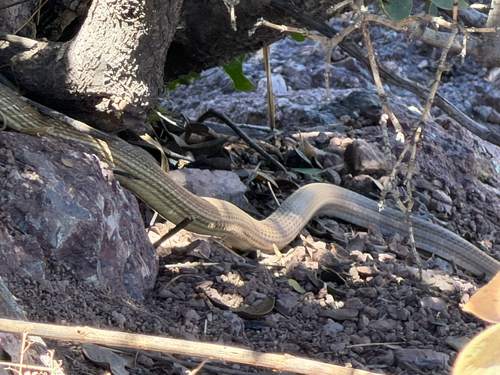
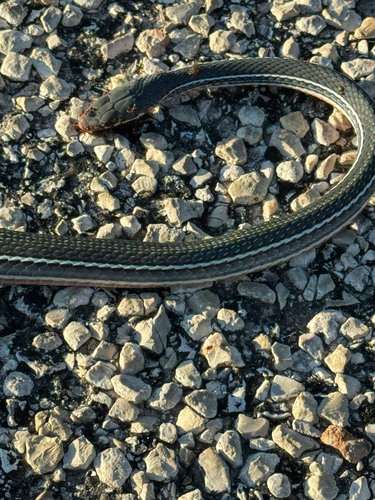
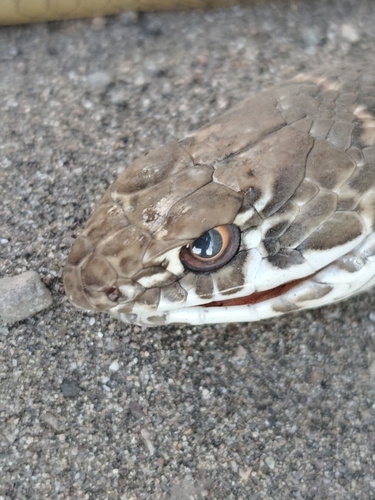
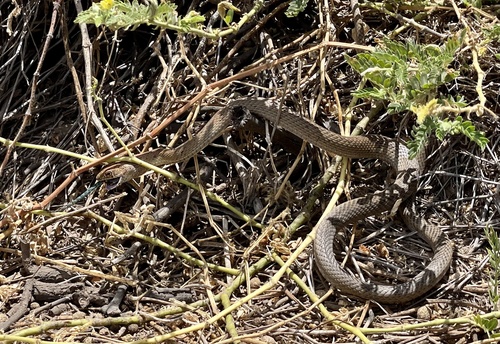
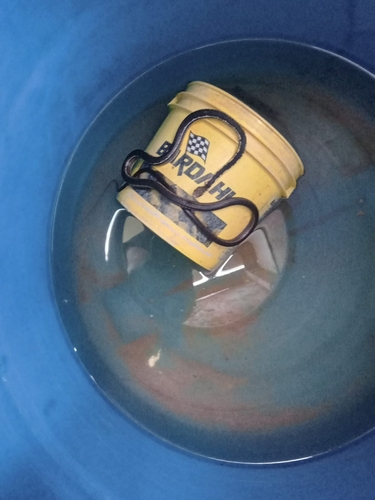
6 photographs of the Striped Whipsnake. © Matt Berger.
The Striped Whipsnake (Masticophis taeniatus) is a non-venomous snake in the Colubridae family, recorded in 2 countries.
- Also called
- Coachwhip / Whipsnake
- Family
- Colubridae
- Size
- Very slender, 3–6 ft.
- Habitat
- Open deserts, grasslands, and scrub.
- Behavior
- Fast, alert, day-active visual hunters that flee rapidly when approached.
- Identify
- Long, whip-thin body; coachwhips often show a braided-whip tail pattern.
About the Striped Whipsnake
The striped whipsnake (Masticophis taeniatus) is a species of nonvenomous snake in the subfamily Colubrinae of the family Colubridae. The species is closely related to the California whipsnake (Masticophis lateralis). The striped whipsnake is native to the western United States and adjacent northern Mexico.
Identification
The striped whipsnake is approximately 30–72 inches (76–183 cm) in total length (including tail). This snake exhibits black, dark brown, or gray coloration on its back, often with an olive or bluish tint. Along the center of each of the first four rows of pale dorsal scales, is a dark longitudinal stripe. There is a white to cream-colored stripe down its side that is bisected by either a solid or dashed black line. The coloring on the snake's belly tends to be cream to yellowish, fading to white toward the head, and coral pink toward the tail. This snake also features a lower preocular between the upper labial scales of the mouth. The anal scale is divided.
Geographic range
The striped whipsnake is found throughout the western United States and northern Mexico. The northernmost part of its geographic range is in south central Washington, and continues southward into the Great Basin between the Cascade-Sierran crest and the continental divide. Its range then continues southeast across the continental divide into New Mexico and western and central Texas. The southernmost part of its range lies in Michoacán, Mexico. In the Western United States its range also extends outside of the Great Basin into the Rogue River Valley in southwestern Oregon and northern California. There is a population in Bryce Canyon National Park in Utah.
Habitat
The striped whipsnake is commonly found in a wide variety of habitats including shrublands, grasslands, sagebrush flats, canyons, piñon-juniper woodlands, and open pine-oak forests. It is attracted to both permanent and seasonal rocky streams, and it frequents both flatlands and mountains.
Behavior
The species Masticophis taeniatus is diurnal, active during the day, and is very alert and fast moving. It seeks shelter in rock outcrops, small mammal burrows, as well as in trees and shrubs depending on the habitat it occupies. This snake is nonvenomous, but it preys on a wide variety of species including lizards, other snakes (including venomous rattlesnakes), small mammals, young birds, frogs, and insects.
Reproduction
The striped whipsnake is oviparous. Little is known about the reproductive activities of Masticophis taeniatus. After fertilization the female striped whipsnake will lay a clutch of 3–12 eggs, between the months of June and July, usually in an abandoned rodent burrow. One study has shown a natural incubation period of 44 to 58 days.
Subspecies
Adapted from Wikipedia, available under CC BY-SA.
Frequently asked: Striped Whipsnake
- Is the Striped Whipsnake venomous?
- No. The Striped Whipsnake (Masticophis taeniatus) is non-venomous and is not considered dangerous to humans. Like most snakes, it will retreat rather than bite when given the chance.
- Is the Striped Whipsnake poisonous?
- Snakes are venomous, not poisonous. "Poisonous" means harmful to eat or touch; "venomous" means injecting toxins through a bite. The Striped Whipsnake is neither poisonous nor venomous.
- Is the Striped Whipsnake dangerous?
- The Striped Whipsnake is not dangerous to humans. It has no medically significant venom and bites only defensively if cornered or handled.
- Where does the Striped Whipsnake live?
- The Striped Whipsnake has verified records in 2 countries, including United States of America, Mexico. See the distribution section below for its full range.
- How do I identify the Striped Whipsnake?
- Long, whip-thin body; coachwhips often show a braided-whip tail pattern.
- How big does the Striped Whipsnake get?
- Very slender, 3–6 ft.
- Why is it called the Striped Whipsnake?
- The subspecific name, girardi, is in honor of French-American herpetologist Charles Frédéric Girard.
Where it is found
More Colubridae snakes
 Common CoachwhipMasticophis flagellum
 Striped RacerMasticophis lateralis
 Neotropical Whip SnakeMasticophis mentovarius
 Sonoran WhipsnakeMasticophis bilineatus
 Schott's WhipsnakeMasticophis schotti
 Baja California CoachwhipMasticophis fuliginosus
 Clarion Island Whip SnakeMasticophis anthonyi
 Baja California Striped Whip SnakeMasticophis aurigulus
Classification
How scientists group this snake, from the broadest category down to the exact species. Each step narrows to its closest relatives.
- OrderThe broad group of scaled reptiles: all snakes and lizards
- Squamata
- FamilyA group of related snakes that share key traits
- Colubridae
- GenusA close-knit group of very similar species
- Masticophis
- SpeciesThis exact snake, named in the two-part scientific name
- Masticophis taeniatus
Keep learning
- What to Do If You Find a SnakeFound a snake at home or on a trail? Here is how to stay calm, give it space, identify it safely, and know when to call a professional.
- Venomous vs Nonvenomous: How to Tell the DifferenceThe folk rules for telling venomous snakes apart, where each one fails, and why location-based identification beats guessing by sight.
- What Is a Snake? Anatomy and the BasicsA clear overview of what makes a snake a snake: limbless body plan, anatomy, evolution from lizards, species diversity, and why they are ectothermic.
- How to Keep Snakes Out of Your Yard and HomeA practical guide to keeping snakes out of your yard and home using habitat changes that work, plus what to skip and what to do if one shows up.
Distribution from GBIF & iNaturalist. Venom status per CDC. Background: Wikipedia. Informational only. Never handle a snake to identify it.