
Colubridae
Schokar's bronzeback
HarmlessDendrelaphis schokari
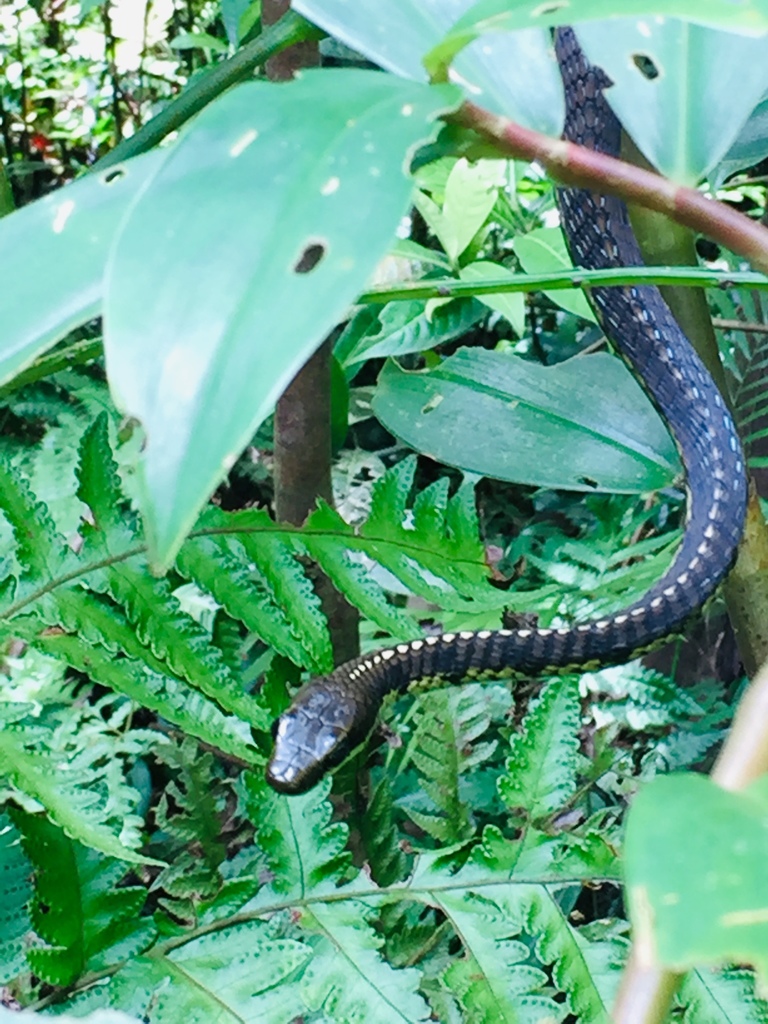
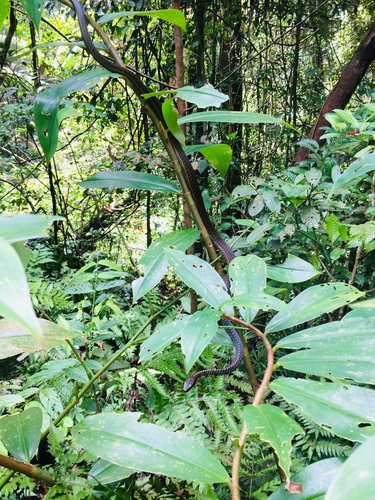
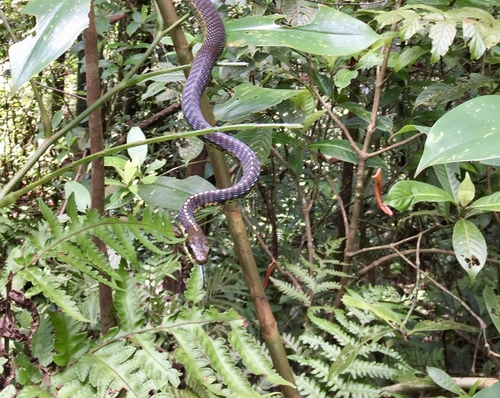
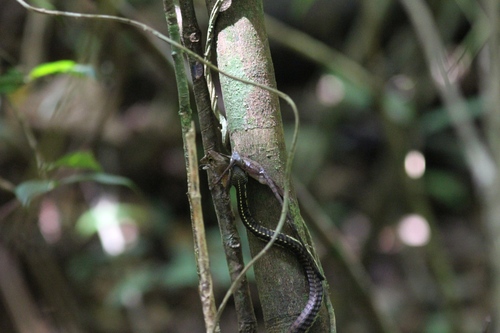
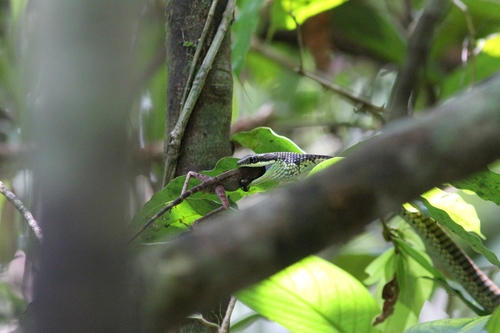
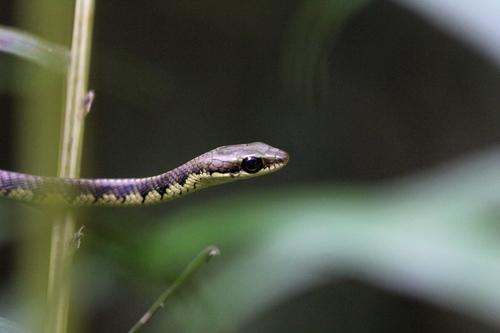
6 photographs of the Schokar's bronzeback. © klukoff.
The Schokar's bronzeback (Dendrelaphis schokari) is a non-venomous snake in the Colubridae family, recorded in 2 countries.
- Family
- Colubridae
About the Schokar's bronzeback
Dendrelaphis schokari, also known as the common bronze-back or Schokar's bronzeback (Sinhala: තරු/මූකලන් හාල්දන්ඩා, Tharu/Mookalan Haaldanda in Sinhala), is a species of non-venomous arboreal snake in the family Colubridae. The species is endemic to Sri Lanka.
Taxonomy
Dendrelaphis schokari belongs to the genus Dendrelaphis, which contains 48 other described species.
Dendrelaphis is one of five genera belonging to the vine snake subfamily Ahaetuliinae, of which Dendrelaphis is most closely related to Chrysopelea, as shown in the cladogram below:
Habitat
Dendrelaphis schokari inhabits forests and open areas of all climatic zones of the island of Sri Lanka, from lowlands to about 750 m (2,460 ft) above sea level. It is diurnal, and though a tree snake, it is observed foraging on land as well.
Diet
Its prey consists of frogs, lizards, geckos, skinks, insects and also eggs of small birds. It can make long jumps among trees if necessary while chasing its prey.
Description
It can be distinguished easily from other Dendrelaphis species by having a cream-colored spotted line on its olive green dorsum (back) from neck to mid fore body along the spine.
Formal description
Dendrelaphis schokari adult female: snout-to-vent length (SVL) 51 cm (20 in); tail 22.5 cm (8.9 in); 161 ventrals (2 preventrals); 113 subcaudals, all divided; anal shield divided; 1 loreal scale (L+R); 9 infralabials (L+R); first infralabials touch at the mental groove; first sublabial touches infralabials 6 and 7 (L+R); 9 supralabials (L+R), supralabials 5 and 6 touch the eye (L+R); 2 postoculars (L+R); temporal formula: 2+2 (L+R); dorsal formula: 15-15-11; vertebral scales enlarged but smaller than the scales of the first dorsal row; width of the dorsal scale at the position of the middle ventral 2.1 mm; eye-diameter 4.9 mm (L+R); distance anterior border of eye to posterior border of nostril 4.5 mm (L+R); a dark postocular stripe starts behind the eye, covers only the lower quarter of the temporal region and ends at the edge of the jaw; a vertebral stripe, formed by yellow spots on the vertebral scales, starts behind the head and is no longer visible after the level of the 34th ventral scale; an interparietal spot is absent; a faint light ventrolateral line is present, not bordered by black lines; ground color brown, based on the color of unshed skin; supralabials and throat yellow; ventrals yellow anteriorly, yellowish-green posteriorly.
Adapted from Wikipedia, available under CC BY-SA.
Frequently asked: Schokar's bronzeback
- Is the Schokar's bronzeback venomous?
- No. The Schokar's bronzeback (Dendrelaphis schokari) is non-venomous and is not considered dangerous to humans. Like most snakes, it will retreat rather than bite when given the chance.
- Is the Schokar's bronzeback poisonous?
- Snakes are venomous, not poisonous. "Poisonous" means harmful to eat or touch; "venomous" means injecting toxins through a bite. The Schokar's bronzeback is neither poisonous nor venomous.
- Is the Schokar's bronzeback dangerous?
- The Schokar's bronzeback is not dangerous to humans. It has no medically significant venom and bites only defensively if cornered or handled.
- Where does the Schokar's bronzeback live?
- The Schokar's bronzeback has verified records in 2 countries, including Sri Lanka, India. See the distribution section below for its full range.
- What does the Schokar's bronzeback eat?
- Its prey consists of frogs, lizards, geckos, skinks, insects and also eggs of small birds. It can make long jumps among trees if necessary while chasing its prey.
Where it is found
More Colubridae snakes
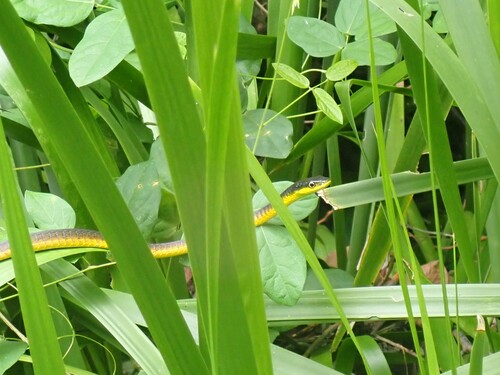 Common Tree SnakeDendrelaphis punctulatus
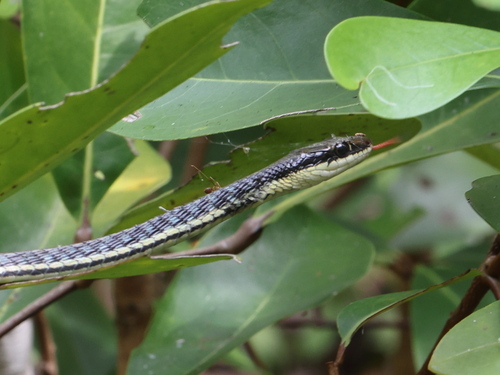 Painted BronzebackDendrelaphis pictus
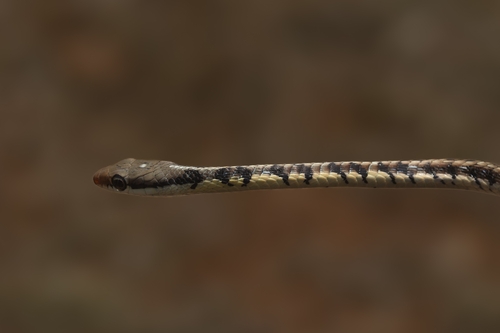 Common Bronzeback Tree SnakeDendrelaphis tristis
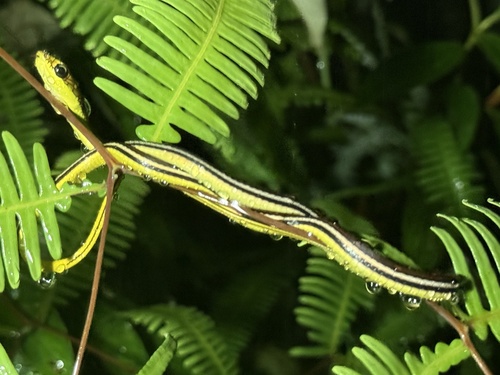 Striped BronzebackDendrelaphis caudolineatus
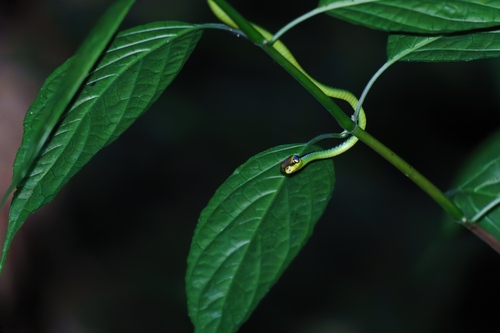 Elegant BronzebackDendrelaphis formosus
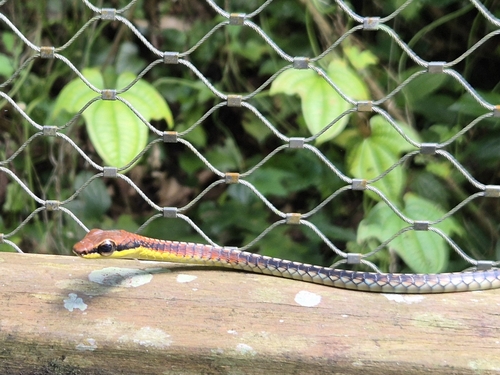 Kopstein's BronzebackDendrelaphis kopsteini
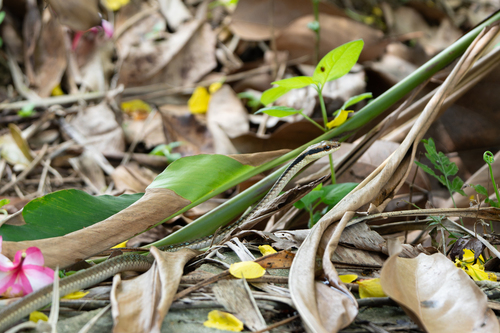 Vietnamese BronzebackDendrelaphis ngansonensis
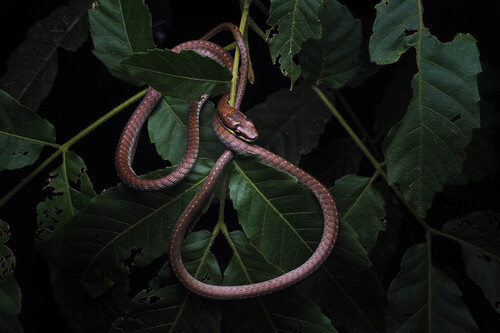 Northern Tree SnakeDendrelaphis calligaster
Classification
How scientists group this snake, from the broadest category down to the exact species. Each step narrows to its closest relatives.
- OrderThe broad group of scaled reptiles: all snakes and lizards
- Squamata
- FamilyA group of related snakes that share key traits
- Colubridae
- GenusA close-knit group of very similar species
- Dendrelaphis
- SpeciesThis exact snake, named in the two-part scientific name
- Dendrelaphis schokari
Keep learning
- What to Do If You Find a SnakeFound a snake at home or on a trail? Here is how to stay calm, give it space, identify it safely, and know when to call a professional.
- Venomous vs Nonvenomous: How to Tell the DifferenceThe folk rules for telling venomous snakes apart, where each one fails, and why location-based identification beats guessing by sight.
- What Is a Snake? Anatomy and the BasicsA clear overview of what makes a snake a snake: limbless body plan, anatomy, evolution from lizards, species diversity, and why they are ectothermic.
- How to Keep Snakes Out of Your Yard and HomeA practical guide to keeping snakes out of your yard and home using habitat changes that work, plus what to skip and what to do if one shows up.
Distribution from GBIF & iNaturalist. Venom status per CDC. Background: Wikipedia. Informational only. Never handle a snake to identify it.