
Viperidae
Gloyd's Hump-nosed Viper
VenomousHypnale nepa

The Gloyd's Hump-nosed Viper (Hypnale nepa) is a venomous snake in the Viperidae family, recorded in 2 countries.
If you are bitten
This is a venomous snake. Treat any bite as a medical emergency: stay calm, keep the bitten limb still and roughly level with the heart, remove rings and tight clothing, and get to emergency care immediately. Do not apply a tourniquet, cut the wound, apply ice, or try to suck out venom. Call your local emergency number or poison center.
- Family
- Viperidae
- Danger
- high
About the Gloyd's Hump-nosed Viper
Hypnale nepa, the Sri Lankan hump-nosed viper, is a venomous pitviper species endemic to Sri Lanka where it is known as මූකලන් තෙලිස්සා (mukalan thelissa) in Sinhala. Earlier thought that Hypnale walli and Hypnale nepa were two distinct species, but it is now accepted that it is the same species and Hypnale walli is a synonym name. Relatively small, they are distinguished by a strongly upturned snout. No subspecies are currently recognized.
Description
Adults grow to a total length of 30–35 cm (11+3⁄4–13+3⁄4 in). According to Wall (1921), the maximum recorded lengths are for a male of 38.7 cm (15+1⁄4 in) and a female of 38.1 cm (15.0 in). According to Deraniyagala (1955), the largest specimen in the Colombo museum was 39.2 cm (15+1⁄2 in) in total length with a tail measuring 5.9 cm (2+1⁄4 in). In general, the tail is 13-18% of total body length. The body is moderately slender, with a head that is conspicuously distinct from the neck.
This species is distinguished from H. hypnale by a snout that has a strongly upturned tip. This is due to an extended rostral scale, which is immediately followed by a raised wart-like hump covered with 7-14 very small scales. Also, the hemipenes have clearly visible spines.
The scalation includes 17 rows of dorsal scales at midbody that are weakly keeled or smooth, 124-142 ventral scales, and 33-41 subcaudal scales.
The color pattern consists of a light brown to dark brown to pale olive ground color, flecked and mottled with darker tones. This is overlaid with a series of 17-26 dorsolateral suboval or subtriangular brown blotches that alternate or oppose each other middorsally. These blotches are 3-4 scales wide and extend down to the third scale row. The top of the head is brown, and usually lacks any pattern, except for a black postorbital stripe that extends to the neck.
Geographic range
Hypnale nepa is found in Sri Lanka throughout forested areas, from lowland rainforest to over 1,800 m (5,900 ft) altitude. The type locality given is "Africa." An obvious error, this was amended to "Sri Lanka" by Hoge and Romano-Hoge (1981).
Adapted from Wikipedia, available under CC BY-SA.
Local and regional names
The Gloyd's Hump-nosed Viper is known by these names across the regions where it lives:
- Chinese
- 斯里蘭卡瘤鼻蝮
- Czech
- ostrolebec srílanský
- English
- Geckos, Sri Lanka Humpnose Viper, Wall's Humpnose Viper
- Russian
- Цейлонский щитомордник
Frequently asked: Gloyd's Hump-nosed Viper
- Is the Gloyd's Hump-nosed Viper venomous?
- Yes. The Gloyd's Hump-nosed Viper (Hypnale nepa) is venomous and belongs to the Viperidae family (viper). Its bite is considered high risk to people. Treat any bite as a medical emergency.
- Is the Gloyd's Hump-nosed Viper poisonous?
- Snakes are venomous, not poisonous. "Poisonous" means harmful to eat or touch; "venomous" means injecting toxins through a bite. The Gloyd's Hump-nosed Viper is venomous, delivering venom through a bite.
- Is the Gloyd's Hump-nosed Viper dangerous?
- This is a venomous snake. Treat any bite as a medical emergency: stay calm, keep the bitten limb still and roughly level with the heart, remove rings and tight clothing, and get to emergency care immediately. Do not apply a tourniquet, cut the wound, apply ice, or try to suck out venom. Call your local emergency number or poison center.
- Where does the Gloyd's Hump-nosed Viper live?
- The Gloyd's Hump-nosed Viper has verified records in 2 countries, including Sri Lanka, Germany. See the distribution section below for its full range.
If you are bitten by the Gloyd's Hump-nosed Viper
Do
- Get away from the snake and stay calm. Most bites worsen when people panic or try again to handle the snake.
- Call 911 or Poison Control (1-800-222-1222) right away. Antivenom works best when given early.
- Note the time of the bite and, from a safe distance, the snake's color and pattern, a phone photo is enough. Do not chase it.
- Keep the bitten limb still and at roughly heart level. Sit or lie down and limit movement.
- Remove rings, watches, and tight clothing near the bite before swelling starts.
- Gently wash the bite with soap and water and cover it with a clean, dry dressing.
Do not
- Do not cut the wound or try to suck out the venom.
- Do not apply a tourniquet or ice.
- Do not drink alcohol or caffeine.
- Do not take aspirin or ibuprofen, they can worsen bleeding. Acetaminophen is safer for pain.
- Do not try to catch or kill the snake. A dead snake can still bite by reflex.
First-aid guidance adapted from the U.S. Centers for Disease Control and Prevention (CDC NIOSH), Venomous Snakes. Educational only; always follow the instructions of emergency responders.
Where it is found
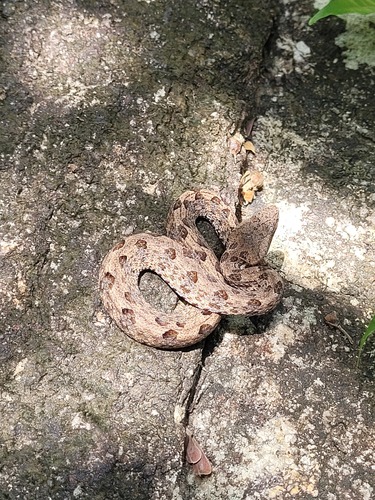
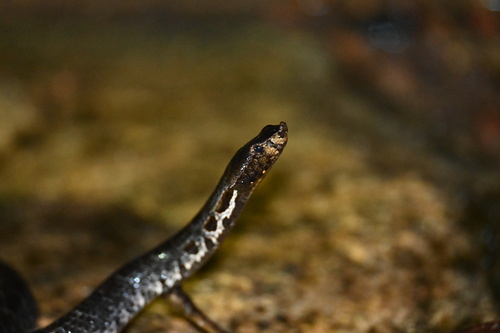
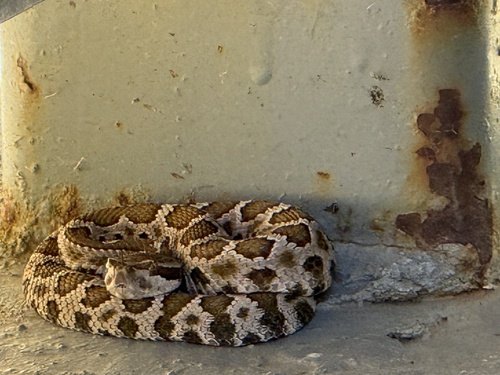
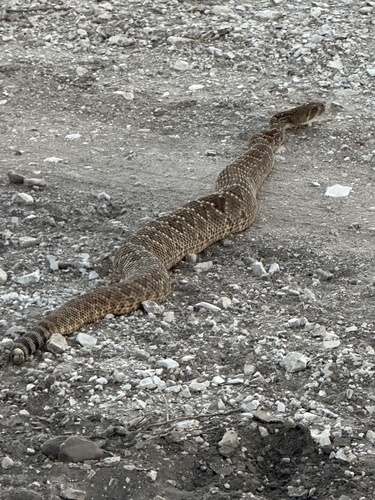
More Viperidae snakes
Classification
How scientists group this snake, from the broadest category down to the exact species. Each step narrows to its closest relatives.
Keep learning
- Are Snakes Dangerous? The Real Risk, in PerspectiveMost snakes are harmless and avoid people. Here is the honest picture of snakebite risk worldwide and how to lower your own.
- Snakebite First Aid: What to Do (and What Never to Do)A clear, CDC-based guide to snakebite first aid: the steps that help, the popular myths that hurt, and how to tell a serious bite from a minor one.
- Venomous vs Nonvenomous: How to Tell the DifferenceThe folk rules for telling venomous snakes apart, where each one fails, and why location-based identification beats guessing by sight.
- What to Do If You Find a SnakeFound a snake at home or on a trail? Here is how to stay calm, give it space, identify it safely, and know when to call a professional.
Distribution from GBIF & iNaturalist. Venom status per CDC. Background: Wikipedia. Informational only. Never handle a snake to identify it.