
Colubridae
Cloud Forest Parrot Snake
HarmlessLeptophis modestus
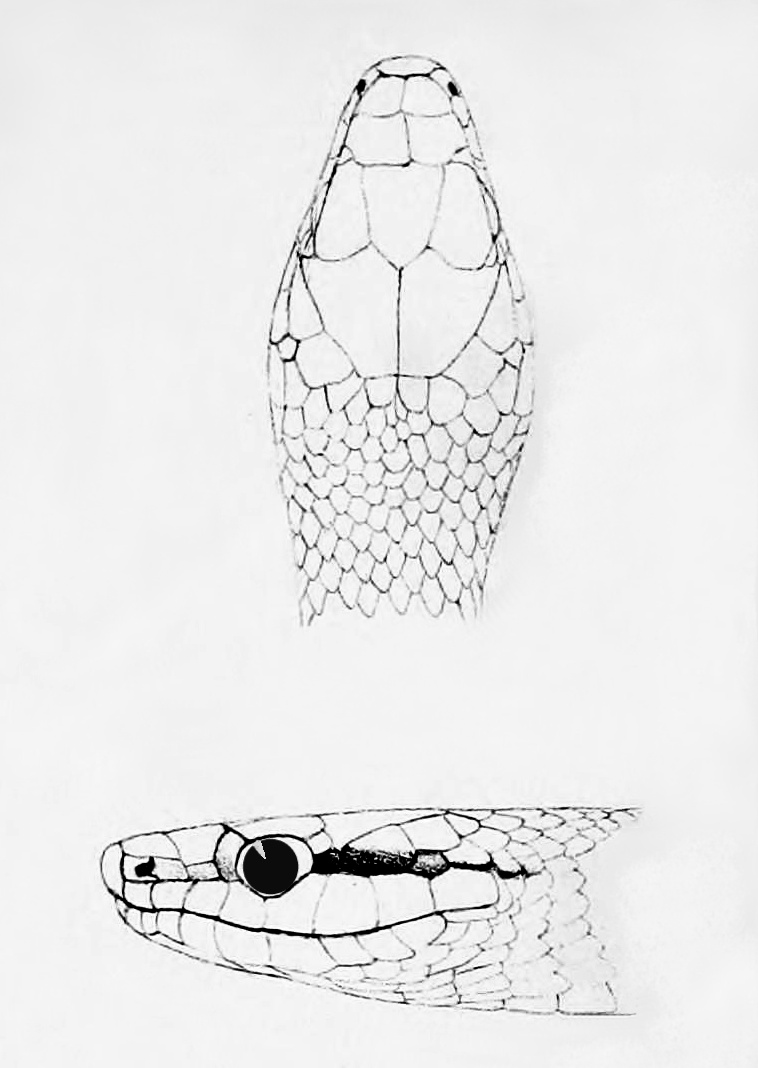
The Cloud Forest Parrot Snake (Leptophis modestus) is a non-venomous snake in the Colubridae family, recorded in 5 countries.
- Family
- Colubridae
About the Cloud Forest Parrot Snake
Leptophis modestus, known commonly as the cloud forest parrot snake, is a species of snake in the family Colubridae. It is endemic to Mesoamerica, where it lives in mountain forests.
Taxonomy
The first description of the species was published by Albert Günther in 1872, then under the name Abaetulla modesta. He redesignated the species, giving it its current name, in 1894.
The name modestus means moderate in Latin. According to James R. McCranie, it's uncertain why Günther choose this name, but that it may be referring to the moderate eye size of the species, which Günther mentioned in his description of it.
There are currently no recognized subspecies.
Description
The type specimen of Leptophis modestus is 130 cm (51 in) in total length, and has a 54 cm (21 in) tail. Males of the species can reach lengths of up to 175.5 cm (69.1 in).
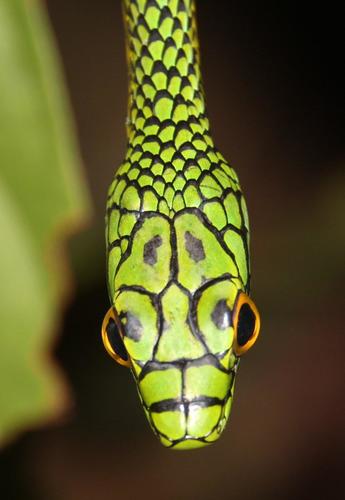
Dorsally, it is olive-green. There is a blackish streak behind each eye, and the lips and throat are yellowish. Ventrally, it is pale green.
The dorsal scales are arranged in 15 rows at midbody, strongly keeled except for the first row (adjacent to the ventrals) and on the tail.
Males have 168–178 ventral scales and 171–186 subcaudal scales, while females have 173–183 ventral scales and 166–179 subcaudal scales. The snake's anal plate is divided.
Distribution and habitat
Leptophis modestus can be found in the mountain forests of southern Mexico, central Guatemala, northwestern El Salvador and southwestern Honduras, at elevations of 1,335–2,590 metres (4,380–8,497 ft) The types of forest the snake inhabits include rainforests, humid oak and pine forests, sweetgum forests, evergreen cloud forests and hardwood cloud forests.
Conservation status
It is currently considered a threatened species. Habitat loss due to deforestation has led to a decrease in population numbers.
Adapted from Wikipedia, available under CC BY-SA.
Frequently asked: Cloud Forest Parrot Snake
- Is the Cloud Forest Parrot Snake venomous?
- No. The Cloud Forest Parrot Snake (Leptophis modestus) is non-venomous and is not considered dangerous to humans. Like most snakes, it will retreat rather than bite when given the chance.
- Is the Cloud Forest Parrot Snake poisonous?
- Snakes are venomous, not poisonous. "Poisonous" means harmful to eat or touch; "venomous" means injecting toxins through a bite. The Cloud Forest Parrot Snake is neither poisonous nor venomous.
- Is the Cloud Forest Parrot Snake dangerous?
- The Cloud Forest Parrot Snake is not dangerous to humans. It has no medically significant venom and bites only defensively if cornered or handled.
- Where does the Cloud Forest Parrot Snake live?
- The Cloud Forest Parrot Snake has verified records in 5 countries, including Guatemala, Honduras, El Salvador. See the distribution section below for its full range.
Where it is found
More Colubridae snakes
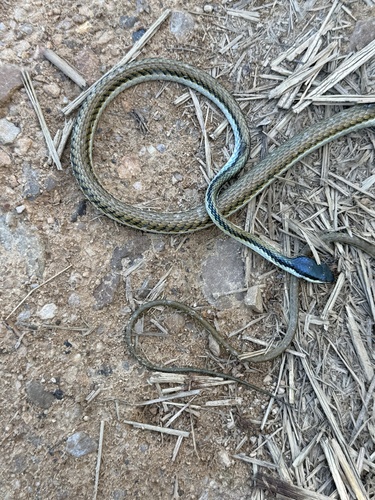 Mexican Parrot SnakeLeptophis mexicanus
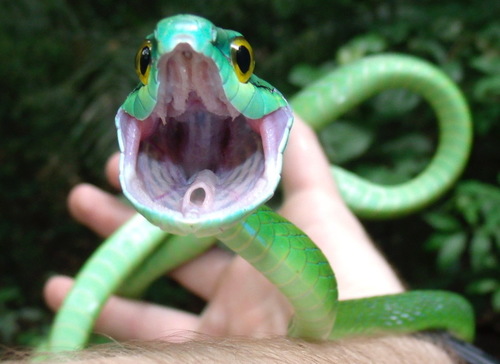 Western Parrot-SnakeLeptophis occidentalis
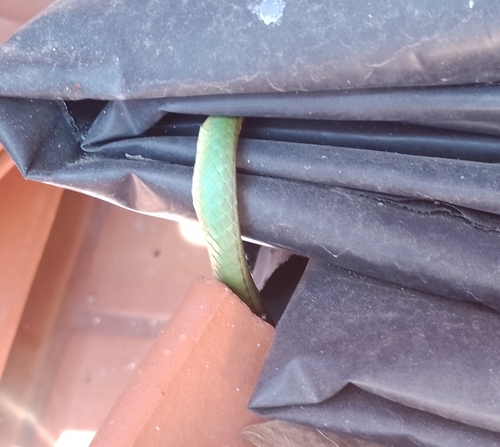 Pacific Coast Parrot SnakeLeptophis diplotropis
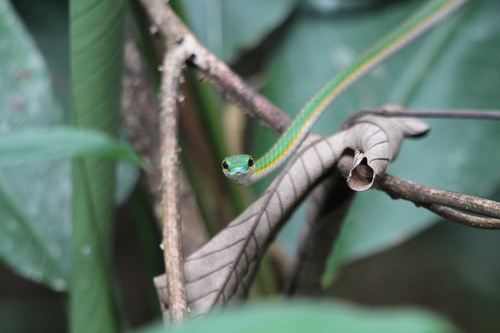 Giant Parrot SnakeLeptophis ahaetulla
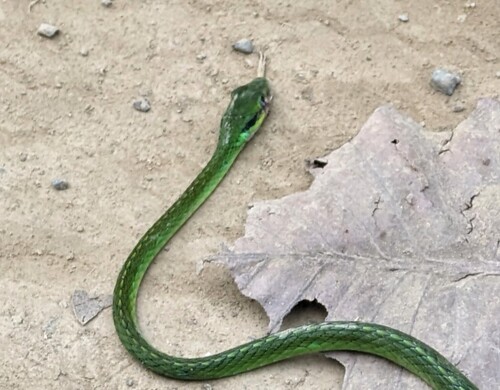 Cope's Parrot SnakeLeptophis depressirostris
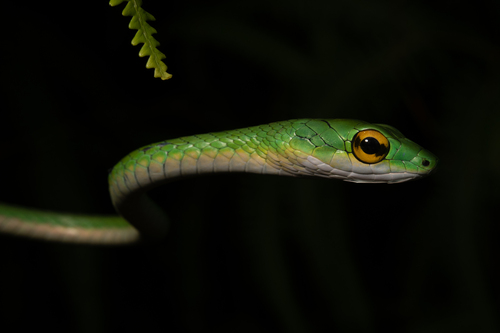 Leptophis praestansLeptophis praestans
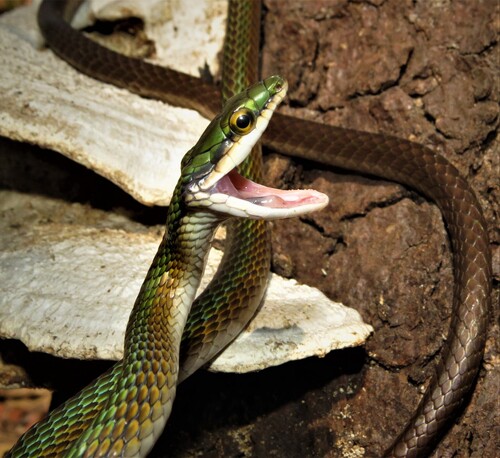 Southern Green Parrot SnakeLeptophis marginatus
 Black-skinned Parrot SnakeLeptophis nigromarginatus
Classification
How scientists group this snake, from the broadest category down to the exact species. Each step narrows to its closest relatives.
- OrderThe broad group of scaled reptiles: all snakes and lizards
- Squamata
- FamilyA group of related snakes that share key traits
- Colubridae
- GenusA close-knit group of very similar species
- Leptophis
- SpeciesThis exact snake, named in the two-part scientific name
- Leptophis modestus
Keep learning
- What to Do If You Find a SnakeFound a snake at home or on a trail? Here is how to stay calm, give it space, identify it safely, and know when to call a professional.
- Venomous vs Nonvenomous: How to Tell the DifferenceThe folk rules for telling venomous snakes apart, where each one fails, and why location-based identification beats guessing by sight.
- What Is a Snake? Anatomy and the BasicsA clear overview of what makes a snake a snake: limbless body plan, anatomy, evolution from lizards, species diversity, and why they are ectothermic.
- How to Keep Snakes Out of Your Yard and HomeA practical guide to keeping snakes out of your yard and home using habitat changes that work, plus what to skip and what to do if one shows up.
Distribution from GBIF & iNaturalist. Venom status per CDC. Background: Wikipedia. Informational only. Never handle a snake to identify it.