
Colubridae
Boulenger's Bronzeback
HarmlessDendrelaphis bifrenalis
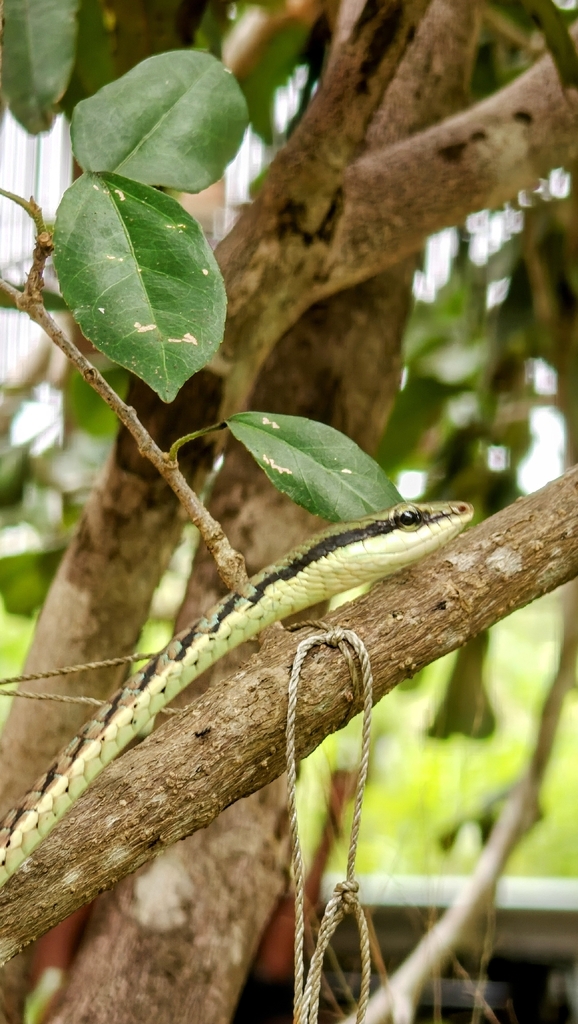
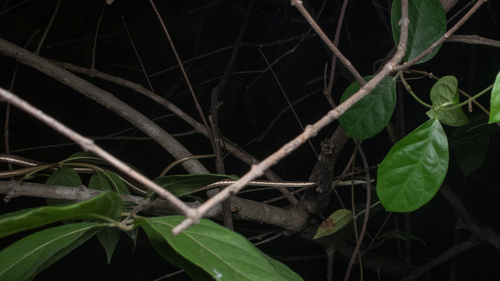
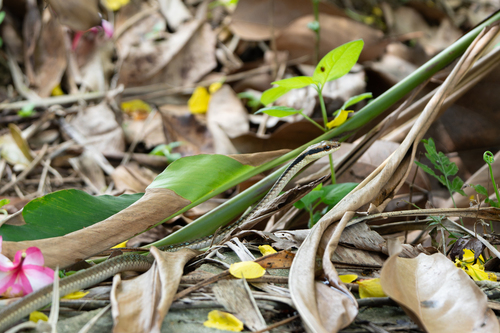
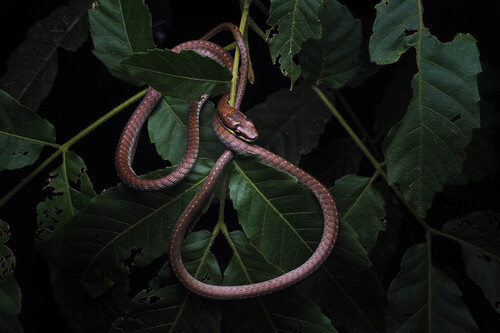
2 photographs of the Boulenger's Bronzeback. © Harsha Jayaramaiah.
The Boulenger's Bronzeback (Dendrelaphis bifrenalis) is a non-venomous snake in the Colubridae family, recorded in 2 countries.
- Family
- Colubridae
About the Boulenger's Bronzeback
Dendrelaphis bifrenalis, also called Boulenger's bronzeback, Boulenger's bronze-back, and Travancore bronze-brown snake, is a colubrid snake native to Eastern Ghats of Southern India and Sri Lanka. It was first described by George Albert Boulenger in 1890. Dendrelaphis wickrorum from Sri Lanka was previously confused with this species.
Habitat and ecology
This oviparous, diurnal and arboreal species can be found in trees, shrubs and bushes in wet and intermediate zones of lowlands to mid hills. However, there are references of finding it from Mullaitivu, Vavuniya and Trincomalee of northern dry zone of Sri Lanka. It is often encountered on low vegetation, however, and it may also descend to the ground in search of food. Arboreal and feeds on frogs, geckos, skinks and agamid lizards. Sometimes descends to the ground, and it is said that when moving on the ground it has a peculiar habit of keeping its head and 1/8 of the forebody erect. These are very active and do not get panicked easily. Dendrelaphis is one of the quickest snakes to escape and hide, when exited they expose the skin underneath scales. Ventral keels help them to climb trees.
Description
Cylindrical, narrow, slender body is present with a dorso-ventrally flattened pear-shaped head. The neck region is clear. Long and compressed snout is present. The tip of it is broad and rounded. The nostrils are present laterally and they are rounded. Round pupil is present in large eyes. Prehensile tail is 1/3 of the body of the snake. Dorsal body of the snake is copper color. Top of the labials and chin is cream or light green color. The tongue is red in color. There is a black broad bar at the sides of the head and run along the eye to the neck region. Lateral corner of the anterior body has black cross strips in a diagonal angle. Two yellow lines run on the lateral sides of the body. Sometimes these lines may be margined by black dots. Ventral body is yellowish green. These are oviparous snakes. They lay eggs in tree hollows. Five long eggs are laid by them at a time. Adult snakes grow about 700–900 mm. Mid-body consists of 15 rows of scales. Vertebrals are clear and enlarged. Dendrelaphis bifrenalis differ in having a red color tongue from other Dendrelaphis species.
Adapted from Wikipedia, available under CC BY-SA.
Frequently asked: Boulenger's Bronzeback
- Is the Boulenger's Bronzeback venomous?
- No. The Boulenger's Bronzeback (Dendrelaphis bifrenalis) is non-venomous and is not considered dangerous to humans. Like most snakes, it will retreat rather than bite when given the chance.
- Is the Boulenger's Bronzeback poisonous?
- Snakes are venomous, not poisonous. "Poisonous" means harmful to eat or touch; "venomous" means injecting toxins through a bite. The Boulenger's Bronzeback is neither poisonous nor venomous.
- Is the Boulenger's Bronzeback dangerous?
- The Boulenger's Bronzeback is not dangerous to humans. It has no medically significant venom and bites only defensively if cornered or handled.
- Where does the Boulenger's Bronzeback live?
- The Boulenger's Bronzeback has verified records in 2 countries, including Sri Lanka, India. See the distribution section below for its full range.
Where it is found
More Colubridae snakes
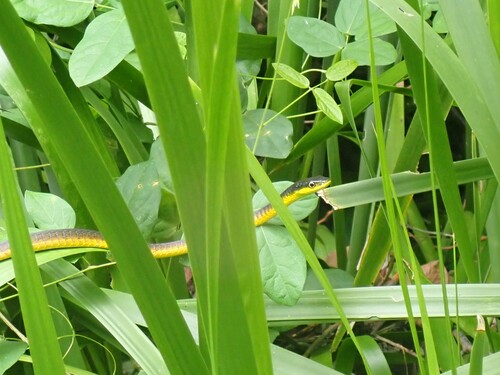 Common Tree SnakeDendrelaphis punctulatus
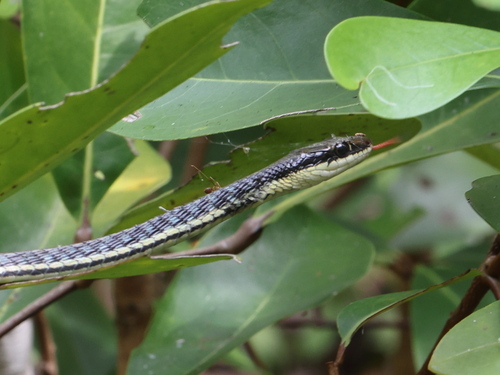 Painted BronzebackDendrelaphis pictus
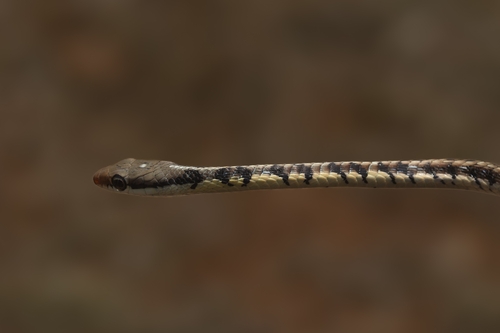 Common Bronzeback Tree SnakeDendrelaphis tristis
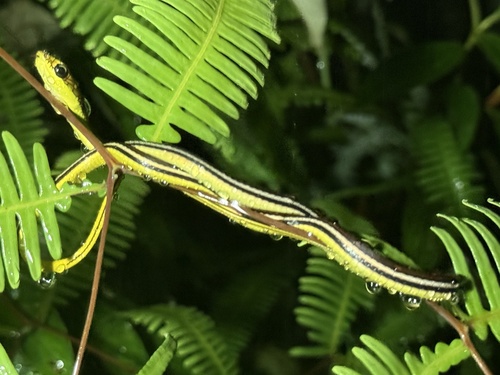 Striped BronzebackDendrelaphis caudolineatus
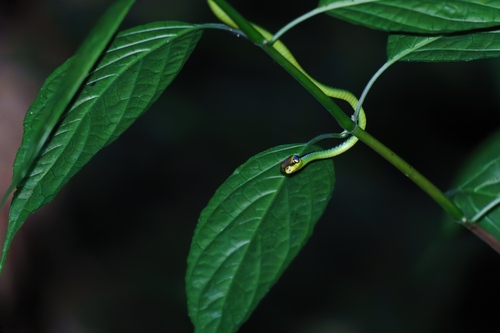 Elegant BronzebackDendrelaphis formosus
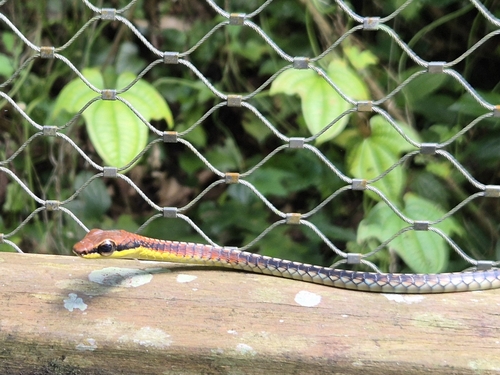 Kopstein's BronzebackDendrelaphis kopsteini
 Vietnamese BronzebackDendrelaphis ngansonensis
 Northern Tree SnakeDendrelaphis calligaster
Classification
How scientists group this snake, from the broadest category down to the exact species. Each step narrows to its closest relatives.
- OrderThe broad group of scaled reptiles: all snakes and lizards
- Squamata
- FamilyA group of related snakes that share key traits
- Colubridae
- GenusA close-knit group of very similar species
- Dendrelaphis
- SpeciesThis exact snake, named in the two-part scientific name
- Dendrelaphis bifrenalis
Keep learning
- What to Do If You Find a SnakeFound a snake at home or on a trail? Here is how to stay calm, give it space, identify it safely, and know when to call a professional.
- Venomous vs Nonvenomous: How to Tell the DifferenceThe folk rules for telling venomous snakes apart, where each one fails, and why location-based identification beats guessing by sight.
- What Is a Snake? Anatomy and the BasicsA clear overview of what makes a snake a snake: limbless body plan, anatomy, evolution from lizards, species diversity, and why they are ectothermic.
- How to Keep Snakes Out of Your Yard and HomeA practical guide to keeping snakes out of your yard and home using habitat changes that work, plus what to skip and what to do if one shows up.
Distribution from GBIF & iNaturalist. Venom status per CDC. Background: Wikipedia. Informational only. Never handle a snake to identify it.