
Colubridae
Barnes' Cat Snake
HarmlessBoiga barnesii

The Barnes' Cat Snake (Boiga barnesii) is a rear-fanged, mildly venomous snake in the Colubridae family, recorded in 1 country.
- Family
- Colubridae
About the Barnes' Cat Snake
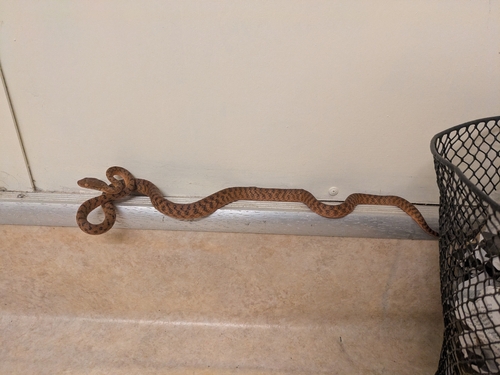
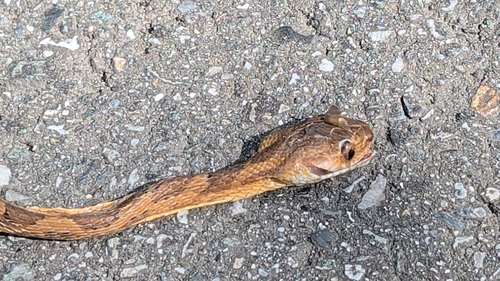
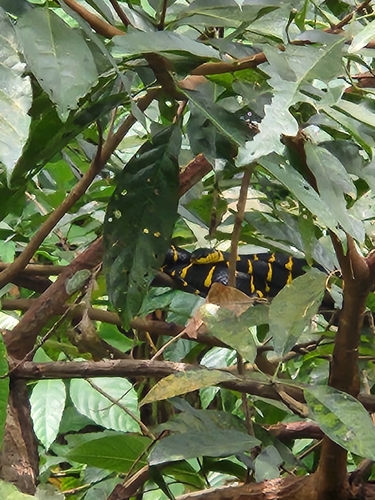
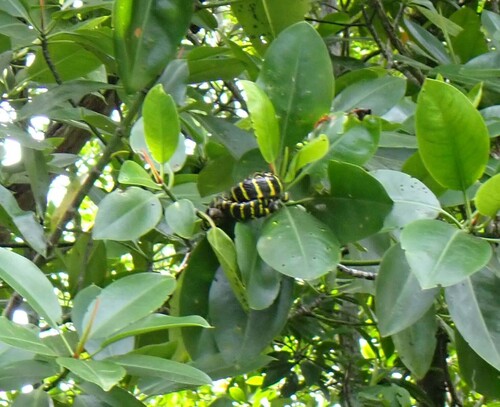
Boiga barnesii is a species of cat snake endemic to Sri Lanka. It is known as Barnes' cat snake in English and panduru mapila-පදුරු මාපිලා in Sinhala. It is a member of the snake family Colubridae. It is distributed in the lowlands and midlands up to approximately 600 m (2,000 ft) above sea level, with known localities include Matale, Kandy, Gannoruwa, Gampola, Ambagamuwa, Balangoda, Labugama and Sinharaja Rain Forest. Barnes' cat snake is mainly a forest-dwelling species but may occasionally be found in human habitats. It is the smallest cat snake in Sri Lanka and grows up to a maximum of about 600 mm (24 in) in snout-vent length. Being a nocturnal and an arboreal hunter, it mainly feeds on agamid lizards and geckos. The day time is usually spent inside a tree hole or a crevice. It's a very timid and a mildly venomous snake and rarely attempts to bite.
Etymology
The specific name, barnesii, is in honour of Richard Hawksworth Barnes (1831-1904), who collected specimens in Ceylon (now Sri Lanka) for the British Museum (Natural History), including the type specimen of this species.
Scalation
B. barnesii has 19 scale rows at midbody. It has 2–3 preoculars. The ventrals number 208–271, and the subcaudals number 98–120.
Description
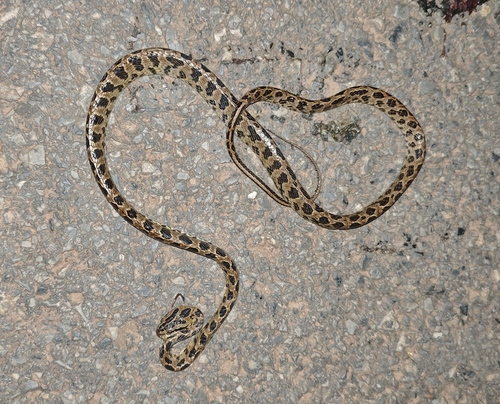
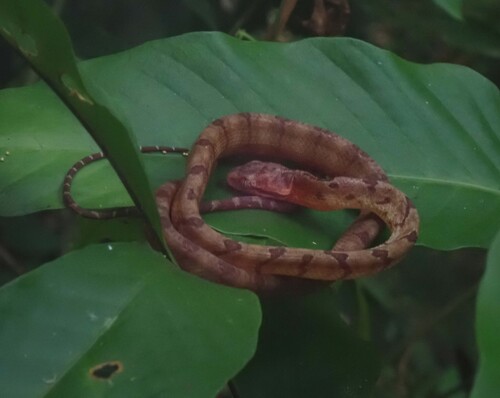
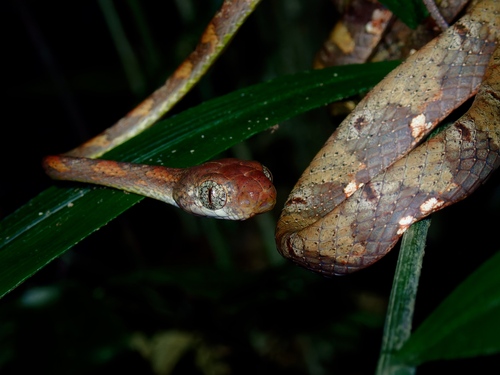
The dorsum of B. barnesii is reddish-brown, with a purplish brown vertebral series of blotches running from nape to the mid-tail region. A lateral series of the same color also can be seen. The head is purplish black, with a light gray post-ocular stripe. The ventral surface is creamy, with gray or brown spots.
The maximum length recorded is 522 mm (20.6 in).
Toxicity
Although panduru mapila is only mildly venomous, and bites on humans produce only local symptoms, there is a common misconception in Sri Lanka that all mapilas-මාපිලා (cat snakes) are highly venomous and could kill a human with its venom. This misconception may be because the name mapila refers to different species in different parts of the island. Due to differences in local knowledge and nomenclature, the krait species found in Sri Lanka (common krait or thel karawala-තෙල් කරවලා, Ceylon krait or mudu karawala-මුදු කරවලා) are also referred to or misidentified as mapila. Both krait species mentioned (Bungarus caeruleus and Bungarus ceylonicus) are highly venomous.
Adapted from Wikipedia, available under CC BY-SA.
Frequently asked: Barnes' Cat Snake
- Is the Barnes' Cat Snake venomous?
- The Barnes' Cat Snake (Boiga barnesii) is rear-fanged and only mildly venomous. It is not considered dangerous to humans (its venom is weak and its fangs sit at the back of the mouth) but a bite can cause local swelling or irritation, so it should not be handled.
- Is the Barnes' Cat Snake poisonous?
- Snakes are venomous, not poisonous. "Poisonous" means harmful to eat or touch; "venomous" means injecting toxins through a bite. The Barnes' Cat Snake is neither poisonous nor venomous.
- Is the Barnes' Cat Snake dangerous?
- The Barnes' Cat Snake is not dangerous to humans. It has no medically significant venom and bites only defensively if cornered or handled.
- Where does the Barnes' Cat Snake live?
- The Barnes' Cat Snake has verified records in 1 country, including Sri Lanka. See the distribution section below for its full range.
- Why is it called the Barnes' Cat Snake?
- The specific name, barnesii, is in honour of Richard Hawksworth Barnes (1831-1904), who collected specimens in Ceylon (now Sri Lanka) for the British Museum (Natural History), including the type specimen of this species.
Where it is found
More Colubridae snakes
Classification
How scientists group this snake, from the broadest category down to the exact species. Each step narrows to its closest relatives.
- OrderThe broad group of scaled reptiles: all snakes and lizards
- Squamata
- FamilyA group of related snakes that share key traits
- Colubridae
- GenusA close-knit group of very similar species
- Boiga
- SpeciesThis exact snake, named in the two-part scientific name
- Boiga barnesii
Keep learning
- What to Do If You Find a SnakeFound a snake at home or on a trail? Here is how to stay calm, give it space, identify it safely, and know when to call a professional.
- Venomous vs Nonvenomous: How to Tell the DifferenceThe folk rules for telling venomous snakes apart, where each one fails, and why location-based identification beats guessing by sight.
- What Is a Snake? Anatomy and the BasicsA clear overview of what makes a snake a snake: limbless body plan, anatomy, evolution from lizards, species diversity, and why they are ectothermic.
- How to Keep Snakes Out of Your Yard and HomeA practical guide to keeping snakes out of your yard and home using habitat changes that work, plus what to skip and what to do if one shows up.
Distribution from GBIF & iNaturalist. Venom status per CDC. Background: Wikipedia. Informational only. Never handle a snake to identify it.