
Colubridae
Andaman Cat Snake
HarmlessBoiga andamanensis
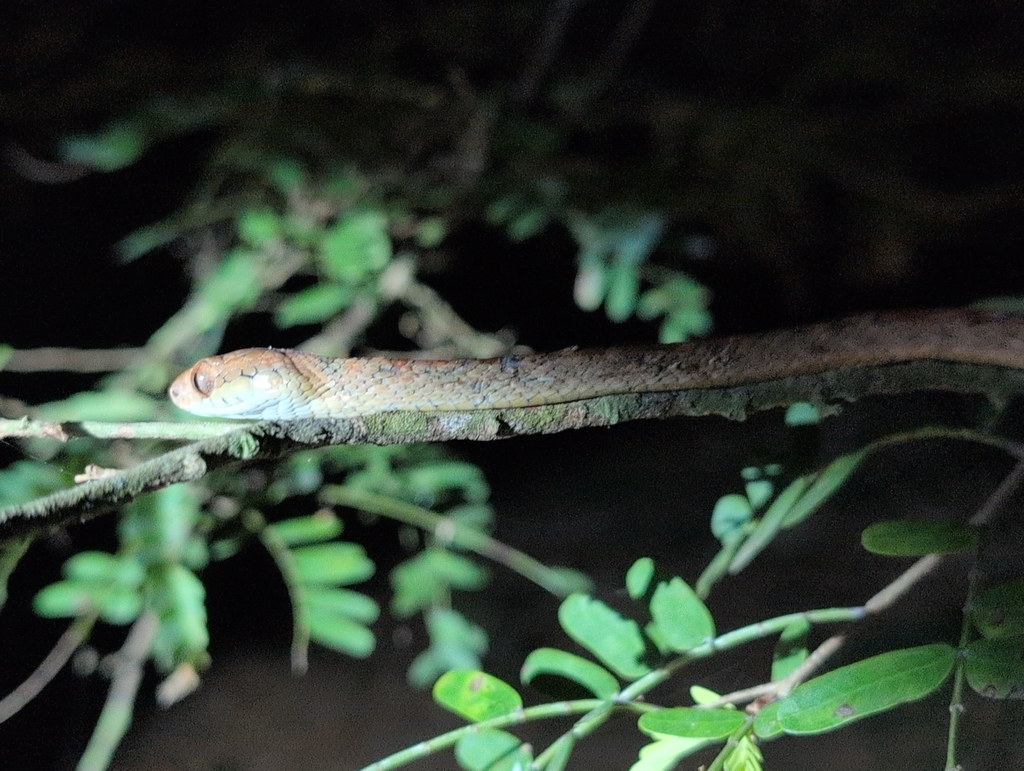
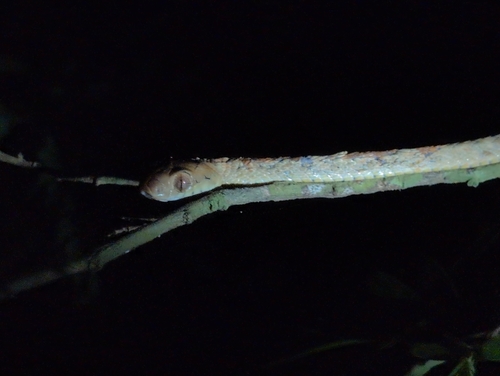
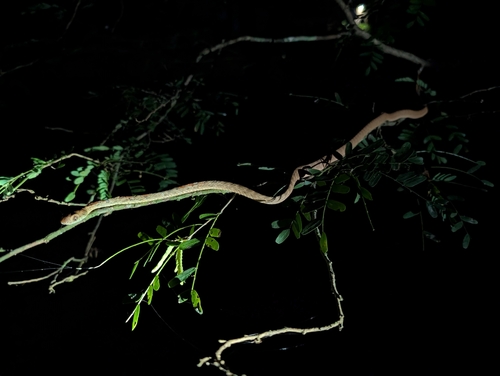
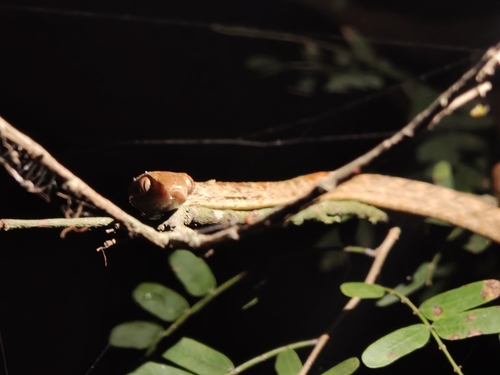
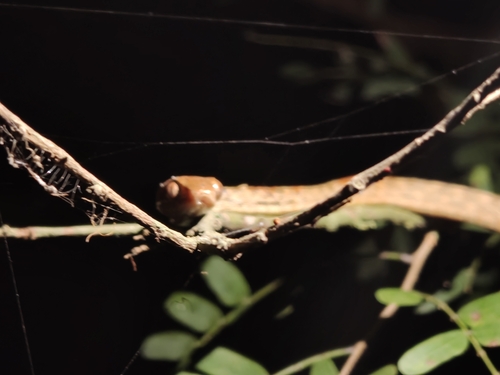
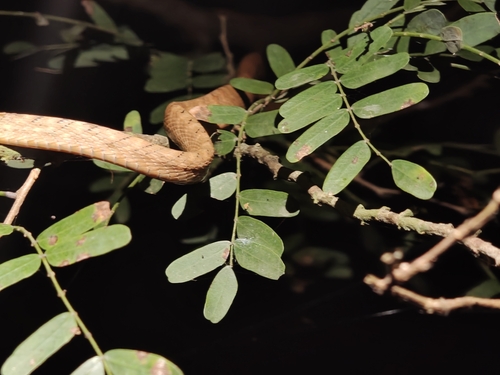
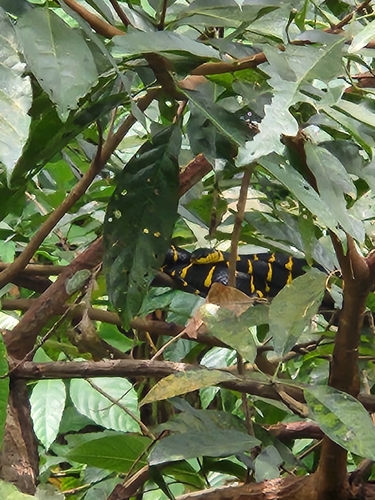
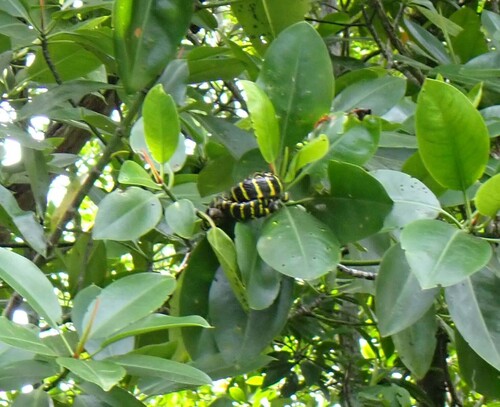
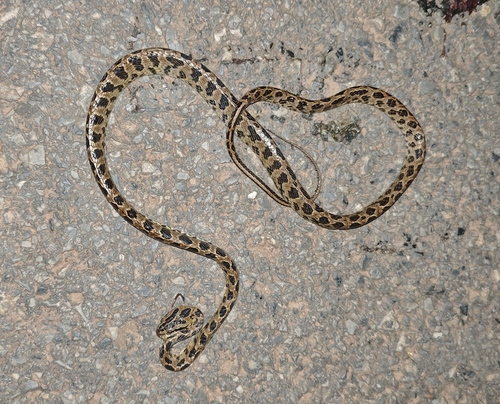
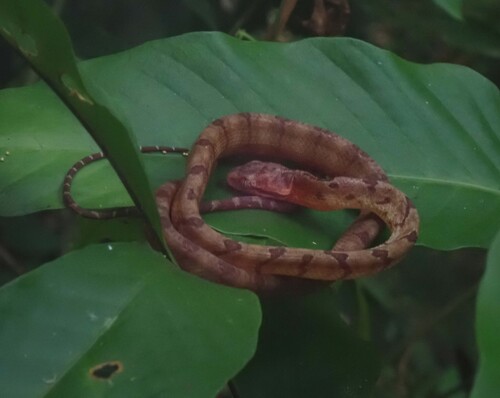
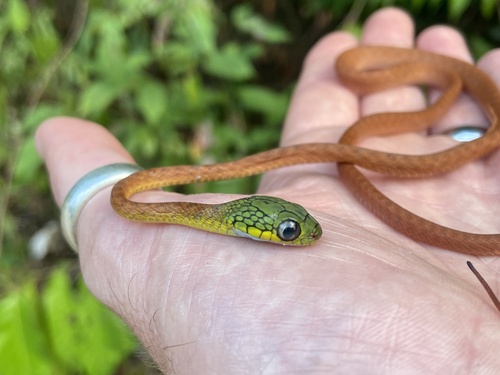
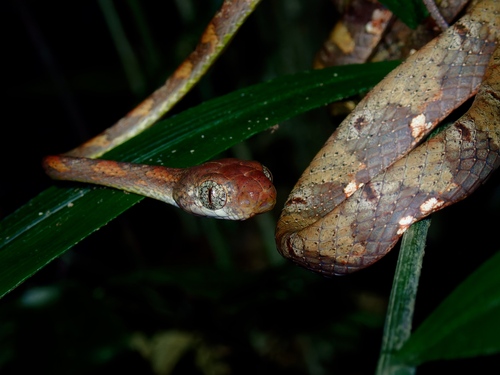
6 photographs of the Andaman Cat Snake. © T R Shankar Raman.
The Andaman Cat Snake (Boiga andamanensis) is a rear-fanged, mildly venomous snake in the Colubridae family, recorded in 1 country.
- Family
- Colubridae
About the Andaman Cat Snake
Boiga andamanensis, known commonly as the Andaman cat snake, is a species of rear-fanged snake in the family Colubridae. The species is endemic to the Andaman Islands.
Description
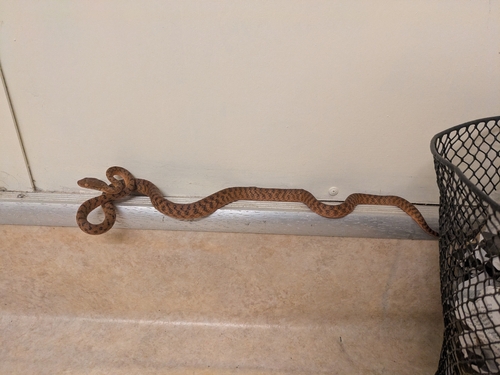
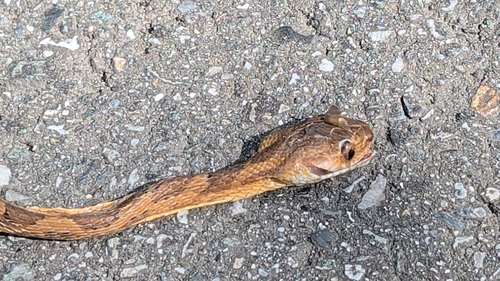
The body of B. andamanensis is long, thin, and laterally compressed, with smooth dorsal scales. The head is distinctly broader than the neck. The eye is large, and has a vertical pupil. The tail is long. Dorsally, the Andaman cat snake is pale reddish or greyish brown, uniform, or with a series of dark brown vertebral spots or thin cross-lines. There is dark colour usually on the scale edges. The markings are most distinct on the forebody. The top of the head has faint, dark brown or black lines. The upper lip scales are white, the last few with thin black rear edges. There is an indistinct black line from behind the eye to the angle of the mouth. The underside of the body is white or yellowish, usually with a series of black spots on each side. Juveniles and sub-adults are similarly patterned, and usually dark orange above, paler below. Most of the scales on the top of the head vary in shape and size, and are distinctly larger than the dorsal scales. The average adult total length (including tail) is approximately 0.85 metres (2.8 ft), but it may grow to a total length of 1.49 metres (4.9 ft).
Scalation
Dorsal scales in 21:21:15 oblique rows, smooth; vertebral scales distinctly enlarged. Ventrals 255–269, strongly angulate laterally; anal entire; subcaudals 118–133, paired. Loreal 1; preocular 1, reaches upper surface of head, often touches frontal; postoculars 2, rarely 3; temporals 3+3 or 3+4; supralabials 8 (3rd to 5th touching eye).
Geographic range
B. andamanensis is endemic to the Andaman islands of India.
Habitat
The Andaman cat snake is a forest species and is also frequently found in thatched roofs of houses.
Behaviour and ecology
B. andamanensis is nocturnal and arboreal. It is occasionally seen on the ground searching for prey. It generally has a mild disposition but has been observed to strike when approached. If provoked it will raise its forebody, coil into loops, often vibrating its tail, and bite readily. It is a rear-fanged snake and has a mild venom which can paralyze small prey. It preys mainly on geckos, other small lizards (especially lizards of the genus Calotes), and rodents, but will occasionally eat tree frogs and bats.
Adapted from Wikipedia, available under CC BY-SA.
Frequently asked: Andaman Cat Snake
- Is the Andaman Cat Snake venomous?
- The Andaman Cat Snake (Boiga andamanensis) is rear-fanged and only mildly venomous. It is not considered dangerous to humans (its venom is weak and its fangs sit at the back of the mouth) but a bite can cause local swelling or irritation, so it should not be handled.
- Is the Andaman Cat Snake poisonous?
- Snakes are venomous, not poisonous. "Poisonous" means harmful to eat or touch; "venomous" means injecting toxins through a bite. The Andaman Cat Snake is neither poisonous nor venomous.
- Is the Andaman Cat Snake dangerous?
- The Andaman Cat Snake is not dangerous to humans. It has no medically significant venom and bites only defensively if cornered or handled.
- Where does the Andaman Cat Snake live?
- The Andaman Cat Snake has verified records in 1 country, including India. See the distribution section below for its full range.
Where it is found
More Colubridae snakes
Classification
How scientists group this snake, from the broadest category down to the exact species. Each step narrows to its closest relatives.
- OrderThe broad group of scaled reptiles: all snakes and lizards
- Squamata
- FamilyA group of related snakes that share key traits
- Colubridae
- GenusA close-knit group of very similar species
- Boiga
- SpeciesThis exact snake, named in the two-part scientific name
- Boiga andamanensis
Keep learning
- What to Do If You Find a SnakeFound a snake at home or on a trail? Here is how to stay calm, give it space, identify it safely, and know when to call a professional.
- Venomous vs Nonvenomous: How to Tell the DifferenceThe folk rules for telling venomous snakes apart, where each one fails, and why location-based identification beats guessing by sight.
- What Is a Snake? Anatomy and the BasicsA clear overview of what makes a snake a snake: limbless body plan, anatomy, evolution from lizards, species diversity, and why they are ectothermic.
- How to Keep Snakes Out of Your Yard and HomeA practical guide to keeping snakes out of your yard and home using habitat changes that work, plus what to skip and what to do if one shows up.
Distribution from GBIF & iNaturalist. Venom status per CDC. Background: Wikipedia. Informational only. Never handle a snake to identify it.