
Regional field guide
Snakes in Minnesota
10+ snake species have verified records in Minnesota, including 1 venomous. Pick your county below to see exactly which snakes live near you.
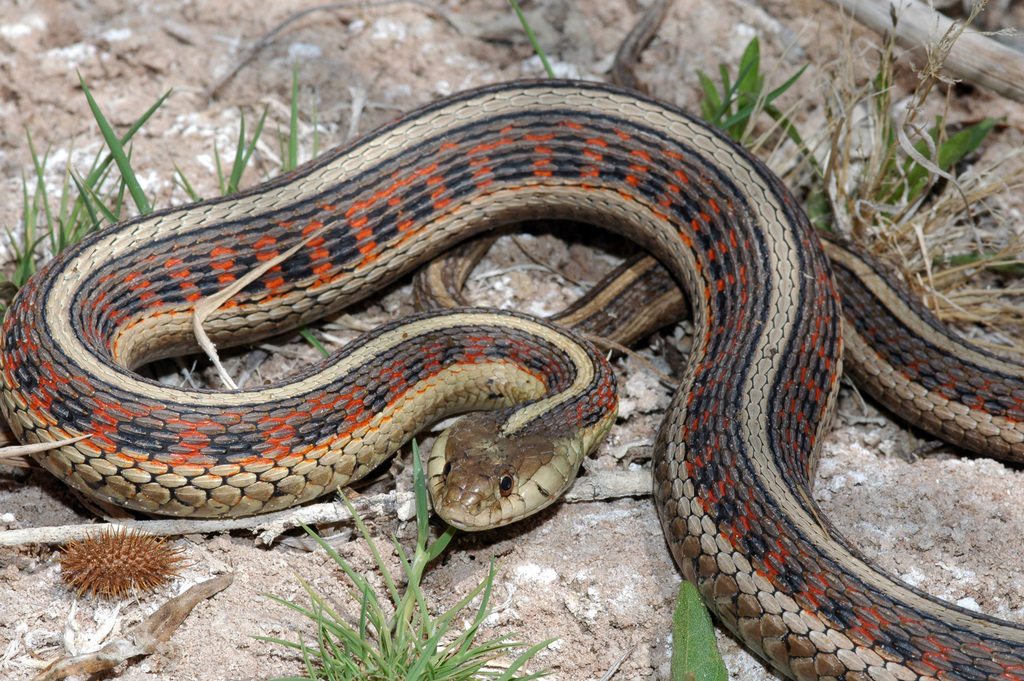
Snakes of Minnesota
Minnesota has about 20+ species of snakes, and only 1 of them is venomous. In practice that means nearly every snake you see in the state is harmless. Minnesota's cold winters keep snake numbers and active seasons modest, and the species that live here are mostly small, shy hunters of rodents, frogs, and insects.
The state's habitats run from the lake-and-bog north woods down to tallgrass prairie in the west and the rugged Driftless bluff country in the southeast. Snakes are most diverse in the warmer southern half, especially the Mississippi River corridor and the dry, rocky prairies and oak woodlands of the southeast. The far north, with its conifer forest and short summers, supports only a few hardy species.
Minnesota's single venomous species is the Timber Rattlesnake, found only in the bluff country of the southeast along the Mississippi and its tributaries. It lives on warm, south-facing rocky outcrops and wooded slopes, dens in rock crevices, and is now uncommon and protected. A timber rattlesnake is shy and would rather hide than confront a person, so encounters are rare and bites rarer still. The state once also had the massasauga, but it is considered gone from Minnesota.
Most snakes Minnesotans see are harmless. Common garter snakes are by far the most encountered, in gardens, fields, and along lakeshores. Bullsnakes (gophersnakes) on the western and southern prairies hiss loudly and rattle their tails to imitate a rattlesnake, and are too often killed for the act even though they are valuable rodent control. Plains hognose snakes flatten and bluff dramatically but are harmless. Bites are uncommon and rarely fatal thanks to antivenom, and most happen when people try to handle or kill a snake. Never assume a wild snake is safe to handle, and if a bite happens, call Poison Control at 1-800-222-1222 or 911.
Venomous snakes in Minnesota
Most commonly seen
- Common Garter SnakeCommonly seen
- Red-bellied SnakeCommonly seen
- Western FoxsnakeOften seen
- Plains Garter SnakeOften seen
- Gopher SnakeOften seen
- Eastern Hognose SnakeOften seen
- Common WatersnakeOften seen
- DeKay's BrownsnakeOften seen
- Eastern MilksnakeOften seen
- Plains Hognose SnakeOften seen
- Timber RattlesnakeOften seen
- Smooth GreensnakeOften seen
Counties in Minnesota
81 listed- Aitkin2
- Anoka8
- Becker2
- Beltrami2
- Benton2
- Big Stone3
- Blue Earth5
- Brown1
- Carlton4
- Carver3
- Cass3
- Chippewa3
- Chisago8
- Clay4
- Clearwater2
- Cook2
- Cottonwood4
- Crow Wing5
- Dakota11
- Dodge1
- Douglas2
- Faribault1
- Fillmore9
- Freeborn1
- Goodhue8
- Hennepin9
- Houston11
- Hubbard2
- Isanti4
- Itasca2
- Jackson3
- Kanabec2
- Kandiyohi2
- Kittson2
- Koochiching2
- Lac qui Parle3
- Lake3
- Lake Superior2
- Lake of the Woods2
- Le Sueur4
- Lincoln2
- Lyon2
- Mahnomen1
- Marshall2
- McLeod3
- Meeker2
- Mille Lacs4
- Morrison4
- Mower3
- Murray2
- Nicollet4
- Nobles1
- Norman2
- Olmsted8
- Otter Tail4
- Pine7
- Pipestone1
- Polk3
- Pope4
- Ramsey5
- Redwood3
- Renville3
- Rice6
- Rock3
- Saint Louis2
- Scott6
- Sherburne7
- Sibley1
- Stearns4
- Steele2
- Stevens2
- Swift2
- Todd1
- Wabasha8
- Wadena2
- Waseca1
- Washington8
- Watonwan1
- Winona10
- Wright5
- Yellow Medicine3
Snakes in Minnesota: FAQ
- Are there venomous snakes in Minnesota?
- Yes. 1 venomous snake species has verified records in Minnesota, including Timber Rattlesnake. Most snakes in Minnesota, however, are harmless.
- How many snake species live in Minnesota?
- 10+ snake species have verified records in Minnesota, of which 1 is venomous.
- What is the most commonly seen snake in Minnesota?
- The Common Garter Snake is the most frequently reported snake in Minnesota, based on verified wildlife observations.
- What should I do if I see a venomous snake in Minnesota?
- Keep your distance and do not try to catch or kill it. Most bites happen when people handle or corner a snake. If someone is bitten, contact local emergency services or poison control immediately.