
Regional field guide
Snakes in Georgia
50+ snake species have verified records in Georgia, including 7 venomous. Pick your county below to see exactly which snakes live near you.
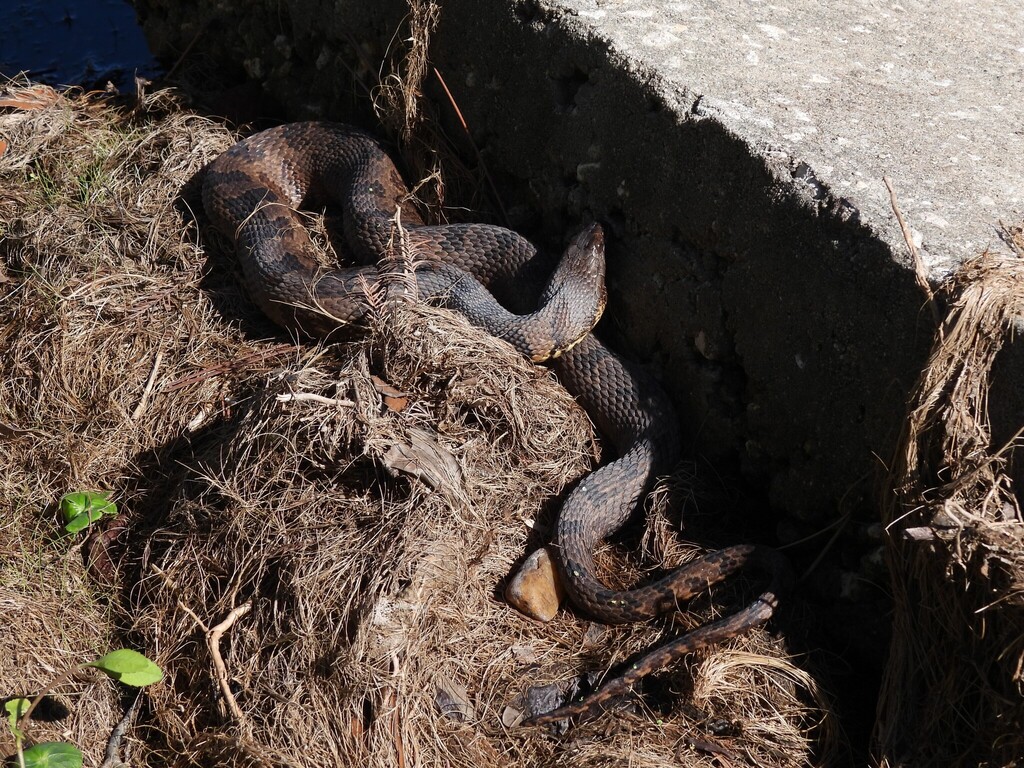
Snakes of Georgia
Georgia is home to roughly 50+ snake species, and only 7 of them are venomous. That ratio is worth remembering: the large majority of Georgia's snakes pose no threat and quietly help control rodents and other pests. The state spans several distinct regions, and each adds species, which is why Georgia's snake list is one of the longest in the Southeast.
The habitat range explains the diversity. The Blue Ridge mountains and Piedmont in the north hold forest species adapted to rocky slopes and cooler woods, while the coastal plain to the south is dominated by pine flatwoods, longleaf forests, and sandy uplands. The Okefenokee Swamp, river bottoms, and coastal marshes provide the wet habitats that water snakes and cottonmouths depend on. Moving from the mountains to the coast, you pass through a sequence of snake communities packed into a single state.
Georgia's venomous snakes sort into a few plain groups. The Eastern Copperhead and the cottonmouths (Northern and Florida) are pit vipers found in woods and near water, with the cottonmouths concentrated in swamps and along the coastal plain. The rattlesnakes include the Eastern Diamondback of the southern pinelands, the Timber Rattlesnake of the mountains and forests, and the small Pygmy Rattlesnake. The Eastern Coralsnake is a banded elapid that stays hidden in leaf litter and is rarely seen. The familiar red, yellow, and black color rhymes only roughly apply in the US and should never be your method for identifying a snake.
The snakes Georgians encounter most are harmless. Black racers and rat snakes are common around homes and fields, kingsnakes earn their keep by eating other snakes, and garter snakes are a garden regular. Brown watersnakes and banded watersnakes share ponds and rivers with cottonmouths and are frequently killed by mistake. On safety: most bites occur when someone tries to handle or kill a snake, and fatalities are very rare because of antivenom and good medical care. Do not treat any wild snake as safe to handle, and if a bite occurs, call Poison Control at 1-800-222-1222 or 911.
Venomous snakes in Georgia
- Eastern CopperheadAgkistrodon contortrix Venomous
- Timber RattlesnakeCrotalus horridus Venomous
- Northern CottonmouthAgkistrodon piscivorus Venomous
- Eastern Diamondback RattlesnakeCrotalus adamanteus Venomous
- Pygmy RattlesnakeSistrurus miliarius Venomous
- Florida CottonmouthAgkistrodon conanti Venomous
- Eastern CoralsnakeMicrurus fulvius Venomous
Most commonly seen
- Brown WatersnakeCommonly seen
- DeKay's BrownsnakeCommonly seen
- Common WatersnakeCommonly seen
- Ring-necked SnakeCommonly seen
- North American RacerCommonly seen
- Common Garter SnakeCommonly seen
- Eastern CopperheadCommonly seen
- Eastern RatsnakeCommonly seen
- Eastern KingsnakeCommonly seen
- Gray RatsnakeCommonly seen
- Timber RattlesnakeCommonly seen
- Red-bellied SnakeCommonly seen
Counties in Georgia
154 listed- Appling8
- Atkinson2
- Bacon2
- Baker23
- Baldwin21
- Banks11
- Barrow9
- Bartow20
- Ben Hill2
- Berrien17
- Bibb21
- Bleckley3
- Brantley7
- Brooks7
- Bryan23
- Bulloch18
- Burke21
- Butts7
- Calhoun5
- Camden20
- Candler8
- Carroll17
- Catoosa12
- Charlton30
- Chatham27
- Chattahoochee13
- Chattooga7
- Cherokee19
- Clarke19
- Clay2
- Clayton12
- Clinch17
- Cobb19
- Coffee14
- Colquitt13
- Columbia17
- Cook12
- Coweta18
- Crawford2
- Crisp13
- Dade14
- Dawson14
- DeKalb16
- Decatur12
- Dodge4
- Dooly3
- Dougherty11
- Douglas18
- Early10
- Echols7
- Effingham15
- Elbert3
- Emanuel14
- Evans5
- Fannin13
- Fayette16
- Floyd21
- Forsyth15
- Franklin4
- Fulton20
- Gilmer13
- Glynn25
- Gordon13
- Grady10
- Greene13
- Gwinnett16
- Habersham10
- Hall18
- Hancock2
- Haralson3
- Harris17
- Hart2
- Heard5
- Henry13
- Houston10
- Irwin6
- Jackson12
- Jasper10
- Jeff Davis5
- Jefferson7
- Jenkins10
- Jones13
- Lamar10
- Lanier7
- Laurens7
- Lee12
- Liberty22
- Lincoln6
- Long22
- Lowndes13
- Lumpkin16
- Macon5
- Madison10
- Marion12
- McDuffie4
- McIntosh23
- Meriwether8
- Miller3
- Mitchell4
- Monroe7
- Montgomery5
- Morgan7
- Murray16
- Muscogee19
- Newton11
- Oconee13
- Oglethorpe14
- Paulding15
- Peach1
- Pickens15
- Pierce3
- Pike2
- Polk7
- Pulaski4
- Putnam11
- Quitman1
- Rabun18
- Richmond24
- Rockdale12
- Schley1
- Screven14
- Seminole1
- Spalding4
- Stephens8
- Stewart8
- Sumter11
- Talbot11
- Tattnall16
- Taylor12
- Telfair18
- Terrell4
- Thomas14
- Tift13
- Toombs9
- Towns8
- Treutlen1
- Troup9
- Turner1
- Twiggs10
- Union16
- Upson2
- Walker17
- Walton10
- Ware22
- Warren2
- Washington4
- Wayne19
- Wheeler9
- White14
- Whitfield11
- Wilcox3
- Wilkes3
- Wilkinson6
- Worth7
Snakes in Georgia: FAQ
- Are there venomous snakes in Georgia?
- Yes. 7 venomous snake species have verified records in Georgia, including Eastern Copperhead, Timber Rattlesnake, Northern Cottonmouth, Eastern Diamondback Rattlesnake. Most snakes in Georgia, however, are harmless.
- How many snake species live in Georgia?
- 50+ snake species have verified records in Georgia, of which 7 are venomous.
- What is the most commonly seen snake in Georgia?
- The Brown Watersnake is the most frequently reported snake in Georgia, based on verified wildlife observations.
- What should I do if I see a venomous snake in Georgia?
- Keep your distance and do not try to catch or kill it. Most bites happen when people handle or corner a snake. If someone is bitten, contact local emergency services or poison control immediately.