
Colubridae
Sawtooth-necked Bronzeback
HarmlessDendrelaphis nigroserratus

The Sawtooth-necked Bronzeback (Dendrelaphis nigroserratus) is a non-venomous snake in the Colubridae family, recorded in 1 country.
- Family
- Colubridae
About the Sawtooth-necked Bronzeback
Dendrelaphis nigroserratus (common name: sawtooth-necked bronzeback) is a species of snakes belonging to the bronzebacks (Dendrelaphis). It is found only in western and southwestern Thailand and the adjacent southeastern Myanmar. A specimen has been preserved in the British Natural History Museum, London since the early 20th century. Due to its resemblance to Wall's bronzeback, the scientific name was formerly assigned under Dendrelaphis cyanochloris, the species name for Wall's bronzeback. It was formally described as a distinct species in 2012 by Gernot Vogel, Johan Van Rooijen and Sjon Hauser. According to the World Wide Fund for Nature report, it became one of the 367 important new species discovered in the Greater Mekong during 2012 and 2013.
Analayses show its significant differences from the typical Wall's bronzeback, including colouration and scales on the neck. Its most distinctive feature is the presence of sawtooth-shaped scales on the back of its neck. This feature is unique among the bronzeback species, and the reason for its common name. In general, they are also larger, the largest specimen measuring 1.63 m in length.
It is classified as "Least Concern" under the IUCN Red List of Threatened Species of 2014.
Description
Dendrelaphis nigroserratus is relatively large species among the bronzeback snakes. The holotype (QSMI 1282) is a juvenile female collected by Sjon Hauser in 2011 from Umphang District in Tak Province. It is 42.8 cm long, and its tail is 13.5 cm long, which is 31.5% of the total body length. Its eyes are conspicuous measuring 0.4 cm in diameter. The largest specimen is a dead female found on the road in Umphang District, and measures 1.63 m long. On average it is much longer than the closely related species such as Dendrelaphis cyanochloris and Dendrelaphis striatus. The general body colour is olive-brown. The head and back are greenish bronze, and the belly is yellowish or greyish green. It can be distinguished from other species from its thick black stripe behind the eye. The broad black streak is relatively broad on the head and runs from behind the eyes, continues as a broad bar on the neck where it breaks up incompletely. This splitting gives rise to a saw-toothed pattern, the reason for its common name as well as its specific epithet, nigroserratus (a Latin niger for "black", and serrare meaning "to saw"). Slightly posterior to this point, it splits completely into broad oblique bars that gradually disappear. This colour pattern in not seen in another species. It is a carnivore and is known to feed on frogs.
Discovery
The first specimen collected was from Myeik (then Mergui) in Myanmar (then Burma) in the early 20th century. It was preserved in the Natural History Museum, London. It was regarded as member of the species Dendrelaphis cyanochloris (Wall's bronzeback) because of their fundamental similarities, including similar habitats. A systematic study in 2003 supported this identification. However, the common sawtooth-necked bronzeback has slight differences from the typical Wall's bronzeback. This distinction was analysed by Gernot Vogel of the Society for Southeast Asian Herpetology in Germany, Johan Van Rooijen of Netherlands Centre for Biodiversity Naturalis, and Sjon Hauser. They published their findings in 2012 in Zootaxa, reclassifying the snake as a new species. The holotype is deposited and maintained at the Queen Saovabha Memorial Institute (Bangkok Snake Farm on Rama IV Road) in Bangkok, Thailand.
Distribution
Adapted from Wikipedia, available under CC BY-SA.
Frequently asked: Sawtooth-necked Bronzeback
- Is the Sawtooth-necked Bronzeback venomous?
- No. The Sawtooth-necked Bronzeback (Dendrelaphis nigroserratus) is non-venomous and is not considered dangerous to humans. Like most snakes, it will retreat rather than bite when given the chance.
- Is the Sawtooth-necked Bronzeback poisonous?
- Snakes are venomous, not poisonous. "Poisonous" means harmful to eat or touch; "venomous" means injecting toxins through a bite. The Sawtooth-necked Bronzeback is neither poisonous nor venomous.
- Is the Sawtooth-necked Bronzeback dangerous?
- The Sawtooth-necked Bronzeback is not dangerous to humans. It has no medically significant venom and bites only defensively if cornered or handled.
- Where does the Sawtooth-necked Bronzeback live?
- The Sawtooth-necked Bronzeback has verified records in 1 country, including Thailand. See the distribution section below for its full range.
Where it is found
More Colubridae snakes
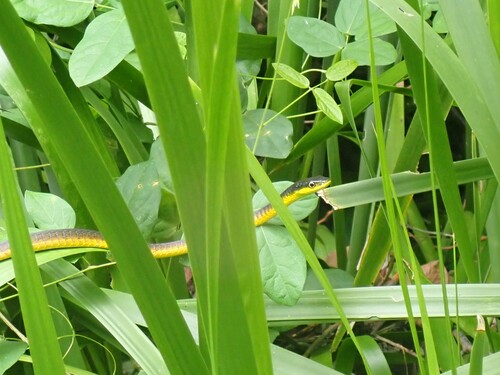 Common Tree SnakeDendrelaphis punctulatus
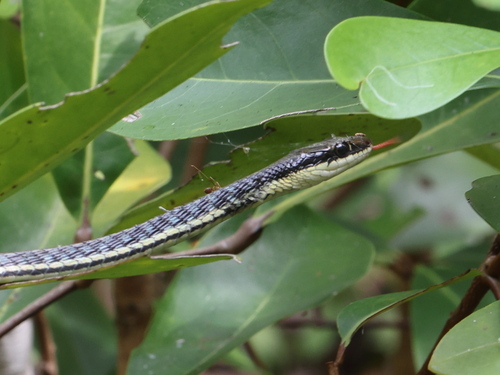 Painted BronzebackDendrelaphis pictus
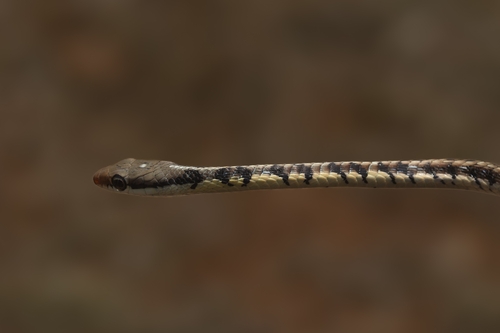 Common Bronzeback Tree SnakeDendrelaphis tristis
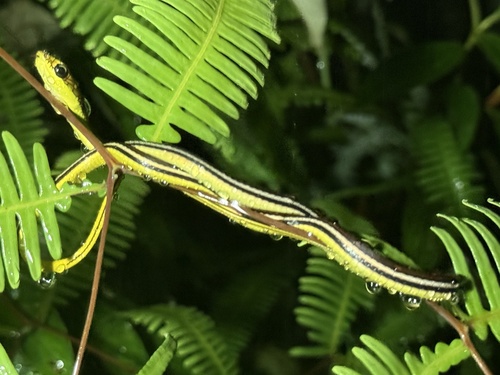 Striped BronzebackDendrelaphis caudolineatus
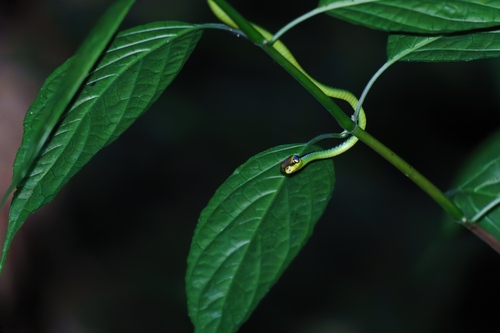 Elegant BronzebackDendrelaphis formosus
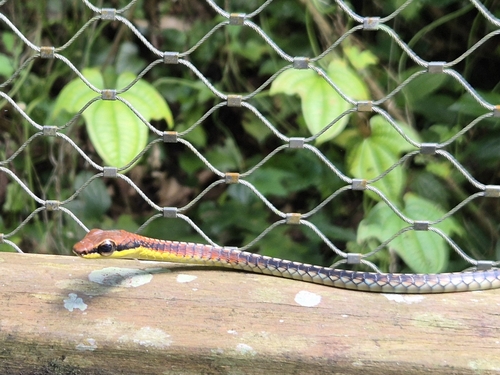 Kopstein's BronzebackDendrelaphis kopsteini
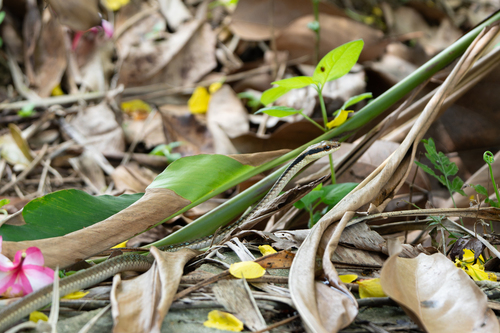 Vietnamese BronzebackDendrelaphis ngansonensis
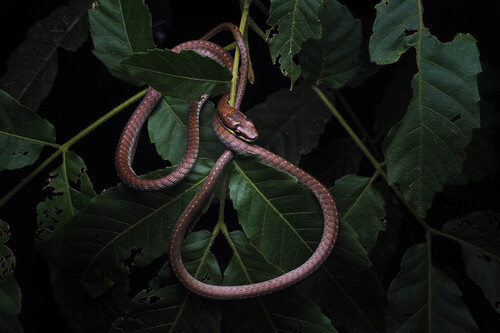 Northern Tree SnakeDendrelaphis calligaster
Classification
How scientists group this snake, from the broadest category down to the exact species. Each step narrows to its closest relatives.
- OrderThe broad group of scaled reptiles: all snakes and lizards
- Squamata
- FamilyA group of related snakes that share key traits
- Colubridae
- GenusA close-knit group of very similar species
- Dendrelaphis
- SpeciesThis exact snake, named in the two-part scientific name
- Dendrelaphis nigroserratus
Keep learning
- What to Do If You Find a SnakeFound a snake at home or on a trail? Here is how to stay calm, give it space, identify it safely, and know when to call a professional.
- Venomous vs Nonvenomous: How to Tell the DifferenceThe folk rules for telling venomous snakes apart, where each one fails, and why location-based identification beats guessing by sight.
- What Is a Snake? Anatomy and the BasicsA clear overview of what makes a snake a snake: limbless body plan, anatomy, evolution from lizards, species diversity, and why they are ectothermic.
- How to Keep Snakes Out of Your Yard and HomeA practical guide to keeping snakes out of your yard and home using habitat changes that work, plus what to skip and what to do if one shows up.
Distribution from GBIF & iNaturalist. Venom status per CDC. Background: Wikipedia. Informational only. Never handle a snake to identify it.