
Rattlesnake
Santa Catalina Island Rattlesnake
VenomousCrotalus catalinensis

The Santa Catalina Island Rattlesnake (Crotalus catalinensis) is a venomous snake in the Viperidae family, recorded in 1 country.
If you are bitten
Rattlesnake bites are medically serious. Expect intense pain, rapid swelling, and bruising. Stay calm, keep the bitten limb still and roughly level with the heart, remove rings and tight clothing, and get to an emergency room immediately. Do NOT apply a tourniquet, cut the wound, apply ice, or try to suck out venom. Call Poison Control at 1-800-222-1222 or 911 in the US, or your local emergency number. (Source: CDC.)
- Also called
- Rattlesnake
- Family
- Viperidae
- Size
- Typically 2–5 ft; some species exceed 6 ft.
- Habitat
- Deserts, rocky outcrops, grasslands, and woodland edges, depending on species.
- Behavior
- Ambush predators that buzz the tail as a warning; mostly active in warm months and often crepuscular in summer heat.
- Identify
- Heavy body, broad triangular head, vertical (cat-like) pupils, and a segmented keratin rattle at the tail tip.
- Danger
- high
About the Santa Catalina Island Rattlesnake
The Santa Catalina rattlesnake (Crotalus catalinensis) is a species of pit viper endemic to Isla Santa Catalina in the Gulf of California just off the east coast of the state of Baja California Sur, Mexico. Like all other pit vipers, it is venomous. No subspecies are currently recognized. A relatively small and slender species, its most distinctive characteristic is that it lacks a rattle. They are also a generally nocturnal species. Though the species is classified as Critically Endangered on the IUCN Red List, there are few efforts for the snake's conservation.
Description
This species is relatively slender and stunted, growing to a maximum of 73.1 cm (2 ft 4.8 in) in length.
The most distinctive feature of this snake is its lack of a rattle. The base of the tail, the "button", has degenerated to such an extent that the rattle immediately falls off with each shed instead of forming a new segment, as it does in other species of rattlesnakes. This is widely believed to be a localized adaptation, as the rattle becomes a liability rather than an asset while hunting. The lack of any large predators or hoofed mammals in its natural locale has also played a factor in making the rattle redundant. It appears that Crotalus catalinensis may not be alone in feeling these selective pressures, as red diamond rattlesnakes on the island of San Lorenzo Sur and San Esteban island black-tailed rattlesnakes also appear to be losing their rattles. Notably, it appears that this phenomenon is confined to populations limited to islands in the Gulf of California.
Natural selection has also given this snake a more elongated body than featured in related mainland forms, and measurably longer teeth; These are both characteristics associated with snakes that hunt in trees and shrubs such as this species. This species also lacks the standard bite-and-release tactic employed by usual rattlesnakes, preferring to instead hold prey in its jaws until the venom can take effect. In this way, it avoids the possibility that prey might fall out or fly away prior to succumbing.
Of the two distinct color variations, the predominant variant has a light cream-colored base, with reddish-brown blotching down the back, and black and white banding around the tail. The other variant has a much lighter, ash gray color, with darker gray blotching. The banding around the tail is still present. The banding tapers off and becomes more obscure. The two different colors were originally thought to be due to natural selection and therefore match different habitat backgrounds, but that has not been supported. There is no difference between the brown and grey within the habitat, as well as no difference in the frequency of color between males and females. However, evidence suggests that the darker coloration on the snakes make them more easily adaptable because of their ability to bask and absorb more heat. This causes their metabolism to speed up which provides them with faster digestion that helps increase strength and physical conditions. Due to these factors, the darker colored snakes have greater reproductive success than the lighter colored snakes. Though the dark snakes have these advantages, their coloration comes at a cost because they are more easily spotted by predators than the sand colored snakes.
Geographic range
Adapted from Wikipedia, available under CC BY-SA.
Local and regional names
The Santa Catalina Island Rattlesnake is known by these names across the regions where it lives:
- Chinese
- 聖卡特里納島響尾蛇
- Czech
- chřestýš zamlklý
- Danish
- Santa Catalina-klapperslange
- English
- Catalina Island Rattlesnake
- German
- Santa-Catalina-Klapperschlange
- Italian
- Crotalo dell'isola di Santa Catalina, Crotalo di Santa Catalina, Serpente a sonagli dell'isola di Santa Catalina, Serpente a sonagli di Santa Catalina
- Polish
- grzechotnik kataliński
- Portuguese
- Cascavel-de-Santa-Catalina
- Spanish
- Cascabel de Santa Catalina, Cascabel de la isla Santa Catalina, Víbora-cascabel muda, víbora cascabel muda
Frequently asked: Santa Catalina Island Rattlesnake
- Is the Santa Catalina Island Rattlesnake venomous?
- Yes. The Santa Catalina Island Rattlesnake (Crotalus catalinensis) is venomous and belongs to the Viperidae family (rattlesnake). Its bite is considered high risk to people. Treat any bite as a medical emergency.
- Is the Santa Catalina Island Rattlesnake poisonous?
- Snakes are venomous, not poisonous. "Poisonous" means harmful to eat or touch; "venomous" means injecting toxins through a bite. The Santa Catalina Island Rattlesnake is venomous, delivering venom through a bite.
- Is the Santa Catalina Island Rattlesnake dangerous?
- Rattlesnake bites are medically serious. Expect intense pain, rapid swelling, and bruising. Stay calm, keep the bitten limb still and roughly level with the heart, remove rings and tight clothing, and get to an emergency room immediately. Do NOT apply a tourniquet, cut the wound, apply ice, or try to suck out venom. Call Poison Control at 1-800-222-1222 or 911 in the US, or your local emergency number. (Source: CDC.)
- Where does the Santa Catalina Island Rattlesnake live?
- The Santa Catalina Island Rattlesnake has verified records in 1 country, including Mexico. See the distribution section below for its full range.
- How do I identify the Santa Catalina Island Rattlesnake?
- Heavy body, broad triangular head, vertical (cat-like) pupils, and a segmented keratin rattle at the tail tip.
- How big does the Santa Catalina Island Rattlesnake get?
- Typically 2–5 ft; some species exceed 6 ft.
- What does the Santa Catalina Island Rattlesnake eat?
- Previous theories suggested the tendency for this rattlesnake to climb into low bushes was connected to a dietary shift toward consuming birds. However, studies conducted from 2002 to 2004 revealed that stomach and fecal contents were 70% mammal (Santa Catalina deer mouse, Peromyscus slevini) and 30% lizard species (Santa Catalina desert iguana, Dipsosaurus catali
If you are bitten by the Santa Catalina Island Rattlesnake
Do
- Get away from the snake and stay calm. Most bites worsen when people panic or try again to handle the snake.
- Call 911 or Poison Control (1-800-222-1222) right away. Antivenom works best when given early.
- Note the time of the bite and, from a safe distance, the snake's color and pattern, a phone photo is enough. Do not chase it.
- Keep the bitten limb still and at roughly heart level. Sit or lie down and limit movement.
- Remove rings, watches, and tight clothing near the bite before swelling starts.
- Gently wash the bite with soap and water and cover it with a clean, dry dressing.
Do not
- Do not cut the wound or try to suck out the venom.
- Do not apply a tourniquet or ice.
- Do not drink alcohol or caffeine.
- Do not take aspirin or ibuprofen, they can worsen bleeding. Acetaminophen is safer for pain.
- Do not try to catch or kill the snake. A dead snake can still bite by reflex.
First-aid guidance adapted from the U.S. Centers for Disease Control and Prevention (CDC NIOSH), Venomous Snakes. Educational only; always follow the instructions of emergency responders.
Where it is found
More Viperidae snakes
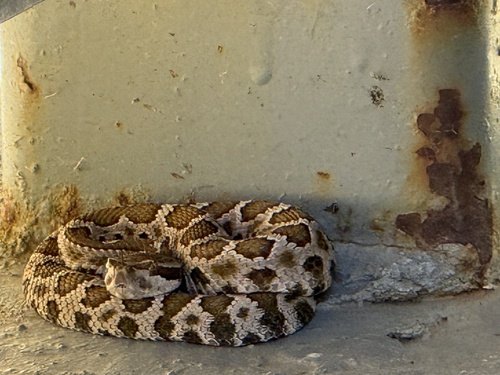 Western RattlesnakeCrotalus oreganus
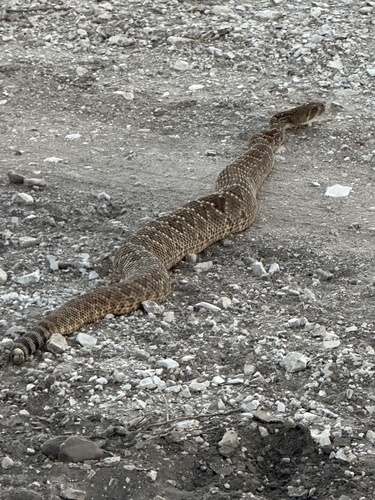 Western Diamond-backed RattlesnakeCrotalus atrox
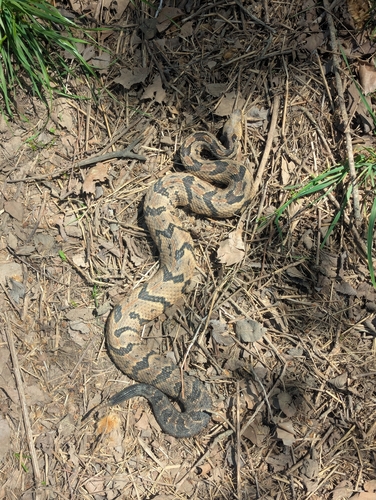 Timber RattlesnakeCrotalus horridus
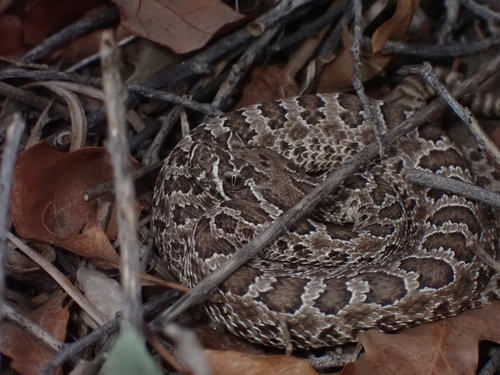 Prairie RattlesnakeCrotalus viridis
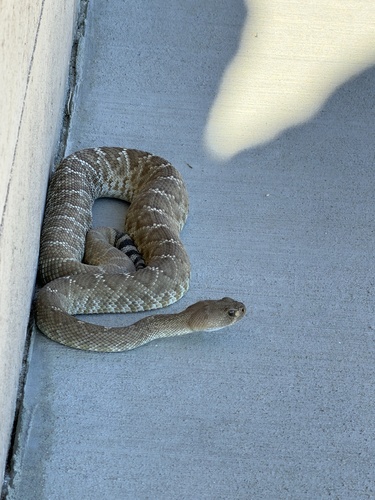 Red Diamond RattlesnakeCrotalus ruber
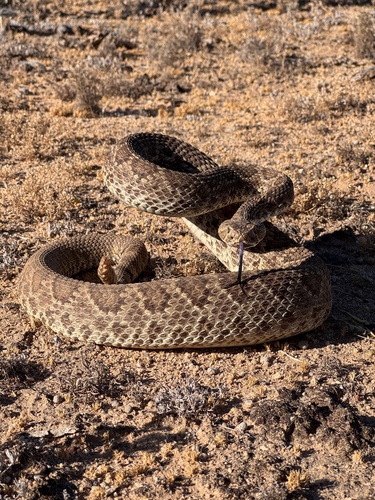 Mojave RattlesnakeCrotalus scutulatus
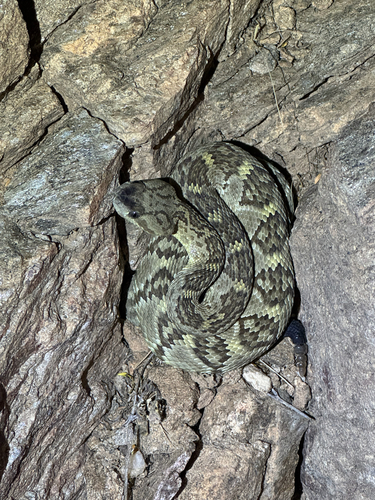 Western Black-tailed RattlesnakeCrotalus molossus
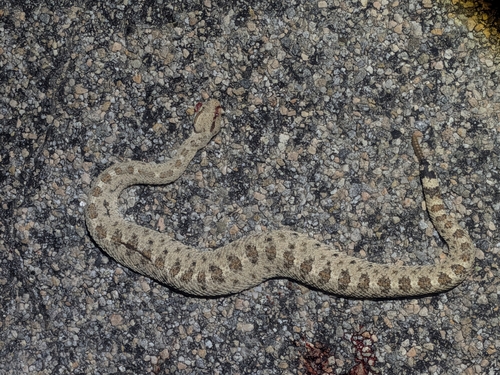 SidewinderCrotalus cerastes
Classification
How scientists group this snake, from the broadest category down to the exact species. Each step narrows to its closest relatives.
Keep learning
- Are Snakes Dangerous? The Real Risk, in PerspectiveMost snakes are harmless and avoid people. Here is the honest picture of snakebite risk worldwide and how to lower your own.
- Snakebite First Aid: What to Do (and What Never to Do)A clear, CDC-based guide to snakebite first aid: the steps that help, the popular myths that hurt, and how to tell a serious bite from a minor one.
- Venomous vs Nonvenomous: How to Tell the DifferenceThe folk rules for telling venomous snakes apart, where each one fails, and why location-based identification beats guessing by sight.
- What to Do If You Find a SnakeFound a snake at home or on a trail? Here is how to stay calm, give it space, identify it safely, and know when to call a professional.
Distribution from GBIF & iNaturalist. Venom status per CDC. Background: Wikipedia. Informational only. Never handle a snake to identify it.