
Genus · Boidae
Types of boas
9 species make up the genus Corallus, the snakes commonly called boas. None are considered dangerous to humans.
About Neotropical tree boas
Corallus are slender, big-eyed, nocturnal tree boas of Central and South America, harmless to people but armed with the longest teeth of any nonvenomous snake.
Corallus is a genus of boas, family Boidae, the same family as the anacondas and the common boa. Like all boas, these are nonvenomous constrictors that give live birth rather than laying eggs. What sets Corallus apart is a fully arboreal lifestyle: every species in the genus is built for living in trees. The genus is purely Neotropical, found from southern Central America down through the Amazon Basin and into the Atlantic Forest, with several species spread across Caribbean and continental island systems.
These are some of the most distinctive tree snakes in the New World. They have laterally compressed bodies that help them balance on branches, strongly prehensile tails for anchoring while they hang out to ambush prey, and large heads that are clearly set off from a narrow neck. Their eyes are big with vertical pupils, a classic signature of a night hunter. Members of the genus range widely in size, with most adults falling roughly between four and seven feet, though the heaviest-bodied species like the emerald tree boa can be stout and powerful for their length.
Color and pattern vary a great deal across the genus and even within a single species. Some, like the Amazon Basin emerald tree boa, are vivid green with a white dorsal pattern as adults. Others, such as the garden tree boa, come in an enormous range of browns, oranges, reds, and grays. A reliable way to recognize Corallus in general terms is the combination of features rather than any one color: a deep slender body, a wedge-shaped head with deep heat-sensing pits along the lips, large forward eyes, and a long grasping tail, usually found draped in vegetation at night.
Corallus are not venomous and are not rear-fanged. They kill by constriction. That said, they are famous among snake handlers for having proportionally enormous front teeth, an adaptation for striking and holding birds and bats in midair from a branch. A defensive bite from a large tree boa can be painful and can draw blood, and a wild snake should never be handled or provoked. They are best observed and left alone. Any serious bite, infection, or allergic reaction should be treated by contacting local emergency services, and in the United States Poison Control at 1-800-222-1222 can advise.
Ecologically these are sit-and-wait ambush predators. They spend the day coiled in cover and become active after dark, using their heat-sensing pits to detect warm-bodied prey such as birds, bats, rodents, lizards, and frogs, with diet shifting as the snake grows. Reproduction is live-bearing, with females giving birth to litters of well-developed young that are independent at birth and immediately arboreal. Behavior is generally secretive and slow-moving by day, with most hunting and movement happening at night.
Corallus belongs to the Boidae family (Boas). Powerful non-venomous constrictors that give birth to live young. Heavy body, smooth scales, and (in many species) heat-sensing pits along the lips. No rattle and no fangs.
Danger: Non-venomous and not dangerous to people. Large individuals are strong and can bite defensively, but they are not a venom threat.
All species (9)
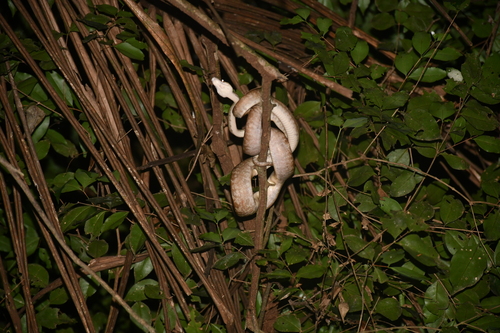 Garden Tree BoaCorallus hortulanaHarmless
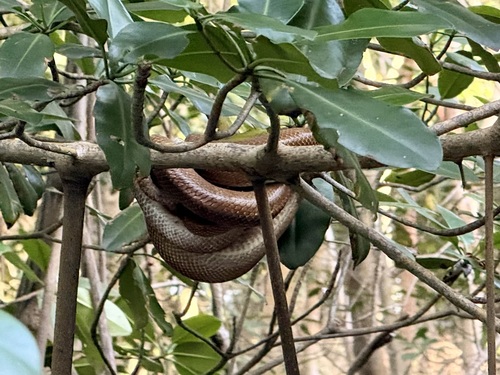 DormilonaCorallus ruschenbergeriiHarmless
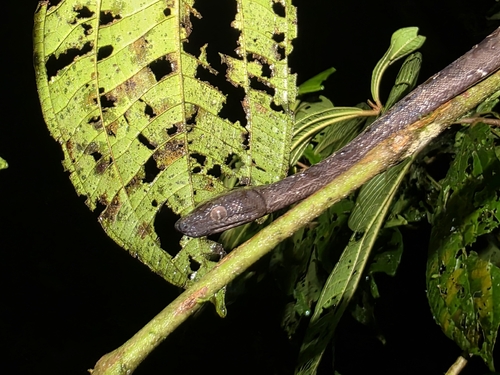 Ringed Tree BoaCorallus annulatusHarmless
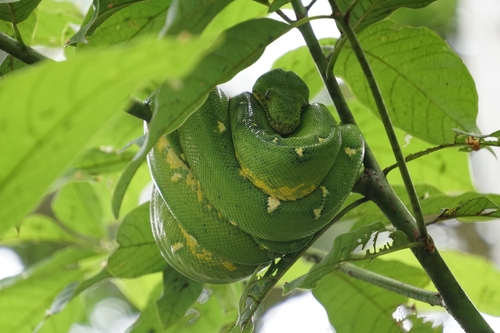 Amazon Basin Emerald Tree BoaCorallus batesiiHarmless
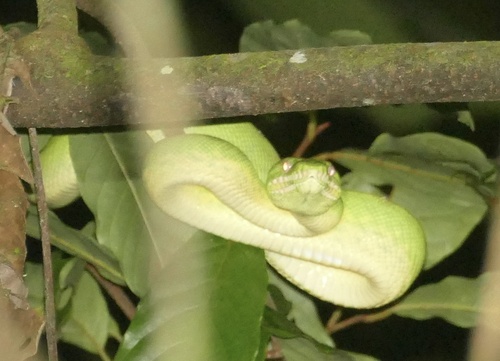 Emerald Tree BoaCorallus caninusHarmless
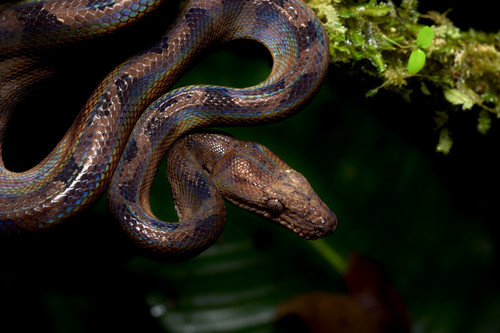 Ecuadorian Annulated Tree BoaCorallus blombergiHarmless
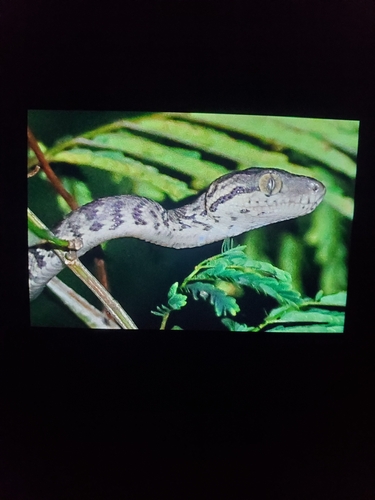 Grenada Bank BoaCorallus grenadensisHarmless
 Cook's Tree BoaCorallus cookiiHarmless
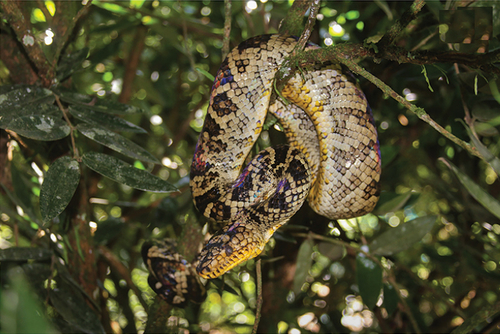 Cropan's BoaCorallus cropaniiHarmless
Keep learning
- What Is a Snake? Anatomy and the BasicsA clear overview of what makes a snake a snake: limbless body plan, anatomy, evolution from lizards, species diversity, and why they are ectothermic.
- How Snakes Move, Hunt, and EatHow snakes move without legs, hunt as ambushers or active foragers, kill by constriction or venom, and swallow prey wider than their head.
- What Do Snakes Eat?All snakes are carnivores. Learn what snakes eat, how diet changes with size and age, how often they feed, and how they hunt and swallow prey.
- Venomous vs Nonvenomous: How to Tell the DifferenceThe folk rules for telling venomous snakes apart, where each one fails, and why location-based identification beats guessing by sight.