
Genus · Boidae
Types of constrictors
5 species make up the genus Boa, the snakes commonly called constrictors. None are considered dangerous to humans.
About boa constrictors
Boa is the genus of true boa constrictors, large non-venomous snakes of the New World that kill prey by coiling and squeezing rather than by venom. Our database lists 5 species, none of them venomous.
Boa belongs to the family Boidae and is the namesake of the boa constrictors. The defining trait of the genus is the way it subdues prey: the snake seizes an animal, throws coils of its body around it, and tightens with each breath the prey takes until circulation stops. There is no venom involved at any stage. The flagship species, Boa constrictor, is one of the few snakes whose common name is also its scientific name, and the word constrictor in that name points straight at how the whole genus makes a living.
A key piece of boa biology sets the genus apart from the pythons it is often confused with. Pythons lay eggs, but boas give live birth. The female carries developing young inside her body and delivers fully formed neonates rather than depositing a clutch to incubate. This live-bearing strategy, which lets the mother regulate the warmth of her developing young by moving in and out of the sun, is one of the clearest dividing lines between the New World boas and the Old World pythons.
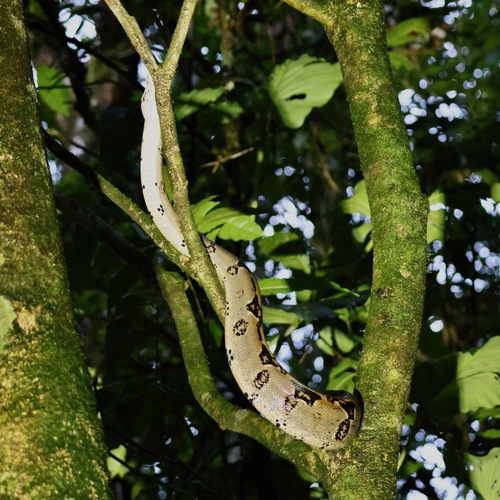
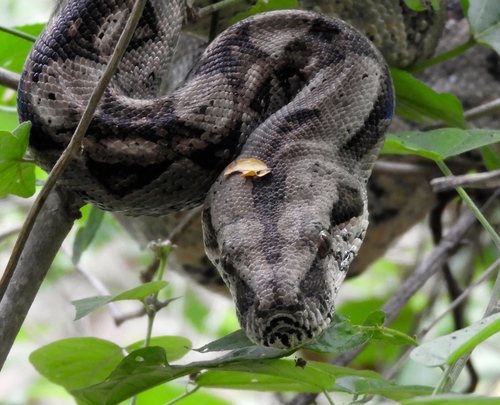
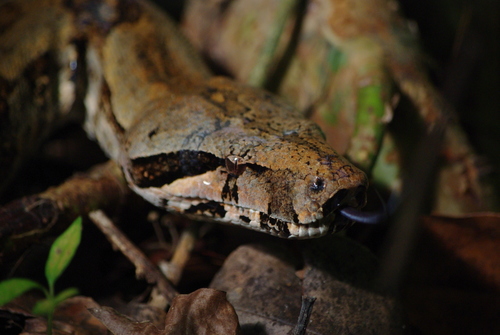
The genus ranges from Mexico south through Central and South America, with populations on some Caribbean islands as well. Across that range its members occupy rainforest, dry forest, and scrub. To recognize a boa, look for a heavy body marked with a series of distinctive saddle-shaped blotches that grow darker and more contrasting toward the tail. Unlike pythons, boas of this genus lack the obvious heat-sensing pits along the lips, which is a useful field clue when telling the two groups apart.
The genus is best known through the boa constrictor itself, a wide-ranging and adaptable snake that has long been one of the most popular large snakes in the pet trade, valued for its size, its patterning, and its generally manageable temperament in captivity. Our database members include the Boa Constrictor, the Central American Boa, the Mexican West Coast Boa Constrictor, the Clouded Boa Constrictor, and the Santa Lucia Boa Constrictor. Several of these are regional forms whose differences in size, color, and pattern reflect the broad spread of habitats the genus occupies.
As predators, boas are both ambush hunters and active foragers that take mammals and birds, and they are capable climbers and swimmers that move readily between the ground, the trees, and the water. By preying on rodents they provide useful natural pest control across their range. On the honest safety question: boas in this genus are not venomous, so there is no venom risk from a bite and they are not dangerous in the way a viper or a cobra is. They are still strong animals, and large individuals deserve real respect for their muscular power alone. As with any wild snake, the right response to encountering one is to give it space and let it move on.
Boa belongs to the Boidae family (Boas). Powerful non-venomous constrictors that give birth to live young. Heavy body, smooth scales, and (in many species) heat-sensing pits along the lips. No rattle and no fangs.
Danger: Non-venomous and not dangerous to people. Large individuals are strong and can bite defensively, but they are not a venom threat.
All species (5)
Keep learning
- What Is a Snake? Anatomy and the BasicsA clear overview of what makes a snake a snake: limbless body plan, anatomy, evolution from lizards, species diversity, and why they are ectothermic.
- How Snakes Move, Hunt, and EatHow snakes move without legs, hunt as ambushers or active foragers, kill by constriction or venom, and swallow prey wider than their head.
- What Do Snakes Eat?All snakes are carnivores. Learn what snakes eat, how diet changes with size and age, how often they feed, and how they hunt and swallow prey.
- Venomous vs Nonvenomous: How to Tell the DifferenceThe folk rules for telling venomous snakes apart, where each one fails, and why location-based identification beats guessing by sight.