
Colubridae
Thickhead Ground Snake
HarmlessAtractus crassicaudatus
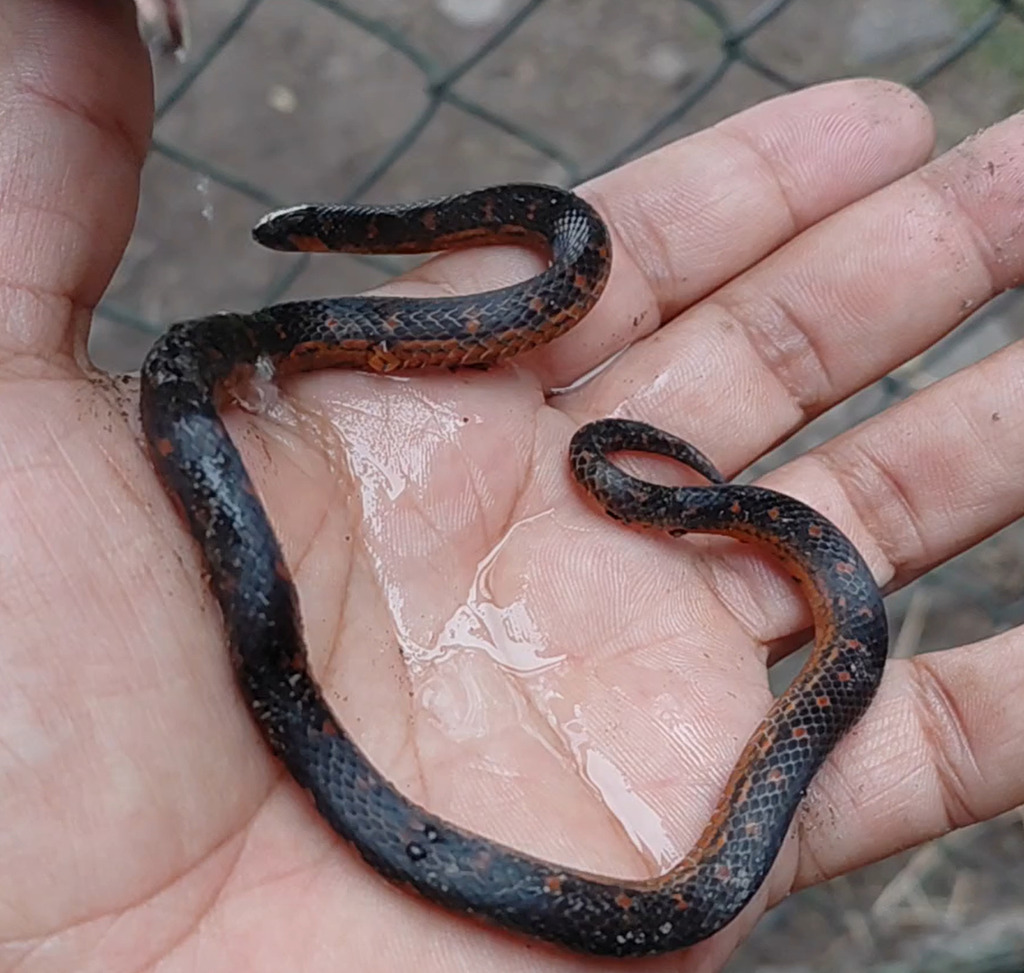
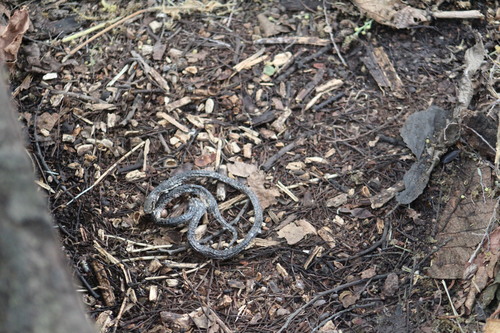
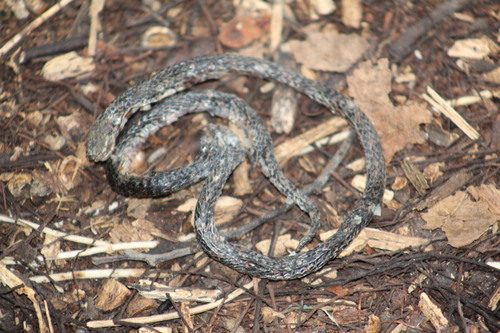
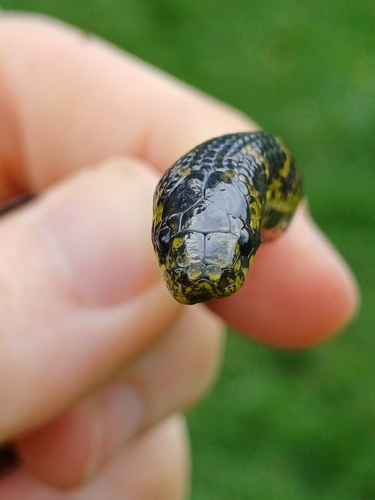
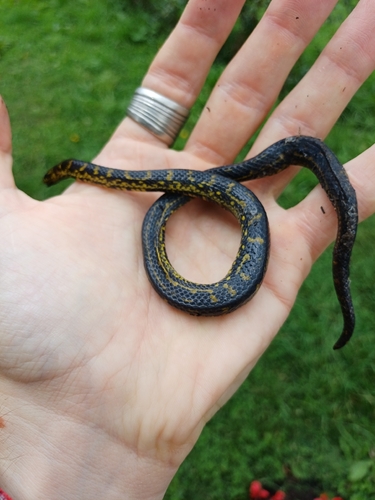
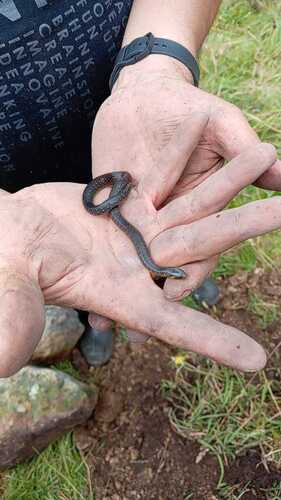
6 photographs of the Thickhead Ground Snake. © GERMAN LEONEL SARMIENTO CRUZ.
The Thickhead Ground Snake (Atractus crassicaudatus) is a non-venomous snake in the Colubridae family, recorded in 2 countries.
- Family
- Colubridae
About the Thickhead Ground Snake
The thickhead ground snake (Atractus crassicaudatus) is a nonvenomous colubrid snake species, with no recognized subspecies, endemic to central Colombia.
Description
The thickhead ground snake is dark purplish-brown or blackish both dorsally and ventrally, with small, yellowish spots dorsally, and larger ones ventrally. The first row of dorsal scales, next to the ventrals on each side, is yellowish. There is a yellowish blotch on each temple.
Its snout is obtuse. The rostral scale is small, the internasals are very small, and the prefrontals are as long as broad. The frontal is as long as or a little longer than broad, as long as its distance from the end of the snout, but much shorter than the parietals. The loreal scale is at least twice as long as it is high. Two postoculars are present; the temporals are 1+2. Seven upper labials (rarely six) occur, the third and fourth (or third) of which enter the orbit; the three lower labials contact the single pair of chin shields. The dorsal scales are smooth, in 17 rows. The ventrals are 146-161 in count. The anal scale is entire, with 19-27 paired subcaudal scales.
Adults may attain 42 centimetres (17 in) in total length. The length of the tail is about 1/10 of the total length.
Distribution
The snake is endemic to the Altiplano Cundiboyacense, where it is found at altitudes between 2,000 and 3,200 metres (6,600 and 10,500 ft). This snake is reportedly particularly common in the area around the capital district of Bogotá, the Eastern Hills of Bogotá, and Lake Herrera on the Bogotá savanna.
Adapted from Wikipedia, available under CC BY-SA.
Frequently asked: Thickhead Ground Snake
- Is the Thickhead Ground Snake venomous?
- No. The Thickhead Ground Snake (Atractus crassicaudatus) is non-venomous and is not considered dangerous to humans. Like most snakes, it will retreat rather than bite when given the chance.
- Is the Thickhead Ground Snake poisonous?
- Snakes are venomous, not poisonous. "Poisonous" means harmful to eat or touch; "venomous" means injecting toxins through a bite. The Thickhead Ground Snake is neither poisonous nor venomous.
- Is the Thickhead Ground Snake dangerous?
- The Thickhead Ground Snake is not dangerous to humans. It has no medically significant venom and bites only defensively if cornered or handled.
- Where does the Thickhead Ground Snake live?
- The Thickhead Ground Snake has verified records in 2 countries, including Colombia, Guatemala. See the distribution section below for its full range.
Where it is found
More Colubridae snakes
 Black Ground SnakeAtractus elaps
 Three-lined Ground SnakeAtractus trilineatus
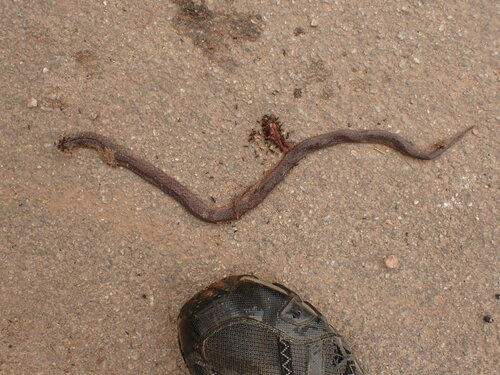 Atractus pantostictusAtractus pantostictus
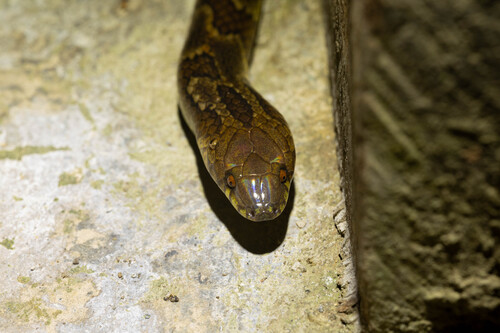 Big Ground SnakeAtractus major
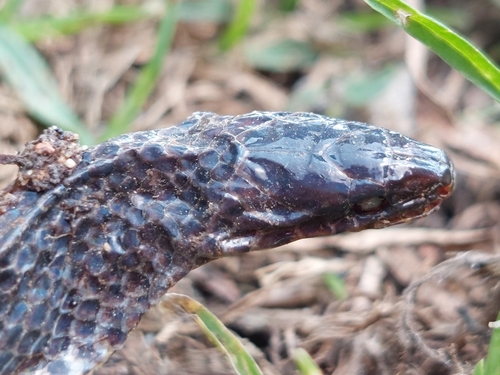 Lasalle's Ground SnakeAtractus lasallei
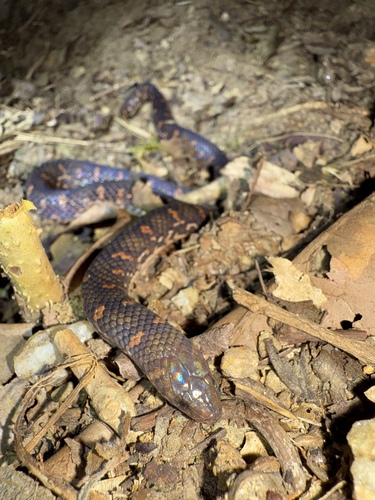 St. Marta's Ground SnakeAtractus sanctaemartae
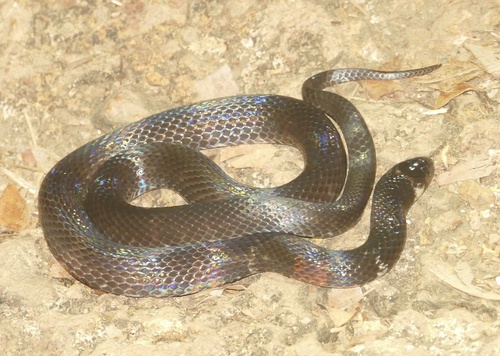 Boie's Ground SnakeAtractus badius
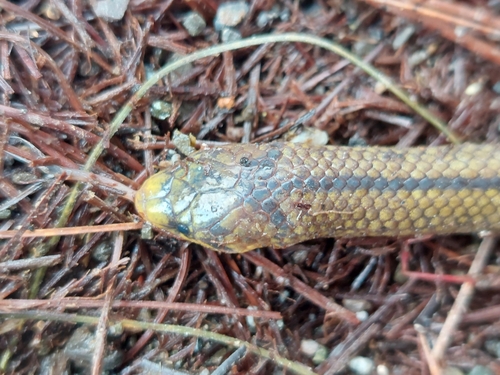 Lehmann's Ground SnakeAtractus lehmanni
Classification
How scientists group this snake, from the broadest category down to the exact species. Each step narrows to its closest relatives.
- OrderThe broad group of scaled reptiles: all snakes and lizards
- Squamata
- FamilyA group of related snakes that share key traits
- Colubridae
- GenusA close-knit group of very similar species
- Atractus
- SpeciesThis exact snake, named in the two-part scientific name
- Atractus crassicaudatus
Keep learning
- What to Do If You Find a SnakeFound a snake at home or on a trail? Here is how to stay calm, give it space, identify it safely, and know when to call a professional.
- Venomous vs Nonvenomous: How to Tell the DifferenceThe folk rules for telling venomous snakes apart, where each one fails, and why location-based identification beats guessing by sight.
- What Is a Snake? Anatomy and the BasicsA clear overview of what makes a snake a snake: limbless body plan, anatomy, evolution from lizards, species diversity, and why they are ectothermic.
- How to Keep Snakes Out of Your Yard and HomeA practical guide to keeping snakes out of your yard and home using habitat changes that work, plus what to skip and what to do if one shows up.
Distribution from GBIF & iNaturalist. Venom status per CDC. Background: Wikipedia. Informational only. Never handle a snake to identify it.