
Bolyeriidae
Round Island Boa
HarmlessCasarea dussumieri
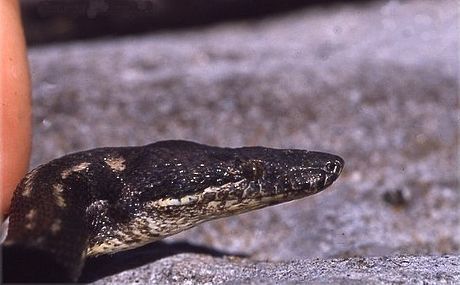
The Round Island Boa (Casarea dussumieri) is a non-venomous snake in the Bolyeriidae family, recorded in 2 countries.
- Family
- Bolyeriidae
About the Round Island Boa
The Round Island boa (Casarea dussumieri), also known commonly as the Round Island keel-scaled boa and the Round Island ground boa, is a species of nonvenomous snake in the monotypic genus Casarea in the family Bolyeriidae. The species is endemic to Round Island, Mauritius. No subspecies are currently recognized.
Etymology
The specific name, dussumieri, is in honor of Jean-Jacques Dussumier, a French merchant, ship owner, and collector of zoological specimens.
Description
Adults of C. dussumieri are slender and reach a maximum total length (including tail) of 150 cm (5 ft). The males have slimmer, more pointed heads and have shorter bodies than the females. The body is covered in small keeled scales that give the species one of its common names. The genus is unique among extant vertebrates as it has a split jaw (intramaxilliary joint that separates anterior and posterior bones), an adaptation that may be advantageous in catching its main prey of geckos and skinks.
The colour pattern is dark brown dorsally, the belly being lighter with dark spots. Over a 24-hour period the boa has a shift in colour, changing from "dark" during its relatively inactive day time period to "light" in the early evening through to dawn when it is most active. This effect is created through polychromatic skin cells.
Geographic range
C. dussumieri is known to survive on Round Island, but has been recorded on the islands of Gunner's Quoin, Flat Island, Ile de la Pas, and on mainland Mauritius (as subfossil remains).
The type locality is "I'île ronde, près de Maurice " (Round Island, Mauritius).
Between 11 and 31 October 2012 the boa was reintroduced into Gunner's Quoin as part of a joint collaborative project involving the Durrell Wildlife Conservation Trust, the Mauritian Wildlife Foundation, and the National Parks and Conservation Service of Mauritius.
Conservation status
The species C. dussumieri is classified as Endangered (E) on the IUCN Red List for the following criteria: D (v2.3, 1994). This means that, although it is not critically endangered, for some time it has faced a very high risk of extinction in the wild. In 1996 the population was estimated to number less than 250 mature individuals.
Recent conservation efforts have seen an increase in the number of adult Round Island boas to around 1,000. This has been achieved by eradicating goats and rabbits from the island and restoring natural habitat, which has led to an increase of the Round Island boas' natural prey, lizards. In recent breeding efforts, Round Island boas in captivity have been fed by scenting small mice with chicken thigh meat.
Reproduction
In C. dussumieri, breeding begins during April, although young have been observed throughout the year. A clutch of up to 12 soft-shelled eggs may be laid amongst leaf litter or in hollow palm trunks, and is sometimes attended by the female. Incubation is unusually long for a snake, lasting about 90 days. The young are bright orange at birth and weigh less than 5 grams.
Adapted from Wikipedia, available under CC BY-SA.
Frequently asked: Round Island Boa
- Is the Round Island Boa venomous?
- No. The Round Island Boa (Casarea dussumieri) is non-venomous and is not considered dangerous to humans. Like most snakes, it will retreat rather than bite when given the chance.
- Is the Round Island Boa poisonous?
- Snakes are venomous, not poisonous. "Poisonous" means harmful to eat or touch; "venomous" means injecting toxins through a bite. The Round Island Boa is neither poisonous nor venomous.
- Is the Round Island Boa dangerous?
- The Round Island Boa is not dangerous to humans. It has no medically significant venom and bites only defensively if cornered or handled.
- Where does the Round Island Boa live?
- The Round Island Boa has verified records in 2 countries, including Mauritius, Madagascar. See the distribution section below for its full range.
- Why is it called the Round Island Boa?
- The specific name, dussumieri, is in honor of Jean-Jacques Dussumier, a French merchant, ship owner, and collector of zoological specimens.
Where it is found
Classification
How scientists group this snake, from the broadest category down to the exact species. Each step narrows to its closest relatives.
- OrderThe broad group of scaled reptiles: all snakes and lizards
- Squamata
- FamilyA group of related snakes that share key traits
- Bolyeriidae
- GenusA close-knit group of very similar species
- Casarea
- SpeciesThis exact snake, named in the two-part scientific name
- Casarea dussumieri
Keep learning
- What to Do If You Find a SnakeFound a snake at home or on a trail? Here is how to stay calm, give it space, identify it safely, and know when to call a professional.
- Venomous vs Nonvenomous: How to Tell the DifferenceThe folk rules for telling venomous snakes apart, where each one fails, and why location-based identification beats guessing by sight.
- What Is a Snake? Anatomy and the BasicsA clear overview of what makes a snake a snake: limbless body plan, anatomy, evolution from lizards, species diversity, and why they are ectothermic.
- How to Keep Snakes Out of Your Yard and HomeA practical guide to keeping snakes out of your yard and home using habitat changes that work, plus what to skip and what to do if one shows up.
Distribution from GBIF & iNaturalist. Venom status per CDC. Background: Wikipedia. Informational only. Never handle a snake to identify it.