
Genus · Bolyeriidae
Casarea
The genus Casarea contains a single species. It is not considered dangerous to humans.
About Round Island boa
A single surviving species of a deeply unusual island snake family, found only on a tiny islet off Mauritius.
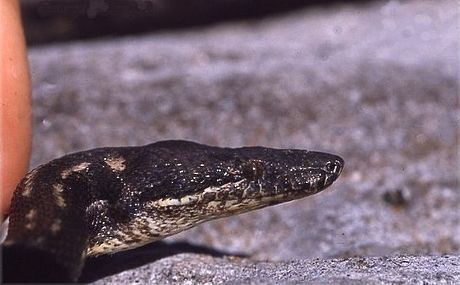
Casarea is a genus in the family Bolyeriidae, the Mauritius or split-jaw boas. It contains the Round Island boa, Casarea dussumieri, which today is the only living member of the entire family. Its one former relative, Bolyeria multocarinata, has not been recorded since the 1970s and is presumed extinct. Bolyeriid snakes are famous among herpetologists for a feature found in no other living snake group: the upper jaw bone, or maxilla, is split into a front and rear half connected by a flexible joint, which lets the jaw hinge to grip hard, smooth prey. Despite the boa name, these snakes are not true boas and are placed in their own family.
The genus is restricted to the Mauritius region of the southwestern Indian Ocean. The Round Island boa survives on Round Island, a small uninhabited islet north of Mauritius, where it lives in dry palm savanna, hardwood scrub, and rocky ground. It once ranged more widely across Mauritius and nearby islets, but introduced goats, rabbits, and rats degraded its habitat and drove the population to this last refuge. Conservation work removing the introduced grazers has allowed the vegetation and the snake to recover, and the species remains a focus of intensive protection.
Members are slender, medium-sized snakes, typically under about a meter and a half, with keeled scales, a narrow head, and coloring that shifts toward darker tones at night and lighter tones by day. They are nocturnal hunters of lizards and small skinks and geckos, using the hinged jaw to hold struggling, smooth-bodied prey. Unlike most boas, the Round Island boa lays eggs rather than giving live birth. Casarea is non-venomous and harmless to people, and as a rare, strictly protected species it should never be collected or handled in the wild; observe it only from a distance and leave any wildlife encounter to trained conservation staff.
Casarea belongs to the Bolyeriidae family (Round Island boas). Critically rare island snakes with a uniquely jointed jaw. A slender, harmless island snake; effectively never encountered in the wild.
Danger: Harmless. Non-venomous.
All species (1)
Keep learning
- What Is a Snake? Anatomy and the BasicsA clear overview of what makes a snake a snake: limbless body plan, anatomy, evolution from lizards, species diversity, and why they are ectothermic.
- How Snakes Move, Hunt, and EatHow snakes move without legs, hunt as ambushers or active foragers, kill by constriction or venom, and swallow prey wider than their head.
- What Do Snakes Eat?All snakes are carnivores. Learn what snakes eat, how diet changes with size and age, how often they feed, and how they hunt and swallow prey.
- Venomous vs Nonvenomous: How to Tell the DifferenceThe folk rules for telling venomous snakes apart, where each one fails, and why location-based identification beats guessing by sight.