
Psammophiidae
Long Sand Racer
HarmlessPsammophis longifrons
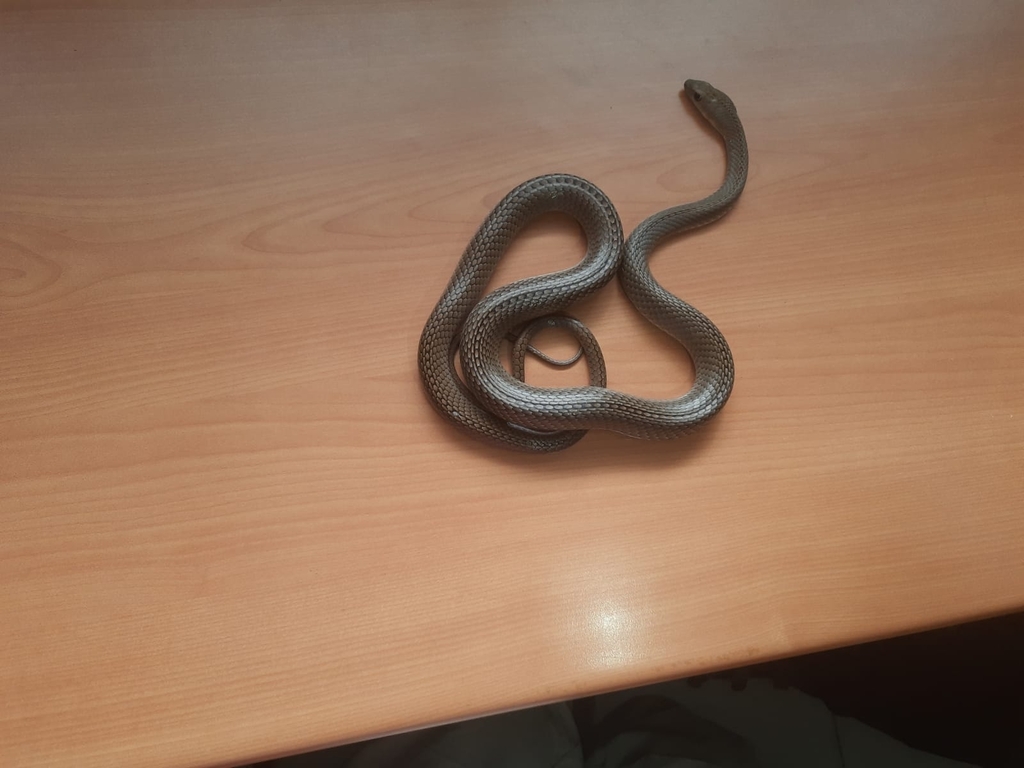
The Long Sand Racer (Psammophis longifrons) is a rear-fanged, mildly venomous snake in the Psammophiidae family, recorded in 1 country.
- Family
- Psammophiidae
About the Long Sand Racer
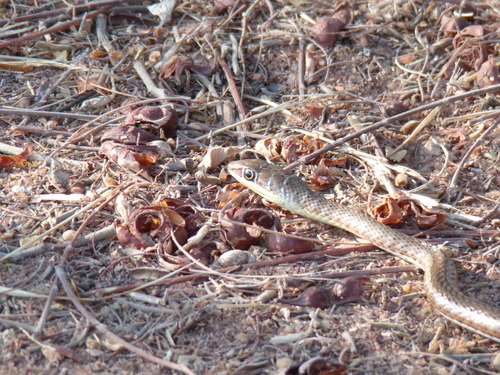
Psammophis longifrons, the stout sand snake or long sand racer, is a species of snake found in India. It can grow to a maximum length of 57 inches (145 centimetres).
Description
Greyish above in front, browner behind, the scales edged with black, particularly those of vertebral region. The top of the head is uniform greyish brown, or the scales are edged with black. Greyish or yellowish below. Total length 1230 mm, tail 375 mm. Of considerably stouter build than the other Indian member of this genus.
Maxillary teeth 12 or 13, 2 in the middle very strongly enlarged, and preceded and followed by a distinct interval; internasal small, 1/2 or less than 1/2 the length of prefrontals; frontal long and narrow, not longer than its distance from end of snout, the anterior end suddenly not enlarged, not greatly broader there than in the middle, not in contact with the preocular; temporals 2+2, 8 supralabials 4th and 5th touching eye. V.166–175; C.79–93; A.2.
Distribution
In Maharashtra it is reported from Bombay presidency north of 19 degree (Thana and Damanganga districts, Bulsar, Panch Mahal), C.P(Nagpur) and Amravati. In Gujarat; Surat, Valsad, Navsari. In Madhya Pradesh it is recorded from Ujjain and Hoshangabad. These records show that this species is distributed in a very narrow range, including three western Indian states, namely Gujarat (central and south), Maharashtra (northern) and Madhya Pradesh (mainly southern west).
Food and behaviour
Its habits are both terrestrial and arboreal.
In captivity (for a short period), it was observed that the snakes were timid and well set without any aggression. Five types of lizards (Hemidactylus flaviviridis, H. triedrus, Calotes versicolor, and Eutropis carinata and four types of frogs (Duttaphrynus melanostictus, Euphlyctis cyanophlyctis, Sphaerotheca breviceps, and Polypedates maculatus) were provided and accepted as food.
Reproduction
A female collected in Gujarat laid eight capsule shaped eggs.
Adapted from Wikipedia, available under CC BY-SA.
Frequently asked: Long Sand Racer
- Is the Long Sand Racer venomous?
- The Long Sand Racer (Psammophis longifrons) is rear-fanged and only mildly venomous. It is not considered dangerous to humans (its venom is weak and its fangs sit at the back of the mouth) but a bite can cause local swelling or irritation, so it should not be handled.
- Is the Long Sand Racer poisonous?
- Snakes are venomous, not poisonous. "Poisonous" means harmful to eat or touch; "venomous" means injecting toxins through a bite. The Long Sand Racer is neither poisonous nor venomous.
- Is the Long Sand Racer dangerous?
- The Long Sand Racer is not dangerous to humans. It has no medically significant venom and bites only defensively if cornered or handled.
- Where does the Long Sand Racer live?
- The Long Sand Racer has verified records in 1 country, including India. See the distribution section below for its full range.
Where it is found
More Psammophiidae snakes
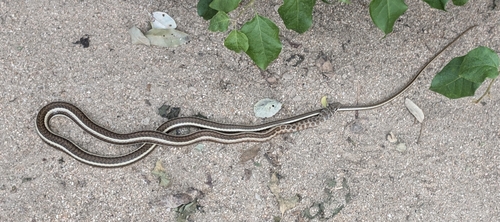 Stripe-bellied Sand SnakePsammophis subtaeniatus
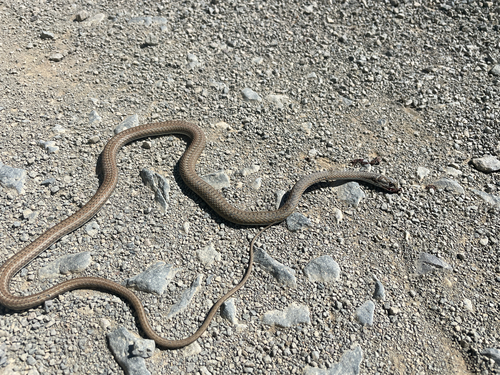 Karoo Sand SnakePsammophis notostictus
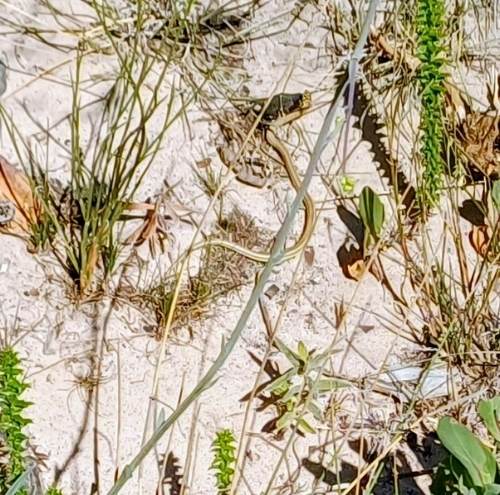 Cross-marked Sand SnakePsammophis crucifer
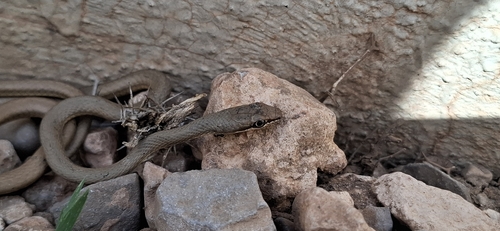 Forskal Sand SnakePsammophis schokari
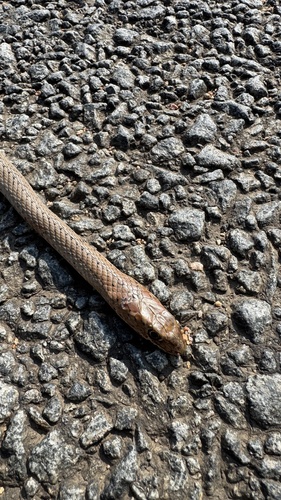 Olive Whip SnakePsammophis mossambicus
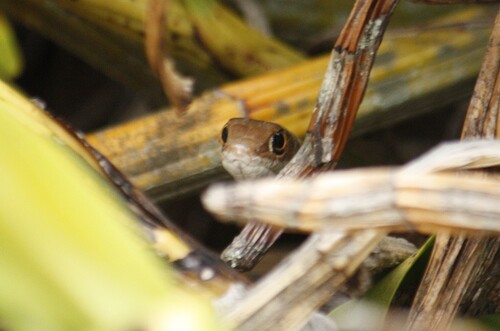 Short-snouted Whip SnakePsammophis brevirostris
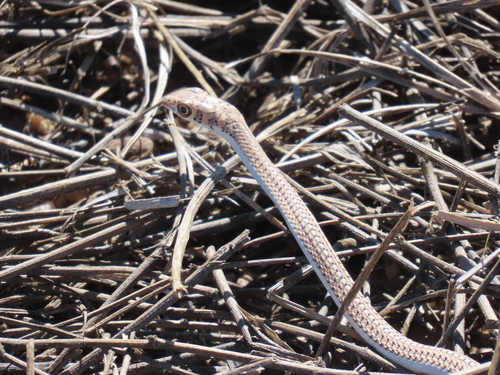 Cape Sand SnakePsammophis leightoni
 Eastern Stripe-bellied Sand SnakePsammophis orientalis
Classification
How scientists group this snake, from the broadest category down to the exact species. Each step narrows to its closest relatives.
- OrderThe broad group of scaled reptiles: all snakes and lizards
- Squamata
- FamilyA group of related snakes that share key traits
- Psammophiidae
- GenusA close-knit group of very similar species
- Psammophis
- SpeciesThis exact snake, named in the two-part scientific name
- Psammophis longifrons
Keep learning
- What to Do If You Find a SnakeFound a snake at home or on a trail? Here is how to stay calm, give it space, identify it safely, and know when to call a professional.
- Venomous vs Nonvenomous: How to Tell the DifferenceThe folk rules for telling venomous snakes apart, where each one fails, and why location-based identification beats guessing by sight.
- What Is a Snake? Anatomy and the BasicsA clear overview of what makes a snake a snake: limbless body plan, anatomy, evolution from lizards, species diversity, and why they are ectothermic.
- How to Keep Snakes Out of Your Yard and HomeA practical guide to keeping snakes out of your yard and home using habitat changes that work, plus what to skip and what to do if one shows up.
Distribution from GBIF & iNaturalist. Venom status per CDC. Background: Wikipedia. Informational only. Never handle a snake to identify it.