
Viperidae
Large-scaled Pit Viper
VenomousCraspedocephalus macrolepis
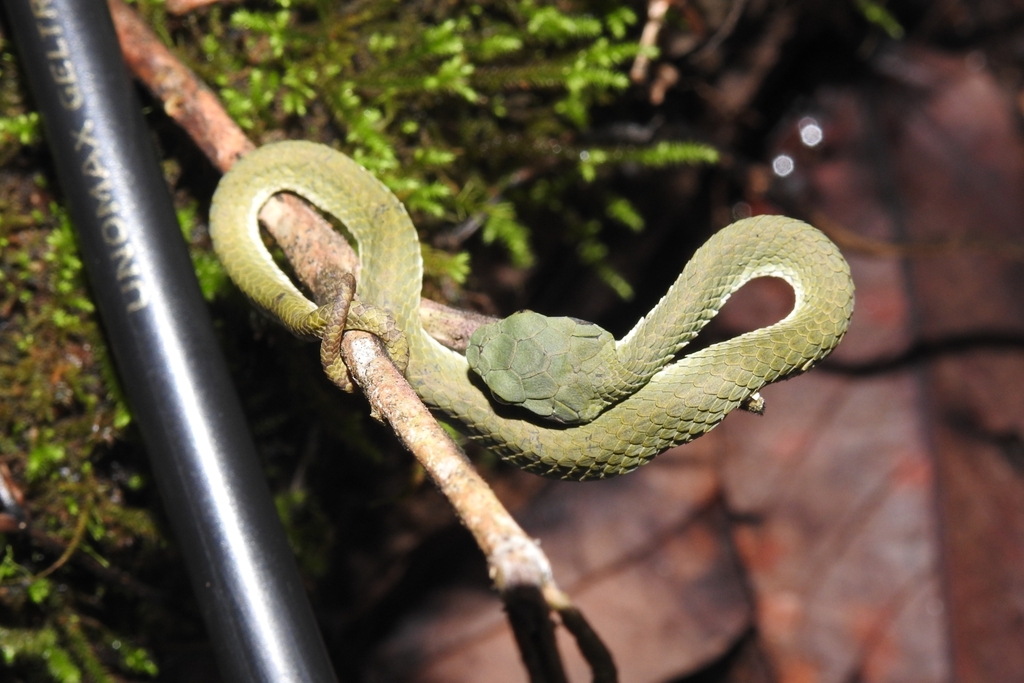
The Large-scaled Pit Viper (Craspedocephalus macrolepis) is a venomous snake in the Viperidae family, recorded in 1 country.
If you are bitten
This is a venomous snake. Treat any bite as a medical emergency: stay calm, keep the bitten limb still and roughly level with the heart, remove rings and tight clothing, and get to emergency care immediately. Do not apply a tourniquet, cut the wound, apply ice, or try to suck out venom. Call your local emergency number or poison center.
- Family
- Viperidae
- Danger
- high
About the Large-scaled Pit Viper
Craspedocephalus macrolepis, commonly known as the large-scaled pit viper, is a venomous pitviper species endemic to the Southern Western Ghats of South India. No subspecies are currently recognized.
Geographic range
It is found in the mountains of southern Western Ghats south of Palakkad Gap, in the Indian states of Kerala and Tamil Nadu. It is a high-elevation specialist, not normally recorded anywhere below 1200 m asl. Precise records are from Nelliyampathy, Munnar, Anaimalai, Palni hills, Meghamalai, Periyar Tiger Reserve, Agasthyamalai and Kalakkad Mundanthurai Tiger Reserve. at elevations of 1200-2695 m asl. The type locality is listed as "Anamalai hills (Tamil Nadu State, southwestern India)".
Description
Adults may attain a total length of 68 cm (27 in), which includes a tail 12 cm (4.7 in) long.
Dorsally, C. macrolepis is bright green, with blackish skin between the scales in some places. There is a yellow or white stripe on each side of the body, which runs along the first dorsal scale row. The upper lips are pale green, and there may be a black streak behind the eye. Ventrally, it is pale greenish.
The dorsal scales, which are large, keeled, and overlapping, are arranged in only 12-15 rows at midbody. The dorsal scales in the 10 middle rows are always the largest, and additional rows are made up of smaller scales. An even number of dorsal scale rows is frequently found in this species, even though it is uncommon in snakes in general. Ventrals 133–143; subcaudals divided 44–58.
The scales on the top of the head are very large, smooth, and overlapping. There is an elongate subocular, which is separated from the upper labials by a row of a few small scales. There are 7-8 upper labials, of which the 3rd is the largest.
Taxonomy
Craspedocephalus macrolepis has a long spineless hemipenis without papillae; the hemipenis has a long calyculate region beginning at some distance from the fork of the hemipenis and continuing until the tip. In addition, it has enlarged head scales, somewhat akin to those of Agkistrodon species. Based on these characters, and its Western Ghats distribution, Malhotra and Thorpe (2004) resurrected the genus Peltopelor Günther, 1864 for this species.
Habitat
Craspedocephalus macrolepis is a slow-moving, arboreal, nocturnal snake that prefers rainforests, and is also found in tea, coffee and cardamom plantations.
Behavior
It is both terrestrial and arboreal, using its prehensile tail to hold onto branches. It is an ambush hunting snake relying on its camouflage to catch prey. The heat-sensing loreal pits are used to locate warm-blooded prey.
Diet
It feeds mainly on frogs, lizards, small birds and rodents.
Venom
Adapted from Wikipedia, available under CC BY-SA.
Local and regional names
The Large-scaled Pit Viper is known by these names across the regions where it lives:
- Russian
- Крупночешуйная куфия
Frequently asked: Large-scaled Pit Viper
- Is the Large-scaled Pit Viper venomous?
- Yes. The Large-scaled Pit Viper (Craspedocephalus macrolepis) is venomous and belongs to the Viperidae family (viper). Its bite is considered high risk to people. Treat any bite as a medical emergency.
- Is the Large-scaled Pit Viper poisonous?
- Snakes are venomous, not poisonous. "Poisonous" means harmful to eat or touch; "venomous" means injecting toxins through a bite. The Large-scaled Pit Viper is venomous, delivering venom through a bite.
- Is the Large-scaled Pit Viper dangerous?
- This is a venomous snake. Treat any bite as a medical emergency: stay calm, keep the bitten limb still and roughly level with the heart, remove rings and tight clothing, and get to emergency care immediately. Do not apply a tourniquet, cut the wound, apply ice, or try to suck out venom. Call your local emergency number or poison center.
- Where does the Large-scaled Pit Viper live?
- The Large-scaled Pit Viper has verified records in 1 country, including India. See the distribution section below for its full range.
- What does the Large-scaled Pit Viper eat?
- It feeds mainly on frogs, lizards, small birds and rodents.
If you are bitten by the Large-scaled Pit Viper
Do
- Get away from the snake and stay calm. Most bites worsen when people panic or try again to handle the snake.
- Call 911 or Poison Control (1-800-222-1222) right away. Antivenom works best when given early.
- Note the time of the bite and, from a safe distance, the snake's color and pattern, a phone photo is enough. Do not chase it.
- Keep the bitten limb still and at roughly heart level. Sit or lie down and limit movement.
- Remove rings, watches, and tight clothing near the bite before swelling starts.
- Gently wash the bite with soap and water and cover it with a clean, dry dressing.
Do not
- Do not cut the wound or try to suck out the venom.
- Do not apply a tourniquet or ice.
- Do not drink alcohol or caffeine.
- Do not take aspirin or ibuprofen, they can worsen bleeding. Acetaminophen is safer for pain.
- Do not try to catch or kill the snake. A dead snake can still bite by reflex.
First-aid guidance adapted from the U.S. Centers for Disease Control and Prevention (CDC NIOSH), Venomous Snakes. Educational only; always follow the instructions of emergency responders.
Where it is found
More Viperidae snakes
 Malabarian Pit ViperCraspedocephalus malabaricus
 Common Bamboo ViperCraspedocephalus gramineus
 Sri Lankan Green Pit ViperCraspedocephalus trigonocephalus
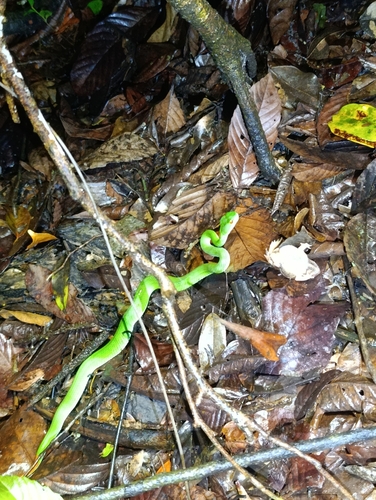 Ruby-eyed Green PitviperTrimeresurus rubeus
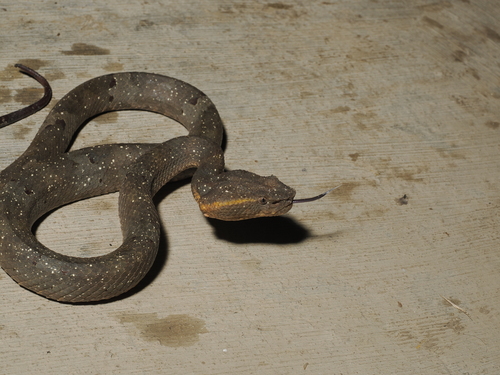 Ashy Pit ViperCraspedocephalus puniceus
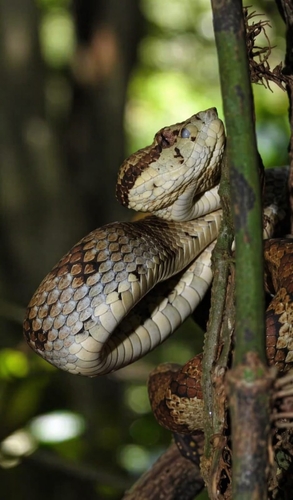 Anamala Pit ViperCraspedocephalus anamallensis
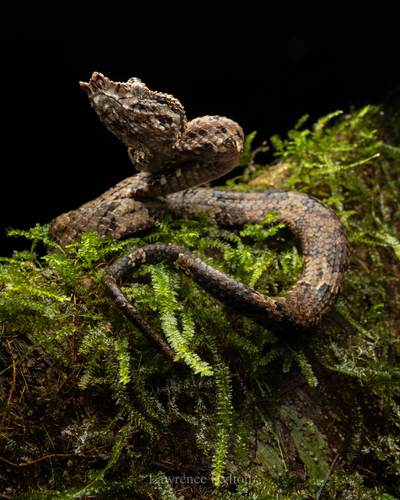 Borneo Pit ViperCraspedocephalus borneensis
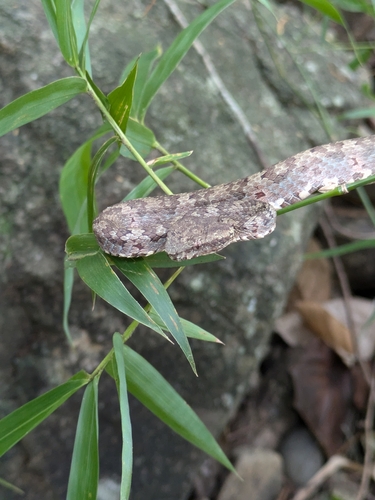 Travancore Pit ViperCraspedocephalus travancoricus
Classification
How scientists group this snake, from the broadest category down to the exact species. Each step narrows to its closest relatives.
- OrderThe broad group of scaled reptiles: all snakes and lizards
- Squamata
- FamilyA group of related snakes that share key traits
- Viperidae
- GenusA close-knit group of very similar species
- Craspedocephalus
- SpeciesThis exact snake, named in the two-part scientific name
- Craspedocephalus macrolepis
Keep learning
- Are Snakes Dangerous? The Real Risk, in PerspectiveMost snakes are harmless and avoid people. Here is the honest picture of snakebite risk worldwide and how to lower your own.
- Snakebite First Aid: What to Do (and What Never to Do)A clear, CDC-based guide to snakebite first aid: the steps that help, the popular myths that hurt, and how to tell a serious bite from a minor one.
- Venomous vs Nonvenomous: How to Tell the DifferenceThe folk rules for telling venomous snakes apart, where each one fails, and why location-based identification beats guessing by sight.
- What to Do If You Find a SnakeFound a snake at home or on a trail? Here is how to stay calm, give it space, identify it safely, and know when to call a professional.
Distribution from GBIF & iNaturalist. Venom status per CDC. Background: Wikipedia. Informational only. Never handle a snake to identify it.