
Colubridae
Dipsas aparatiritos
HarmlessThis species has no widely used English common name.
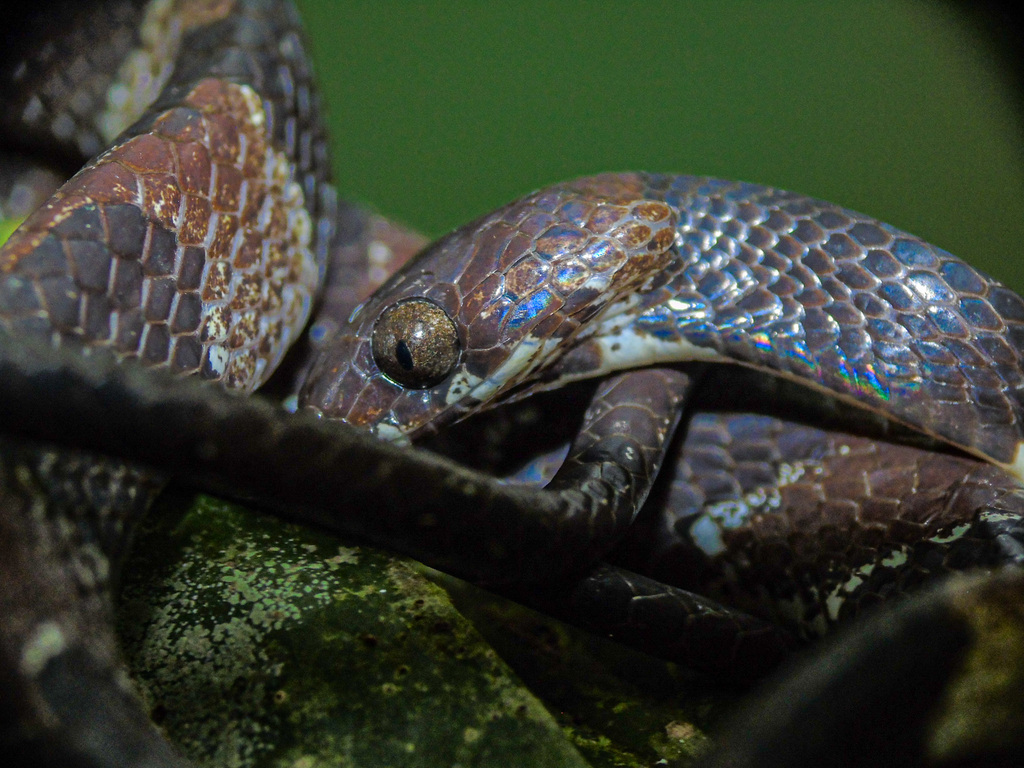
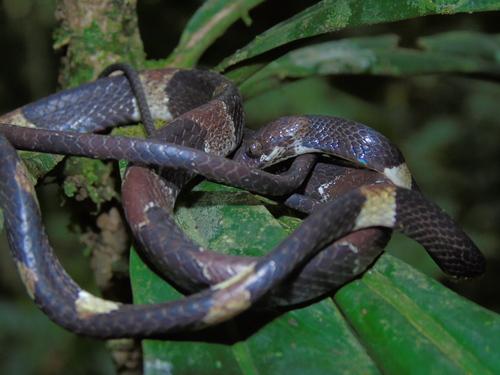
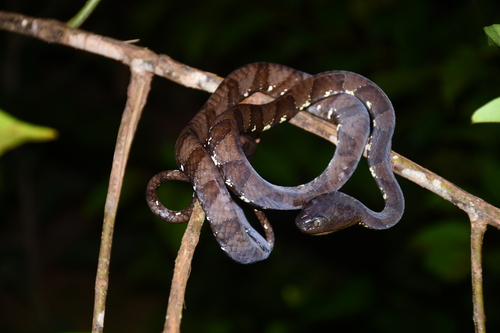
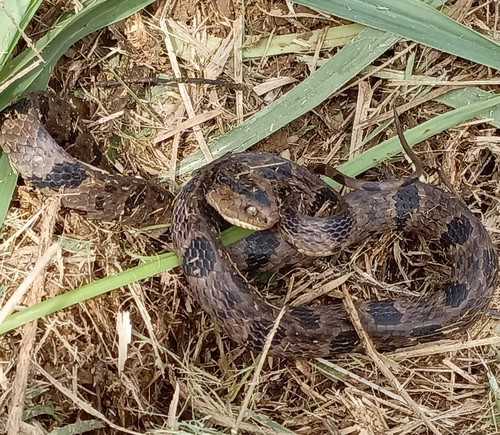
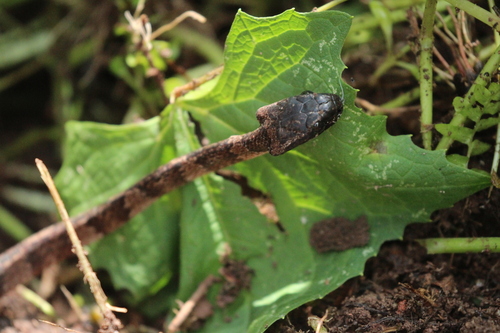
2 photographs of the Dipsas aparatiritos. © Roger A. Morales-Flores.
Dipsas aparatiritos is a non-venomous snake in the Colubridae family, recorded in 1 country.
- Family
- Colubridae
About the Dipsas aparatiritos
Dipsas aparatiritos, also known as the hidden snail-eating snake, is a non-venomous snake found in Panama. Formally described in 2023, its name is derived from a Greek word meaning 'unnoticed', referring to the species occurring at a well-studied herpetological study site for over 40 years before being discovered.
It is found on both the Atlantic and Pacific slopes of the Cordillera Central in western Panama, with an additional population in Chagres National Park. It inhabits inhabit mid-elevation, premontane cloud-forest and has been recorded at elevations of 597–1002 m. It feeds on snails and oligochaetes. The authors of the study describing the species recommended that the species be considered near-threatened due to its rather limited range that suffers from high levels of deforestation.
Taxonomy
Dipsas aparatiritos was formally described in 2023 based on an adult female specimen collected near El Copé de La Pintada in Coclé Province, Panama. The specific epithet is derived from the Greek word aparatíritos (απαρατήρητος), meaning 'unnoticed'. It refers to the snake's presence at a well-studied herpetological study site for over 40 years without being identified as a distinct species. The species has the English common name hidden snail-eating snake and the Spanish common name Caracolera Escondida.
Description
Dipsas aparatiritos can be distinguished from similar species by a number of characteristics. It has 15 dorsal scale rows, one upper preocular scale, two or three postocular scales, 1+2 temporal scales, and seven or eight supralabial scales with the fourth and fifth contacting the orbit. There are eight or nine infralabial scales, with no infralabials in contact behind the mental scale, and a moderately enlarged vertebral row. Males have 191–196 ventral scales and 129–136 subcaudals. Females have 177–197 ventral scales and 111–131 subcaudals. Alternating dark brown and tan brown bands run the length of the body, including the tail.
Distribution and habitat
Dipsas aparatiritos is found on both the Atlantic and Pacific slopes of the Cordillera Central in western Panama, with an additional population in Chagres National Park. The species occurs over an estimated area of 9,630 km2 and has been recorded at elevations of 597–1002 m, which makes it the most widespread species of Dipsas in Panama. Individuals collected from General de División Omar Torrijos Herrera National Park inhabit mid-elevation, premontane cloud-forest with mature secondary forest, permeated by many streams branching from Guabal River. As Donoso in Colón Province, and Quebrada Las Tres Honeras in Panamá Province are in valleys 134–197 m above sea level, a much lower elevation than all other localities, it is likely that the specimens collected there were actually found in the neighboring mountain ridges.
Adapted from Wikipedia, available under CC BY-SA.
Frequently asked: Dipsas aparatiritos
- Is the Dipsas aparatiritos venomous?
- No. The Dipsas aparatiritos is non-venomous and is not considered dangerous to humans. Like most snakes, it will retreat rather than bite when given the chance.
- Is the Dipsas aparatiritos poisonous?
- Snakes are venomous, not poisonous. "Poisonous" means harmful to eat or touch; "venomous" means injecting toxins through a bite. The Dipsas aparatiritos is neither poisonous nor venomous.
- Is the Dipsas aparatiritos dangerous?
- The Dipsas aparatiritos is not dangerous to humans. It has no medically significant venom and bites only defensively if cornered or handled.
- Where does the Dipsas aparatiritos live?
- The Dipsas aparatiritos has verified records in 1 country, including Panama. See the distribution section below for its full range.
Where it is found
More Colubridae snakes
Classification
How scientists group this snake, from the broadest category down to the exact species. Each step narrows to its closest relatives.
- OrderThe broad group of scaled reptiles: all snakes and lizards
- Squamata
- FamilyA group of related snakes that share key traits
- Colubridae
- GenusA close-knit group of very similar species
- Dipsas
- SpeciesThis exact snake, named in the two-part scientific name
- Dipsas aparatiritos
Keep learning
- What to Do If You Find a SnakeFound a snake at home or on a trail? Here is how to stay calm, give it space, identify it safely, and know when to call a professional.
- Venomous vs Nonvenomous: How to Tell the DifferenceThe folk rules for telling venomous snakes apart, where each one fails, and why location-based identification beats guessing by sight.
- What Is a Snake? Anatomy and the BasicsA clear overview of what makes a snake a snake: limbless body plan, anatomy, evolution from lizards, species diversity, and why they are ectothermic.
- How to Keep Snakes Out of Your Yard and HomeA practical guide to keeping snakes out of your yard and home using habitat changes that work, plus what to skip and what to do if one shows up.
Distribution from GBIF & iNaturalist. Venom status per CDC. Background: Wikipedia. Informational only. Never handle a snake to identify it.