
Genus · Boidae
Types of boas
5 species make up the genus Epicrates, the snakes commonly called boas. None are considered dangerous to humans.
About rainbow boas
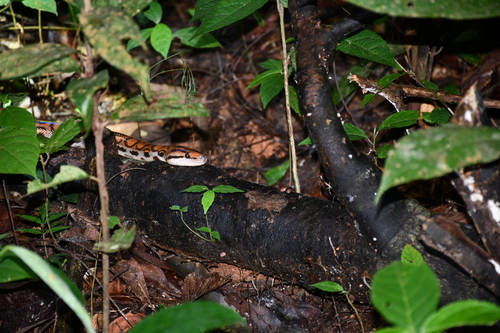
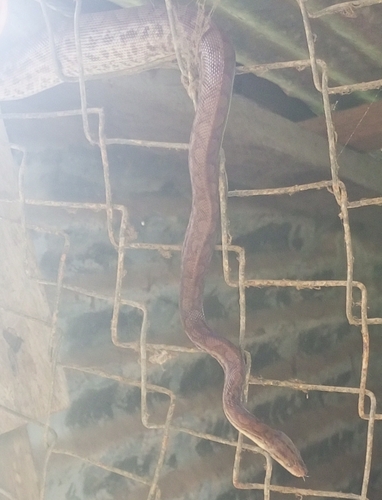
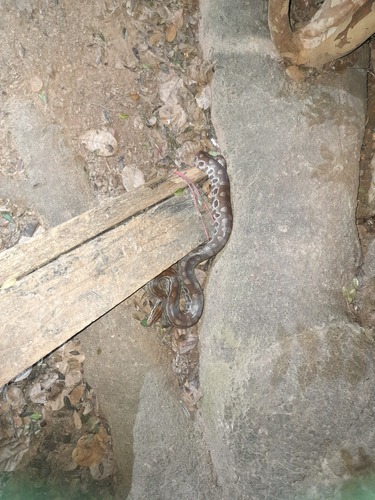
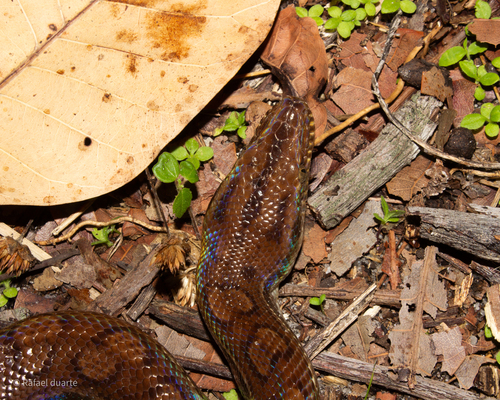
Epicrates is the genus of rainbow boas, nonvenomous New World constrictors famous for the oil-on-water iridescence of their scales.
Epicrates is a genus in the family Boidae, the true boas. Like other boas, its members are nonvenomous constrictors: they kill prey by coiling and tightening, not by injecting venom. They belong to the same broad evolutionary group as anacondas and the common boa, and they are part of the New World boa radiation found across Central and South America and the surrounding islands. Our database holds five species in this genus, including the Western, Brown, Eastern, and Campina Grande rainbow boas.
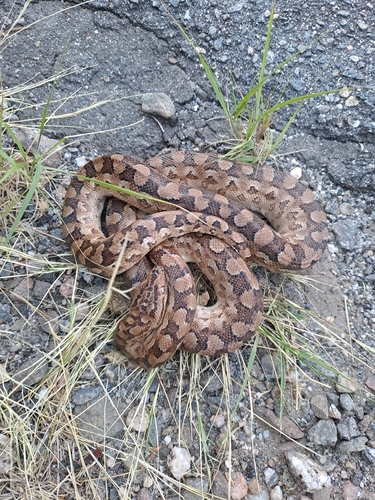
The common name rainbow boa comes from the way light scatters off microscopic ridges on the scales, producing a shifting iridescent sheen across an already colorful body. Typical members are heavy bodied for their length, with a base coloration of reddish brown, orange, or tan marked by dark rings, ovals, or blotches along the back and a row of dark eyespots or crescents along the sides. Adults in this genus are generally medium sized snakes, commonly in the range of roughly 4 to 6 feet, though size varies by species and locality. The head is distinct from the neck and the pupils are vertical, in keeping with their crepuscular and nocturnal habits.
Members occupy a range of habitats across their range, from humid tropical forest to more open woodland, savanna edges, and seasonally dry country, depending on the species. Some are strongly tied to moist environments and are good climbers and swimmers, while others are more terrestrial. Because the genus spans different regions and habitats, the safest way to recognize a rainbow boa is by the combination of a stout boa body, the patterned dorsal markings, and the characteristic iridescence rather than by any single field mark.
These snakes are nonvenomous and are not dangerous in the medical sense; they have no venom and pose no poisoning risk. That said, no wild snake should be handled. A frightened or defensive boa can bite, and the bite of a larger individual can be painful and break skin, and any wild animal is best observed and left alone. Treat identification at a distance as the goal, and never assume a snake is harmless until a qualified person has confirmed what it is.
Ecologically, Epicrates boas are ambush and active foragers that prey on small mammals, birds, lizards, and other small vertebrates, subduing them by constriction. Like most boas they are ovoviviparous, meaning females give live birth rather than laying eggs, producing litters of young that are independent from birth. They are most active at dusk and night, spending daylight hours hidden in cover, burrows, or vegetation, which is why they are seen far less often than their numbers would suggest.
Epicrates belongs to the Boidae family (Boas). Powerful non-venomous constrictors that give birth to live young. Heavy body, smooth scales, and (in many species) heat-sensing pits along the lips. No rattle and no fangs.
Danger: Non-venomous and not dangerous to people. Large individuals are strong and can bite defensively, but they are not a venom threat.
All species (5)
Keep learning
- What Is a Snake? Anatomy and the BasicsA clear overview of what makes a snake a snake: limbless body plan, anatomy, evolution from lizards, species diversity, and why they are ectothermic.
- How Snakes Move, Hunt, and EatHow snakes move without legs, hunt as ambushers or active foragers, kill by constriction or venom, and swallow prey wider than their head.
- What Do Snakes Eat?All snakes are carnivores. Learn what snakes eat, how diet changes with size and age, how often they feed, and how they hunt and swallow prey.
- Venomous vs Nonvenomous: How to Tell the DifferenceThe folk rules for telling venomous snakes apart, where each one fails, and why location-based identification beats guessing by sight.