
Genus · Boidae
Types of boas
2 species make up the genus Charina, the snakes commonly called boas. None are considered dangerous to humans.
About rubber boas
Small, blunt-tailed boas of western North America that look and feel like rubber and are completely harmless to people.
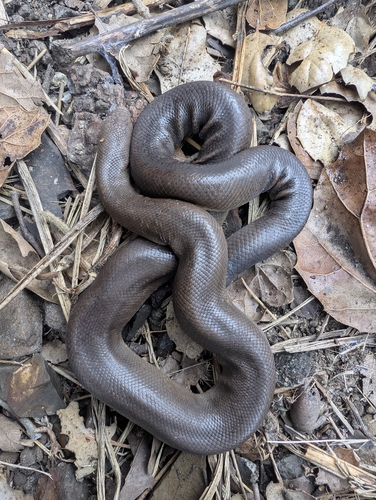
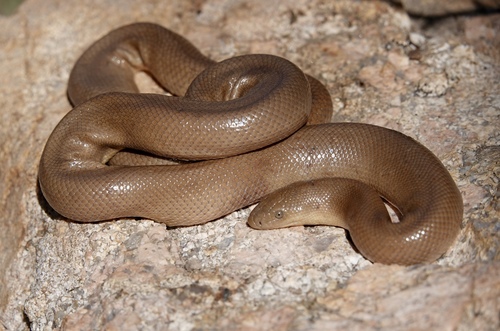
Charina is a genus in the family Boidae, the true boas, and it contains the rubber boas of western North America. Two species are recognized: the Northern Rubber Boa and the Southern Rubber Boa. Unlike the large tropical boas most people picture, these are small, stout snakes rarely exceeding about two feet, with smooth, loose-fitting skin that gives them a distinctly rubbery look and feel. Their most telling trait is a short, blunt tail shaped almost exactly like the head, an adaptation that lets them bluff predators about which end is which.
These boas range through the cooler, more temperate parts of the western United States and into southern British Columbia, with the Southern Rubber Boa restricted to a small area of southern California. They favor moist woodlands, montane forests, grassy meadows, and rocky slopes, often near streams. As cold-tolerant constrictors, they are active at lower temperatures than most snakes and spend much of their time hidden under bark, logs, leaf litter, and rocks, which makes them secretive and easy to overlook.
Rubber boas are nonvenomous and among the most docile snakes anywhere. Like all boas, they kill prey by constriction, feeding mainly on small mammals such as young mice and voles, and they will raid nests, using the blunt tail as a shield against defensive bites from adult rodents. They are slow-moving, accomplished burrowers and climbers, and females give live birth to small litters rather than laying eggs. They pose no danger to humans, though as with any wild animal it is best to observe them without handling and to leave them undisturbed in the field.
Charina belongs to the Boidae family (Boas). Powerful non-venomous constrictors that give birth to live young. Heavy body, smooth scales, and (in many species) heat-sensing pits along the lips. No rattle and no fangs.
Danger: Non-venomous and not dangerous to people. Large individuals are strong and can bite defensively, but they are not a venom threat.
All species (2)
Keep learning
- What Is a Snake? Anatomy and the BasicsA clear overview of what makes a snake a snake: limbless body plan, anatomy, evolution from lizards, species diversity, and why they are ectothermic.
- How Snakes Move, Hunt, and EatHow snakes move without legs, hunt as ambushers or active foragers, kill by constriction or venom, and swallow prey wider than their head.
- What Do Snakes Eat?All snakes are carnivores. Learn what snakes eat, how diet changes with size and age, how often they feed, and how they hunt and swallow prey.
- Venomous vs Nonvenomous: How to Tell the DifferenceThe folk rules for telling venomous snakes apart, where each one fails, and why location-based identification beats guessing by sight.