
Genus · Boidae
Types of boas
5 species make up the genus Candoia, the snakes commonly called boas. None are considered dangerous to humans.
About Pacific ground boas (bevel-nosed boas)
Stout, blunt-snouted boas of the southwest Pacific that give live birth and squeeze their prey rather than bite.
Candoia is a small genus of boas, family Boidae, native to the islands of the southwest Pacific. They are often called Pacific boas, Pacific ground boas, or bevel-nosed boas, the last name a nod to the angular, somewhat upturned snout that distinguishes many members. Our database covers five species in the group, including the Solomon Island ground boa, the New Guinea ground boa, the Pacific boa, and Bibron's bevel-nosed boa.
Geographically these are island snakes. They range across New Guinea, the Solomon Islands, the Bismarck Archipelago, and numerous smaller islands of Melanesia and the western Pacific, with some populations reaching toward Indonesia and the central Pacific. Habitats vary by species and include rainforest floor and leaf litter, low shrubs and trees, gardens, and the edges of human settlement. Some forms are more terrestrial and ground-dwelling, while others spend time climbing in low vegetation.
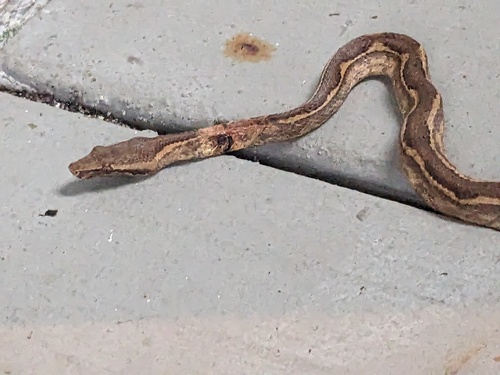
In general terms, Candoia are recognized by a heavy, muscular body, a relatively short tail, and a head that is distinctly set off from the neck with a flattened, angular snout. Coloration is typically cryptic, in browns, grays, reddish tones, and tans, often with darker blotches or a zigzag dorsal pattern that helps them blend into litter and bark. They are generally modest in length compared with the largest boas, which makes the blunt snout and thick build useful field cues.
Like other boas, Candoia are nonvenomous. They subdue prey by constriction, not venom, and are not considered dangerous to people. A wild snake of any kind may bite defensively if cornered or grabbed, so the sensible approach is to observe from a respectful distance and leave it undisturbed rather than attempt to handle a wild animal. If a bite does occur and there is any uncertainty about the snake or the wound, clean the area and seek medical advice; in the United States contact Poison Control at 1-800-222-1222, or call local emergency services in your area.
Ecologically, Candoia are ambush predators that feed on small vertebrates such as lizards, frogs, small mammals, and occasionally other prey, with diet shifting as the snake grows. A defining trait shared with other boas is reproduction: they are viviparous, giving birth to live young rather than laying eggs. Behaviorally they tend to be slow-moving and secretive, most active at night, relying on camouflage and stillness rather than speed to avoid notice.
Candoia belongs to the Boidae family (Boas). Powerful non-venomous constrictors that give birth to live young. Heavy body, smooth scales, and (in many species) heat-sensing pits along the lips. No rattle and no fangs.
Danger: Non-venomous and not dangerous to people. Large individuals are strong and can bite defensively, but they are not a venom threat.
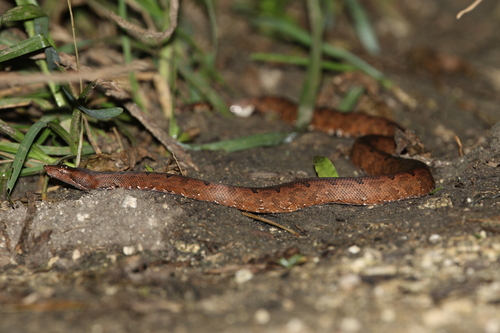
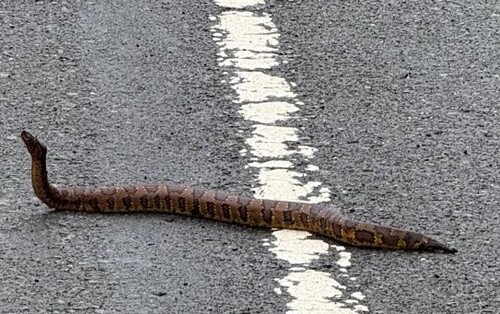
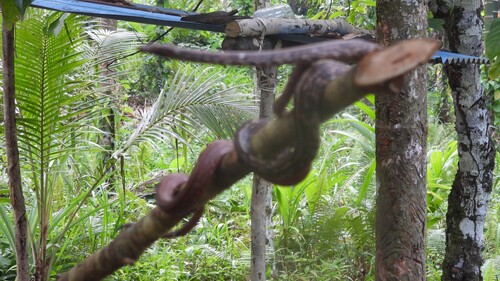
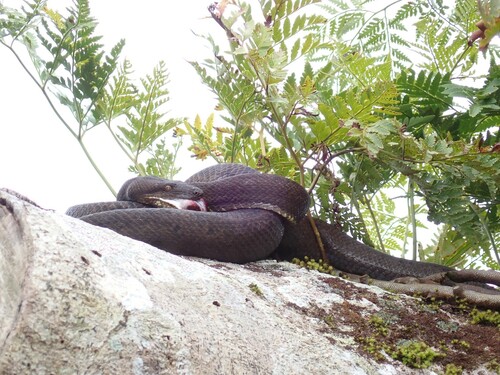
All species (5)
Keep learning
- What Is a Snake? Anatomy and the BasicsA clear overview of what makes a snake a snake: limbless body plan, anatomy, evolution from lizards, species diversity, and why they are ectothermic.
- How Snakes Move, Hunt, and EatHow snakes move without legs, hunt as ambushers or active foragers, kill by constriction or venom, and swallow prey wider than their head.
- What Do Snakes Eat?All snakes are carnivores. Learn what snakes eat, how diet changes with size and age, how often they feed, and how they hunt and swallow prey.
- Venomous vs Nonvenomous: How to Tell the DifferenceThe folk rules for telling venomous snakes apart, where each one fails, and why location-based identification beats guessing by sight.