
Colubridae
Opisthotropis hungtai
HarmlessThis species has no widely used English common name.

Opisthotropis hungtai is a non-venomous snake in the Colubridae family, recorded in 1 country.
- Family
- Colubridae
About the Opisthotropis hungtai
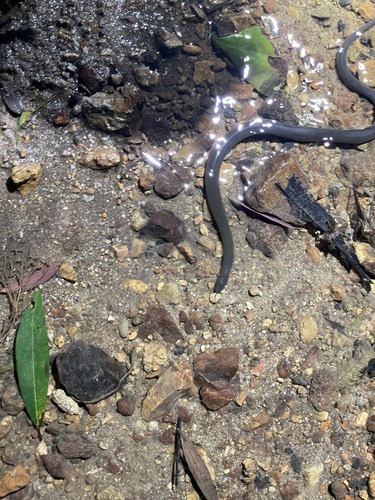
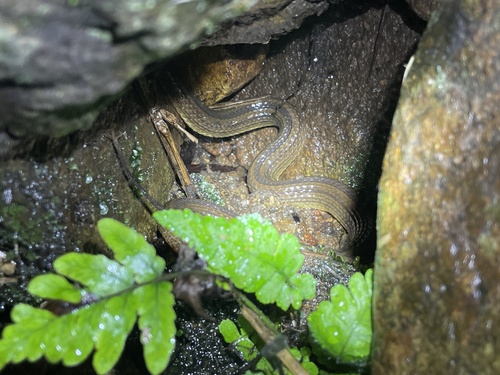
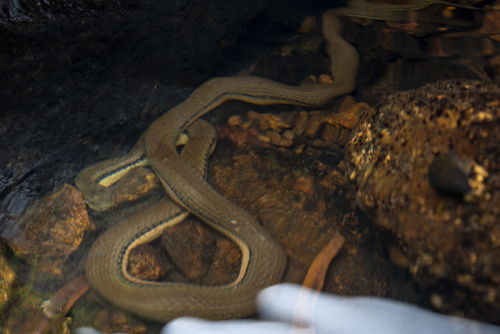
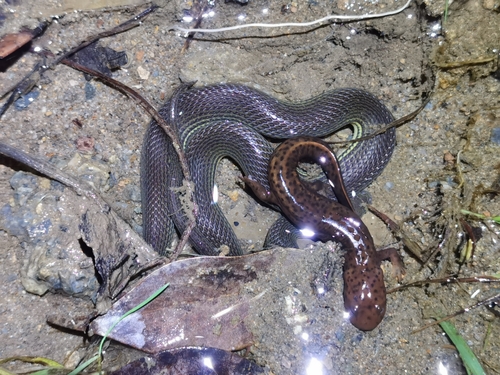
Opisthotropis hungtai, also known as Hung-Ta Chang's mountain keelback, is a species of snake in the family Colubridae. It is a slender, cylindrical snake with a total length of 393.2–511 cm (155–201 in), snout–vent length of 312–413 cm (123–163 in), and tail length of 81.2–180.5 cm (31.97–71.06 in). The upper side of the head is glossy dark with scattered yellow flecking, the chin shields are yellow with brownish-black mottling at the margins, and eyes are black. The body and tail are glossy dark brown with a single yellow spot on each scale, the ventral scales are yellow with brownish-black margins and flecking, and the subcaudal scales yellow with brownish-black margins. Hung-Ta Chang's mountain keelback can be distinguished from other species in its genus by a combination of its measurements, scalation, and coloration.
The species is endemic to mountainous regions in China, where it has been collected from western Guangdong and southeastern Guangxi. It inhabits rocky streams surrounded by dense deciduous forest. It is threatened by the illegal wildlife trade and requires further study to better understand its population size and distribution.
Taxonomy
Opisthotropis hungtai was formally described by the Chinese herpetologist Jian Wang and his colleagues in 2020 based on an adult male specimen collected from the Heishiding Nature Reserve in Guangdong, China, in September 2014. Before the description of the species, specimens were misidentified as being O. maculosa by several authors between 2007 and 2018. The specific epithet huntai honors the Chinese botanist Hung-ta Chang, who founded the Tropical and Subtropical Forest Ecosystem Experimental Center in Heishiding Nature Reserve and helped advance ecological research in southern China. The authors of the description recommended the English common name 'Hung-Ta Chang's mountain keelback' and the Chinese common name 张氏后棱蛇 (Zhang Shi Hou Leng She).
Hung-Ta Chang's mountain keelback is one of over 20 species in the mountain keelback genus Opisthotropis in the family Colubridae. The 2020 study describing the species studied its relationship with 16 other species in its genus and found it to be most closely related to O. haihaensis; these two species were most closely related to a clade formed by O. voquyi and O. jacobi. The following cladogram shows relationships within this clade according to the 2020 study.
Description
Hung-Ta Chang's mountain keelback is a slender, cylindrical snake with a total length of 393.2–511 cm (155–201 in) in females and 464.3–501.2 cm (182.8–197.3 in) in males. The snout–vent length varies from 318–401.6 cm (125–158 in) in males and 312–413 cm (123–163 in) in females, while the tail length is 111.1–180.5 cm (43.74–71.06 in) in males and 81.2–99.6 cm (32.0–39.2 in) in females. The holotype male specimen had glossy dark brown scales with scattered yellow flecking on the upperside of the head, yellow chin shields with brownish black mottling at the margins, and black eyes. The body and tail are glossy dark brown with a single yellow spot on each scale, the spots getting larger towards the sides of the body. The ventral scales are yellow with brownish black lateral margins and a few scattered brown flecks, while the subcaudal scales are yellow with brownish black margins towards the front and sides. The scales on the body and tail are generally smooth, but are keeled on the underside of the tail. Other specimens of the species were very similar-looking to the holotype, but had more maxillary teeth, ventral scales, and subcaudal scales, and a relatively longer tail.
Adapted from Wikipedia, available under CC BY-SA.
Frequently asked: Opisthotropis hungtai
- Is the Opisthotropis hungtai venomous?
- No. The Opisthotropis hungtai is non-venomous and is not considered dangerous to humans. Like most snakes, it will retreat rather than bite when given the chance.
- Is the Opisthotropis hungtai poisonous?
- Snakes are venomous, not poisonous. "Poisonous" means harmful to eat or touch; "venomous" means injecting toxins through a bite. The Opisthotropis hungtai is neither poisonous nor venomous.
- Is the Opisthotropis hungtai dangerous?
- The Opisthotropis hungtai is not dangerous to humans. It has no medically significant venom and bites only defensively if cornered or handled.
- Where does the Opisthotropis hungtai live?
- The Opisthotropis hungtai has verified records in 1 country, including China. See the distribution section below for its full range.
Where it is found
More Colubridae snakes
 Anderson's Mountain KeelbackOpisthotropis andersonii
 Striped Stream SnakeOpisthotropis kuatunensis
 Bicoloured Stream SnakeOpisthotropis lateralis
 Sichuan Mountain KeelbackOpisthotropis latouchii
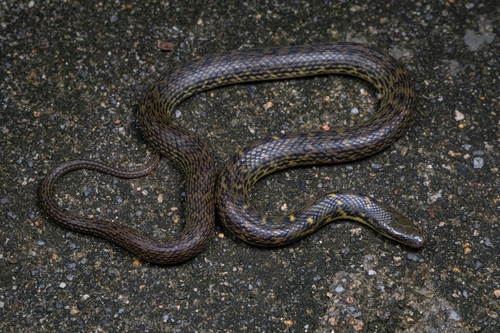 Opisthotropis cheniOpisthotropis cheni
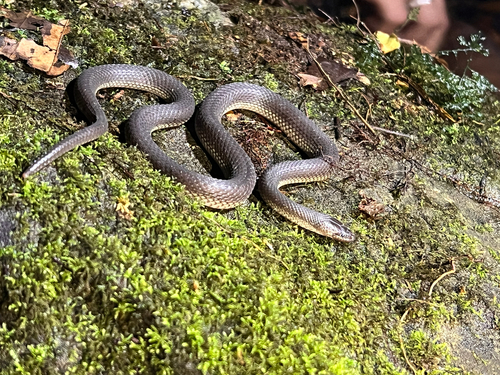 Olive Mountain KeelbackOpisthotropis typica
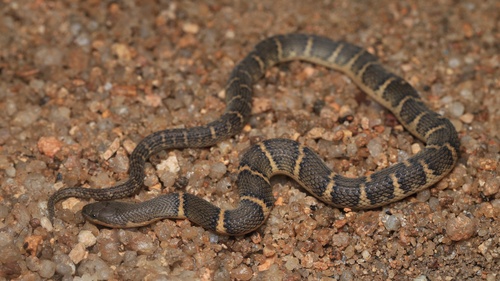 Opisthotropis lauiOpisthotropis laui
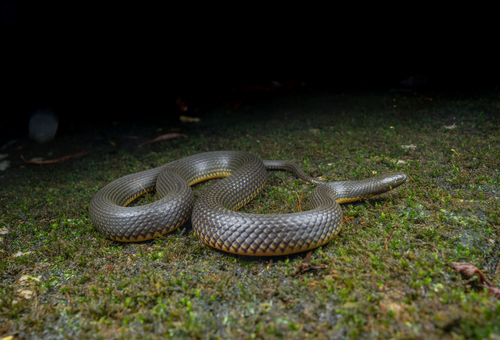 Shenzhen Mountain Stream SnakeOpisthotropis shenzhenensis
Classification
How scientists group this snake, from the broadest category down to the exact species. Each step narrows to its closest relatives.
- OrderThe broad group of scaled reptiles: all snakes and lizards
- Squamata
- FamilyA group of related snakes that share key traits
- Colubridae
- GenusA close-knit group of very similar species
- Opisthotropis
- SpeciesThis exact snake, named in the two-part scientific name
- Opisthotropis hungtai
Keep learning
- What to Do If You Find a SnakeFound a snake at home or on a trail? Here is how to stay calm, give it space, identify it safely, and know when to call a professional.
- Venomous vs Nonvenomous: How to Tell the DifferenceThe folk rules for telling venomous snakes apart, where each one fails, and why location-based identification beats guessing by sight.
- What Is a Snake? Anatomy and the BasicsA clear overview of what makes a snake a snake: limbless body plan, anatomy, evolution from lizards, species diversity, and why they are ectothermic.
- How to Keep Snakes Out of Your Yard and HomeA practical guide to keeping snakes out of your yard and home using habitat changes that work, plus what to skip and what to do if one shows up.
Distribution from GBIF & iNaturalist. Venom status per CDC. Background: Wikipedia. Informational only. Never handle a snake to identify it.