
Anomochilidae
Mountain Pipe Snake
HarmlessAnomochilus monticola

The Mountain Pipe Snake (Anomochilus monticola) is a non-venomous snake in the Anomochilidae family, recorded in 2 countries.
- Family
- Anomochilidae
About the Mountain Pipe Snake
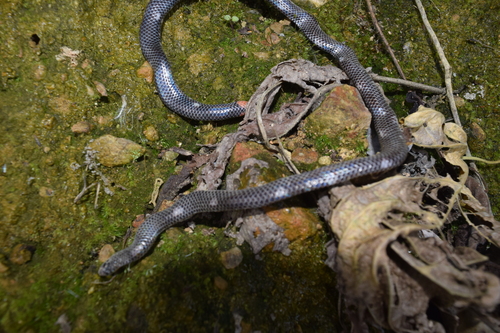
Anomochilus monticola, the Kinabalu giant blind snake, mountain pipe snake, or Mount Kinabalu dwarf pipesnake, is a species of snake in the dwarf pipesnake family Anomochilidae. It is endemic to Kinabalu Park in northern Borneo, where it inhabits montane and submontane rainforest at altitudes of 1,450–1,513 m (4,760–4,960 ft). Described by the herpetologist Indraneil Das and colleagues in 2008, the species is a stout, cylindrical snake with a small head and short, conical tail. It is the largest species in its genus, with a total length of 521 mm (20.5 in). It is mostly iridescent blue-black in color, with a deep brown belly, large pale horn-colored blotches along the underside, a chrome orange band around the tail, a pale creamy-yellow bar across the snout, and pale horn-colored speckles along its sides. It can be told apart from the other species in its genus by its large size, the absence of a stripe along its sides, and the lack of pale blotches on its back.
The species is nocturnal and fossorial (adapted to living underground). It most likely feeds on earthworms, snakes, and legless lizards. Reproduction in the snake has not been observed, but other species in its genus lay eggs, unusually for their superfamily, where most species give birth to live young. The IUCN Red List currently classifies A. monticola as being data deficient due to a lack of information about its range and threats to the species.
Taxonomy and systematics
Anomochilus monticola was first described by the herpetologist Indraneil Das and colleagues in 2008 on the basis of a female specimen collected from Kinabalu Park, Borneo, in 2004. Previously collected specimens of the species had been incorrectly identified as Cylindrophis ruffus. The specific name monticola is Latin for "inhabitant of mountains", referring to the species's type locality, Mount Kinabalu.
A. monticola is one of three species in the dwarf pipesnake genus Anomochilus, which is the only genus in the family Anomochilidae. Anomochilidae is one of three families in the superfamily Uropeltoidea, along with Uropeltidae and Cylindrophiidae. However, genetic studies indicate that Cylindrophiidae is paraphyletic (not containing all the descendants of a common ancestor) with respect to Anomochilidae, and some authorities merge the latter family into the former.
Description
Like other species in its genus, A. monticola is cylindrical, with a small, rounded head and short, conical tail. It is the largest Anomochilus snake, with a snout–vent length of 507–509 mm (19.96–20.04 in) and an average total length of 521.2 mm (20.52 in). It is mostly uniformly iridescent blue-black in color across the dorsum (upper body), with a chrome orange ring around the tail and a pale creamy-yellow bar across the snout. The underside is uniformly dark brown with large pale horn-colored blotches. The blotches occur in pairs, from the throat down to the tail. The species also has smaller pale horn-colored speckles along its sides. The head is continuous with the neck and, despite the fossorial (adapted to living underground) nature of the species, the snout has no reinforcements to aid in burrowing. The dorsum is smooth, with slightly larger scales than the underside.
Adapted from Wikipedia, available under CC BY-SA.
Frequently asked: Mountain Pipe Snake
- Is the Mountain Pipe Snake venomous?
- No. The Mountain Pipe Snake (Anomochilus monticola) is non-venomous and is not considered dangerous to humans. Like most snakes, it will retreat rather than bite when given the chance.
- Is the Mountain Pipe Snake poisonous?
- Snakes are venomous, not poisonous. "Poisonous" means harmful to eat or touch; "venomous" means injecting toxins through a bite. The Mountain Pipe Snake is neither poisonous nor venomous.
- Is the Mountain Pipe Snake dangerous?
- The Mountain Pipe Snake is not dangerous to humans. It has no medically significant venom and bites only defensively if cornered or handled.
- Where does the Mountain Pipe Snake live?
- The Mountain Pipe Snake has verified records in 2 countries, including Indonesia, Malaysia. See the distribution section below for its full range.
Where it is found
More Anomochilidae snakes
Classification
How scientists group this snake, from the broadest category down to the exact species. Each step narrows to its closest relatives.
- OrderThe broad group of scaled reptiles: all snakes and lizards
- Squamata
- FamilyA group of related snakes that share key traits
- Anomochilidae
- GenusA close-knit group of very similar species
- Anomochilus
- SpeciesThis exact snake, named in the two-part scientific name
- Anomochilus monticola
Keep learning
- What to Do If You Find a SnakeFound a snake at home or on a trail? Here is how to stay calm, give it space, identify it safely, and know when to call a professional.
- Venomous vs Nonvenomous: How to Tell the DifferenceThe folk rules for telling venomous snakes apart, where each one fails, and why location-based identification beats guessing by sight.
- What Is a Snake? Anatomy and the BasicsA clear overview of what makes a snake a snake: limbless body plan, anatomy, evolution from lizards, species diversity, and why they are ectothermic.
- How to Keep Snakes Out of Your Yard and HomeA practical guide to keeping snakes out of your yard and home using habitat changes that work, plus what to skip and what to do if one shows up.
Distribution from GBIF & iNaturalist. Venom status per CDC. Background: Wikipedia. Informational only. Never handle a snake to identify it.