
Pareidae
Baise slug-eating snake
HarmlessPareas baiseensis

The Baise slug-eating snake (Pareas baiseensis) is a non-venomous snake in the Pareidae family.
- Family
- Pareidae
About the Baise slug-eating snake
Pareas baiseensis, also known as the Baise slug-eating snake, is a non-venomous snake endemic to the Guangxi Zhuang Autonomous Region of China.
Description
Colouration
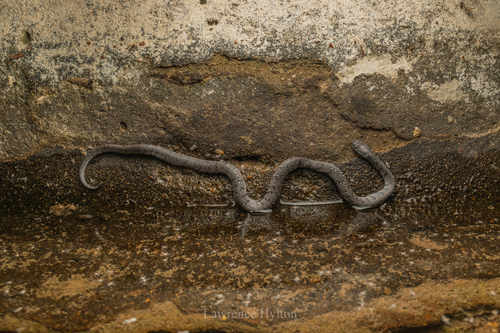
The dorsal surfaces of the head are light brown with dark brown spots. The sides of the head have two lateral postocular stripes. The upper postocular stripe extending from the temporal scales backward to the nape while the lower postocular stripe extends backwards past the ninth supralabial scale, also contacting the nape.
Two black lines on the back of the parietal scales extend back to the neck alongside the two postorbital stripes to form a dark black four-pointed fork-shaped nuchal collar where the inner two tines of the fork are shorter than the outer two.
The dorsum of the body is brown with dark-brown speckling, and about 35 irregular black crossbands spanning from neck to vent on the sides. The ventral scales are yellowish cream with scattered black spots- though the ventral color darkens toward the posterior- flanked by light brown subcaudal scales.
Scalation and size
All four specimens of Pareas baiseensis have 1 postocular scale, 2 preocular scales, 1 loreal scale, 9 infralabial scales and 8 supralabial scales on either side of their heads, though the number of subocular (3/3 for the adult, 2/2 for the juveniles), posterior temporal (3/3 in the adult, +/-1 on either side in juveniles), and anterior temporal scales (2/2 in juveniles, +1 on the right side in the adult) vary between the adult male holotype and the three juvenile unsexed paratypes.
About 190 ventral scales and 95 subcaudal scales are to be expected alongside an undivided cloacal plate. 15 dorsal scale rows can be found across the entire body, with one vertebral scale row enlarged and five medial dorsal scale rows keeled. The total length of the adult holotype is 579mm.
Behaviour
Like its congeners, Pareas baiseensis is a nocturnal, semi-arboreal, oviparous snail and slug-eating specialist.
Distribution
Pareas baiseensis is known only from its type locality in the Daleng Township of Youjiang District, near Baise City in China. The type series this species is known from were found late at night in a well-preserved subtropical broad-leafed evergreen forest at 750 to 790 metres above sea level after light rain at the very beginning of the autumn dry season.
Etymology
The specific epithet baiseensis refers to Baise City, which is near the locality of this species.
Adapted from Wikipedia, available under CC BY-SA.
Frequently asked: Baise slug-eating snake
- Is the Baise slug-eating snake venomous?
- No. The Baise slug-eating snake (Pareas baiseensis) is non-venomous and is not considered dangerous to humans. Like most snakes, it will retreat rather than bite when given the chance.
- Is the Baise slug-eating snake poisonous?
- Snakes are venomous, not poisonous. "Poisonous" means harmful to eat or touch; "venomous" means injecting toxins through a bite. The Baise slug-eating snake is neither poisonous nor venomous.
- Is the Baise slug-eating snake dangerous?
- The Baise slug-eating snake is not dangerous to humans. It has no medically significant venom and bites only defensively if cornered or handled.
- Why is it called the Baise slug-eating snake?
- The specific epithet baiseensis refers to Baise City, which is near the locality of this species.
More Pareidae snakes
Classification
How scientists group this snake, from the broadest category down to the exact species. Each step narrows to its closest relatives.
Keep learning
- What to Do If You Find a SnakeFound a snake at home or on a trail? Here is how to stay calm, give it space, identify it safely, and know when to call a professional.
- Venomous vs Nonvenomous: How to Tell the DifferenceThe folk rules for telling venomous snakes apart, where each one fails, and why location-based identification beats guessing by sight.
- What Is a Snake? Anatomy and the BasicsA clear overview of what makes a snake a snake: limbless body plan, anatomy, evolution from lizards, species diversity, and why they are ectothermic.
- How to Keep Snakes Out of Your Yard and HomeA practical guide to keeping snakes out of your yard and home using habitat changes that work, plus what to skip and what to do if one shows up.
Distribution from GBIF & iNaturalist. Venom status per CDC. Background: Wikipedia. Informational only. Never handle a snake to identify it.