
Genus · Colubridae
Types of vipers
10 species make up the genus Dryophylax, the snakes commonly called vipers. None are considered dangerous to humans.
About mock vipers
Mock vipers are small, rear-fanged South American colubrids that bluff like vipers, flattening the head and striking, while carrying only a mild venom geared toward small cold-blooded prey.
Dryophylax is a genus of rear-fanged snakes in the family Colubridae, the largest and most diverse snake family. It belongs to the New World subfamily Dipsadinae, the dipsadine and xenodontine radiation that dominates South America. The genus has a tangled naming history: many of its members were long placed in the genus Thamnodynastes, and the name Dryophylax has been revived to hold a distinct group of these snakes. With 10 species in our database, it is a modest but ecologically interesting group, and the English name mock viper reflects how convincingly these harmless-to-most snakes imitate dangerous vipers.
The genus is Neotropical and centered on South America, with species spread across Brazil and neighboring countries in a range of warm, often seasonally wet habitats. Members turn up in open savanna and scrub such as the Brazilian cerrado and caatinga, in gallery forest and forest edge, and frequently around marshes, streams, and other wet ground where their cold-blooded prey is abundant. Like many small colubrids, they adapt to disturbed and semi-rural settings and are sometimes found near human habitation.
Recognizing mock vipers comes down to a set of general traits rather than one field mark, and confident species-level identification is genuinely difficult. They are small, slender snakes, usually well under a meter, with keeled body scales that give a rough texture and often a streaked or pinstriped pattern in browns, grays, and olive tones. The common name is earned by behavior and shape: when threatened they can flatten and broaden the head into a triangular, viper-like profile and strike repeatedly, a bluff that makes a harmless snake look like something to fear. Several species in this dataset carry the mock viper name, including the Keeled Sepia Snake, the Coastal Mock Viper, the Petrolina Mock Viper, and the Gambote Mock Viper.
On venom and safety, Dryophylax snakes are rear-fanged and only mildly venomous. They carry enlarged, grooved teeth at the back of the upper jaw and a Duvernoy's gland that produces a venom used to subdue small prey, not as a defense against large animals. Bites to people are uncommon and generally minor, typically causing local effects such as swelling, redness, and irritation, because the fangs sit far back and venom delivery to humans is inefficient. Even so, mildly venomous is not the same as harmless, individual reactions vary, and the viper-like bluffing display means these snakes are easy to misidentify as something far more dangerous. Never assume a wild snake is safe to pick up, do not handle a snake you cannot positively identify, and if anyone is bitten, treat it as a medical emergency and call US Poison Control at 1-800-222-1222 or your local emergency services.
Ecologically, mock vipers are small predators of wet and open landscapes. Their diet leans toward cold-blooded prey such as frogs, toads, tadpoles, small fish, and lizards, with the rear fangs and mild venom helping them subdue active, slippery animals. A notable point of biology is reproduction: unlike the many egg-laying colubrids, snakes of this group and their close relatives are typically live-bearing, giving birth to small litters rather than laying eggs, an adaptation common among South American dipsadines. Behaviorally they are most active at twilight and night, and their first defense is concealment and flight, with the dramatic head-flattening and striking display reserved for when they are cornered.
Dryophylax belongs to the Colubridae family (Colubrids). The largest snake family, and the one most snakes you meet belong to. Typically round pupils, a head only slightly wider than the neck, and no heat-sensing facial pit or rattle. Scales may be smooth and glossy or keeled and matte depending on the species.
Danger: Almost all colubrids are harmless. A small number are rear-fanged with medically significant venom, the boomslang and the twig (vine) snakes of Africa being the dangerous exceptions. Most colubrids will flee or bluff rather than bite.
All species (10)
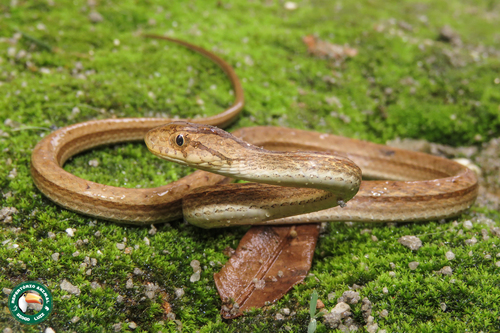 Keeled Sepia SnakeDryophylax hypoconiaHarmless
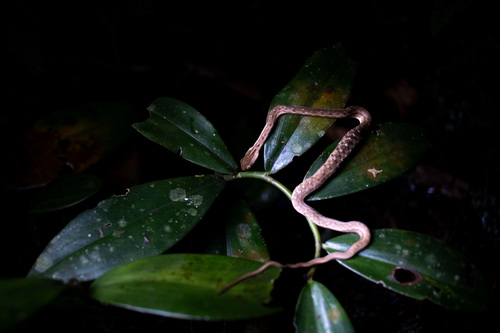 Coastal Mock ViperDryophylax nattereriHarmless
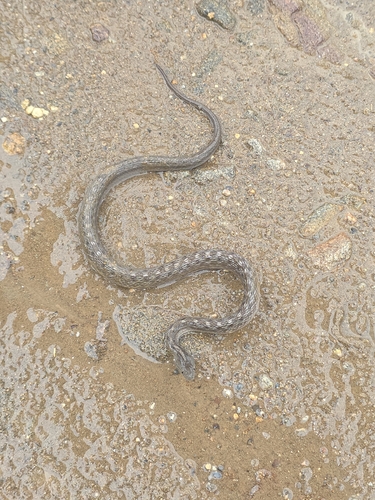 Petrolina Mock ViperDryophylax phoenixHarmless
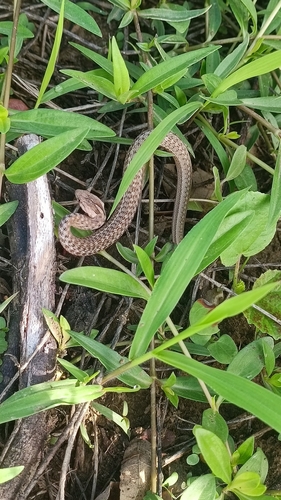 Gambote Mock ViperDryophylax gambotensisHarmless
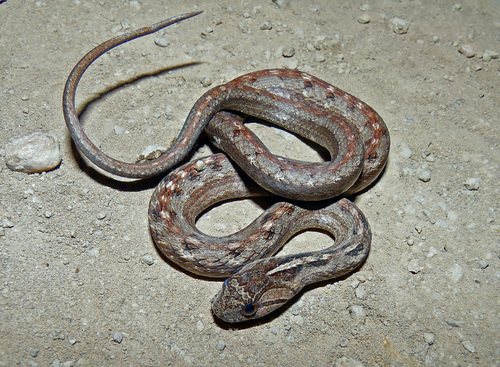 Chaco Sepia SnakeDryophylax chaquensisHarmless
 Paraguana Mock ViperDryophylax paraguanaeHarmless
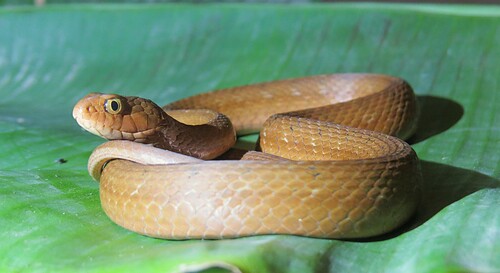 Jararaca Mock ViperDryophylax almaeHarmless
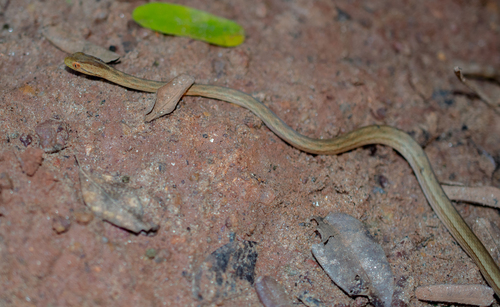 Double-lined Water SnakeDryophylax ramonriveroiHarmless
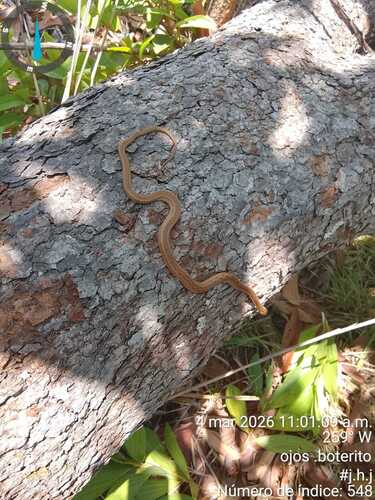 Apure Mock ViperDryophylax dixoniHarmless
- No photoRoze's Coastal House SnakeDryophylax chimantaHarmless
Keep learning
- What Is a Snake? Anatomy and the BasicsA clear overview of what makes a snake a snake: limbless body plan, anatomy, evolution from lizards, species diversity, and why they are ectothermic.
- How Snakes Move, Hunt, and EatHow snakes move without legs, hunt as ambushers or active foragers, kill by constriction or venom, and swallow prey wider than their head.
- What Do Snakes Eat?All snakes are carnivores. Learn what snakes eat, how diet changes with size and age, how often they feed, and how they hunt and swallow prey.
- Venomous vs Nonvenomous: How to Tell the DifferenceThe folk rules for telling venomous snakes apart, where each one fails, and why location-based identification beats guessing by sight.