
Genus · Boidae
Calabaria
The genus Calabaria contains a single species. It is not considered dangerous to humans.
About African burrowing python
A single stout, blunt-nosed boid built for a life spent tunneling through the soils of West and Central Africa.
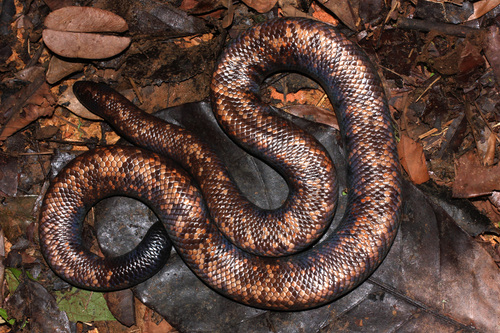
Calabaria is a monotypic genus, meaning it contains just one species: Calabaria reinhardtii, the African burrowing python. Despite the common name, it is not a true python at all. Modern classification places it within the family Boidae, the boas, where it is often treated in its own subfamily. It is a small, heavy-bodied snake with smooth scales, a cylindrical shape, and a short blunt tail that closely resembles its head. That tail mimicry is a defense: when threatened the snake hides its real head and waves the tail as a decoy, and it may also roll into a tight ball, a behavior that has earned it comparison to the unrelated ball python.
The species ranges across the rainforest belt of West and Central Africa, including countries such as Nigeria, Cameroon, Gabon, and the Congo basin. It is a dedicated burrower that spends most of its life underground or under leaf litter, loose soil, and forest debris in moist lowland forest. Its build reflects that lifestyle: small smooth-scaled body, reduced eyes, a reinforced skull, and a rounded snout suited to pushing through earth. Adults are modest in size, typically reaching roughly three feet, making it one of the smaller members of the boa family.
Calabaria reinhardtii is non-venomous and harmless to people. Like all boas it kills by constriction, feeding mainly on small mammals, and it is known for raiding rodent nests to eat nestlings rather than tackling large prey. It reproduces by laying eggs, which is unusual within Boidae since most boas give live birth, and this egg-laying trait was one reason it was long mistaken for a python. It is secretive and rarely seen, relying on hiding, balling up, and tail decoys rather than biting. Because it carries no venom, there is no medical danger from this snake, though as with any wild animal it should be observed and not handled unnecessarily.
Calabaria belongs to the Boidae family (Boas). Powerful non-venomous constrictors that give birth to live young. Heavy body, smooth scales, and (in many species) heat-sensing pits along the lips. No rattle and no fangs.
Danger: Non-venomous and not dangerous to people. Large individuals are strong and can bite defensively, but they are not a venom threat.
All species (1)
Keep learning
- What Is a Snake? Anatomy and the BasicsA clear overview of what makes a snake a snake: limbless body plan, anatomy, evolution from lizards, species diversity, and why they are ectothermic.
- How Snakes Move, Hunt, and EatHow snakes move without legs, hunt as ambushers or active foragers, kill by constriction or venom, and swallow prey wider than their head.
- What Do Snakes Eat?All snakes are carnivores. Learn what snakes eat, how diet changes with size and age, how often they feed, and how they hunt and swallow prey.
- Venomous vs Nonvenomous: How to Tell the DifferenceThe folk rules for telling venomous snakes apart, where each one fails, and why location-based identification beats guessing by sight.