
Genus · Elapidae
Types of adders
8 species make up the genus Acanthophis, the snakes commonly called adders. All of them are venomous.
About death adders
Death adders are one of evolution's great impostors: true elapids, cousins of cobras and brown snakes, that have come to look and hunt almost exactly like the vipers found on other continents.
Acanthophis belongs to the family Elapidae, the same lineage as cobras, mambas, taipans and the Australian brown snakes. Yet a death adder looks nothing like its relatives. It has a short, thick, muscular body, a broad triangular head set off from the neck, and a thin tapering tail. That viper-like build is a textbook case of convergent evolution: while most elapids are slender, fast-moving active hunters, death adders independently arrived at the same body plan and lifestyle as the unrelated true vipers, because both solve the same problem of sitting still and ambushing prey. Our database lists 8 species in the genus, including the Southern Death Adder, Northern Death Adder, Rough-scaled Death Adder, New Guinea Death Adder and Pilbara Death Adder, and all 8 are venomous.
The genus is native to Australia and New Guinea, where different species occupy forest, woodland and scrub. They are heavily camouflaged, with banded or mottled patterns in browns, greys and reddish tones that blend into leaf litter, sand and soil. Rather than roam in search of food, a death adder settles into one spot and waits, often shuffling backward until it is partly buried with only the head and tail tip exposed. A single ambush site can serve it for days.
Their signature behavior is caudal luring. With the body hidden, the snake twitches the slender, pale tip of its tail so that it resembles a wriggling grub or worm. Lizards, birds and frogs that approach the apparent meal are met instead by the snake, which delivers what is reported to be the fastest strike of any Australian snake, drawing back to ambush position in a fraction of a second. This lie-in-wait strategy, combined with strong camouflage, makes the death adder an efficient predator that expends very little energy.
Death adder venom contains potent neurotoxins that can interfere with the signals between nerves and muscles and lead to paralysis. Before effective antivenom was available, bites from these snakes were frequently fatal, which is the most common explanation for the name; some sources instead suggest it is a corruption of an older term, sometimes given as 'deaf adder.' Ecologically they are ambush specialists that can remain motionless for long stretches, and unlike many snakes they give birth to live young rather than laying eggs.
For people, the danger comes from exactly what makes them successful hunters. Because a death adder stays still and is so well hidden, including alongside trails and in leaf litter, a person can walk up to or nearly step on one without seeing it. A bite is a medical emergency. No wild venomous snake should ever be handled, and the right response is not first aid improvised in the field but professional emergency care. In Australia, call 000 and get the person to hospital, where antivenom and monitoring can be provided. Treat any death adder as a snake to observe from a safe distance and never to touch.
Acanthophis belongs to the Elapidae family (Cobras, mambas, coral & sea snakes). Front-fanged venomous snakes, many with potent neurotoxic venom. Usually slender with a head barely wider than the neck and fixed front fangs (not the folding fangs of vipers). Coral snakes are boldly ringed; sea snakes have a flattened, paddle-like tail.
Danger: All elapids are venomous and the family is responsible for a large share of fatal snakebites worldwide. Many are shy, but bites can be life-threatening. Treat any bite as a medical emergency.
All species (8)
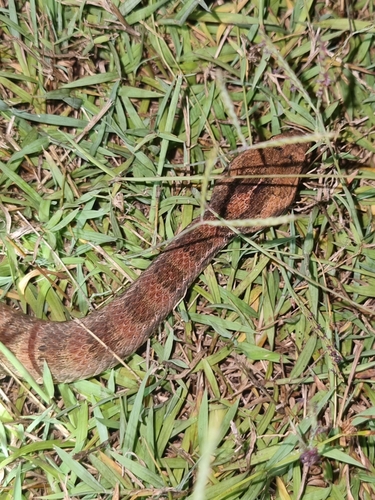 Southern Death AdderAcanthophis antarcticusVenomous
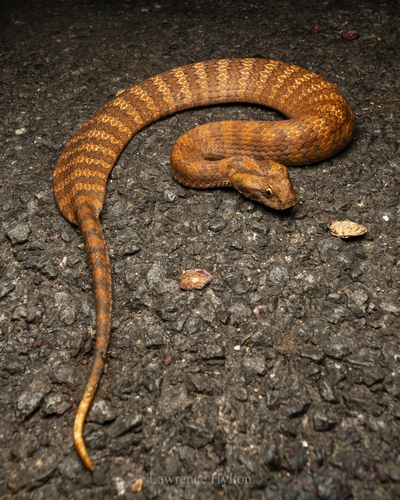 Northern Death AdderAcanthophis praelongusVenomous
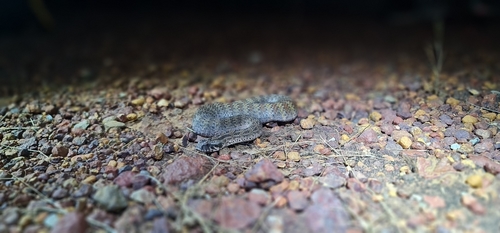 Rough-scaled Death AdderAcanthophis rugosusVenomous
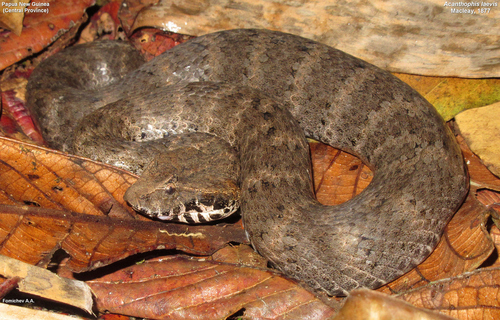 New Guinea Death AdderAcanthophis laevisVenomous
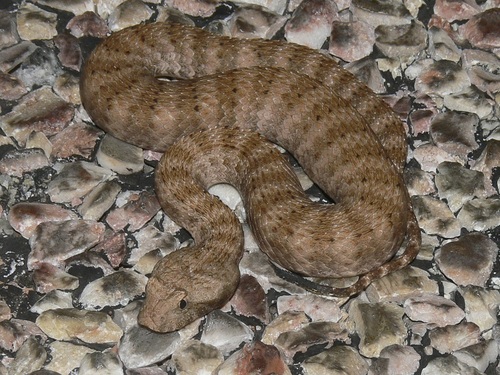 Pilbara Death AdderAcanthophis wellsiVenomous
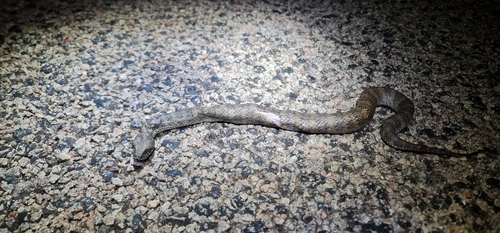 Plains Death AdderAcanthophis hawkeiVenomous
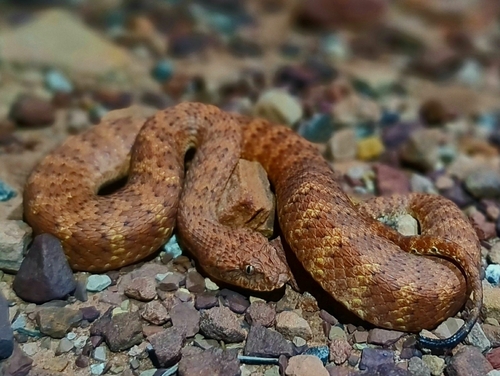 Desert Death AdderAcanthophis pyrrhusVenomous
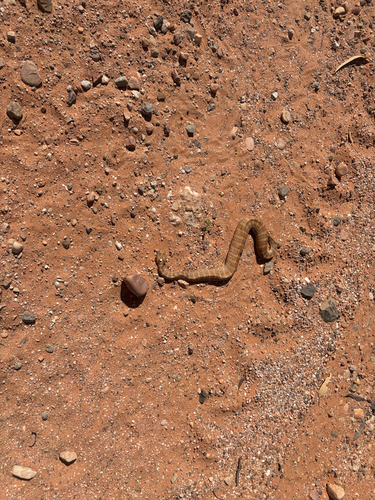 Kimberley Death AdderAcanthophis cryptamydrosVenomous
Keep learning
- Venomous vs Nonvenomous: How to Tell the DifferenceThe folk rules for telling venomous snakes apart, where each one fails, and why location-based identification beats guessing by sight.
- Are Snakes Dangerous? The Real Risk, in PerspectiveMost snakes are harmless and avoid people. Here is the honest picture of snakebite risk worldwide and how to lower your own.
- Snake Venom Explained: How It Works and WhyWhat snake venom actually is, why it evolved, the main venom types, fang delivery, how antivenom works, and why ranking the most venomous snake is hard.
- How Snakes Move, Hunt, and EatHow snakes move without legs, hunt as ambushers or active foragers, kill by constriction or venom, and swallow prey wider than their head.