
Homalopsidae
Cat-eyed Fishing Snake
HarmlessGerarda prevostiana
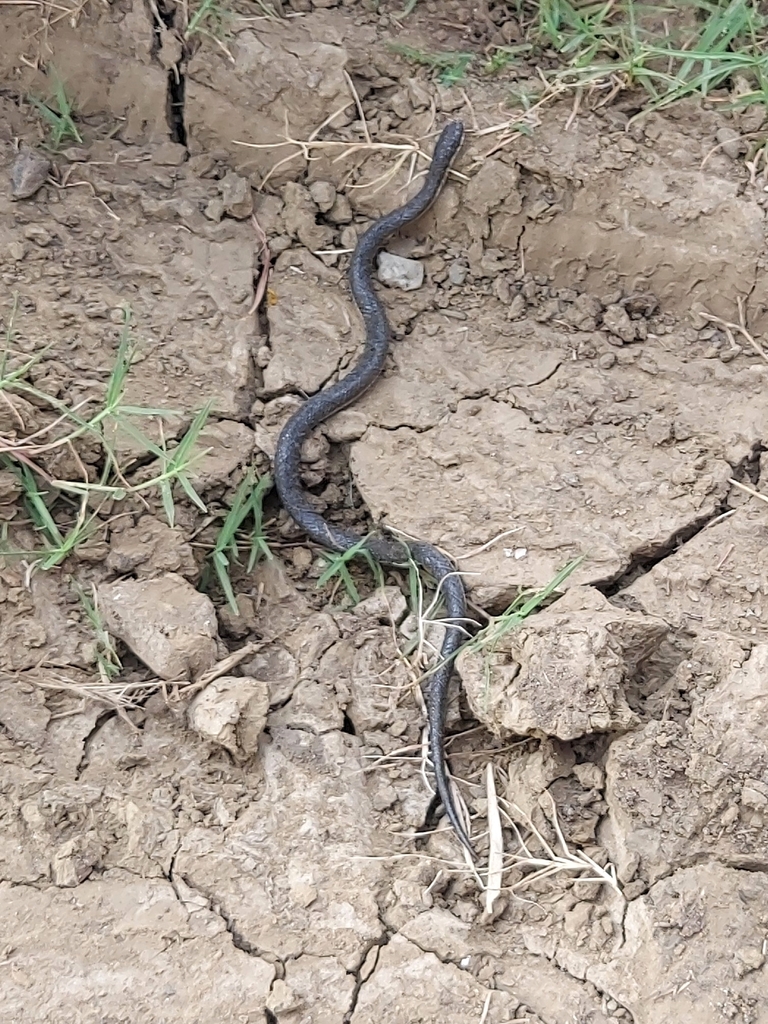
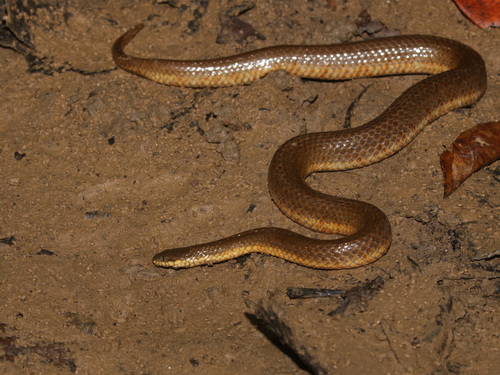
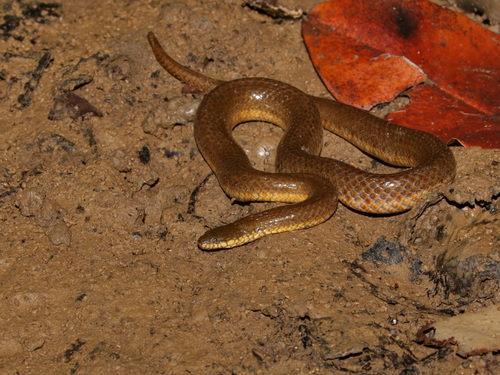
3 photographs of the Cat-eyed Fishing Snake. © Ramesh Shenai Jr..
The Cat-eyed Fishing Snake (Gerarda prevostiana) is a non-venomous snake in the Homalopsidae family.
- Family
- Homalopsidae
About the Cat-eyed Fishing Snake
Gerarda prevostiana, commonly known as the cat-eyed water snake, Gerard's water snake, and the glossy marsh snake, is a species of snake in the family Homalopsidae. The species is endemic to Asia. It is the only species in the genus Gerarda.
Etymology
The generic name, Gerarda, is in honor of someone named "Gerard". Unfortunately, John Edward Gray, who named the genus in 1849, did not specify whom he was honoring. Two possibilities are Adam Gerard or Rev. Gerard R. Smith, both of whom sent specimens of reptiles to Gray at the British Museum.
The specific name, prevostiana, is in honor of French naturalist and illustrator Florent Prévost.
Diet
G. prevostiana feeds almost exclusively on crabs, which it tears into bite-sized pieces by pulling them through its coils, in contrast to most other snakes which swallow their prey whole.
Description
G. prevostiana has the following scalation. The frontal is a little longer than broad, shorter than its distance from the end of the snout, or than the parietals. The loreal is slightly longer than deep, a little smaller than the nasal. There is one preocular, and there are two postoculars. The temporals are arranged 1+2. There are eight upper labials, the fourth entering the eye. Four of the lower labials are in contact with the anterior chin shields. The anterior chin shields are much larger than the posterior chin shields. The dorsal scales are in 17 rows at midbody. The ventrals number 146–158. The anal is divided. The subcaudals number 31–34.
The body is uniform dark olive above, with three outer rows of scales whitish. The upper lip is white, and the rostral is dark olive. The ventrals and subcaudals are whitish, with dark edges.
The total length is 41 cm (16 inches), including the tail which is 5 cm (2 inches) long.
Geographic range
G. prevostiana is found in coastal areas between western India (Mumbai) to eastern Philippines; it occurs in India (including the Andaman Islands) Sri Lanka, Bangladesh, Myanmar, Thailand, Peninsular Malaysia, Singapore, Cambodia, Indonesia (Borneo: Sarawak), and the Philippines (Luzon).
Habitat
The preferred natural habitat of G. prevostiana is coastal areas, especially those with mangrove forest.
Behavior
G. prevostiana is terrestrial and nocturnal.
Reproduction
G. prevostiana is ovoviviparous.
Adapted from Wikipedia, available under CC BY-SA.
Frequently asked: Cat-eyed Fishing Snake
- Is the Cat-eyed Fishing Snake venomous?
- No. The Cat-eyed Fishing Snake (Gerarda prevostiana) is non-venomous and is not considered dangerous to humans. Like most snakes, it will retreat rather than bite when given the chance.
- Is the Cat-eyed Fishing Snake poisonous?
- Snakes are venomous, not poisonous. "Poisonous" means harmful to eat or touch; "venomous" means injecting toxins through a bite. The Cat-eyed Fishing Snake is neither poisonous nor venomous.
- Is the Cat-eyed Fishing Snake dangerous?
- The Cat-eyed Fishing Snake is not dangerous to humans. It has no medically significant venom and bites only defensively if cornered or handled.
- What does the Cat-eyed Fishing Snake eat?
- G. prevostiana feeds almost exclusively on crabs, which it tears into bite-sized pieces by pulling them through its coils, in contrast to most other snakes which swallow their prey whole.
- Why is it called the Cat-eyed Fishing Snake?
- The generic name, Gerarda, is in honor of someone named "Gerard". Unfortunately, John Edward Gray, who named the genus in 1849, did not specify whom he was honoring. Two possibilities are Adam Gerard or Rev. Gerard R. Smith, both of whom sent specimens of reptiles to Gray at the British Museum. The specific name, prevostiana, is in honor of French naturalist and illustrator Florent Prévost.
More Homalopsidae snakes
 Southeast Asian BockadamCerberus schneiderii
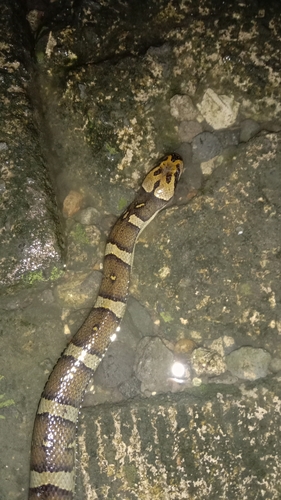 Puff-faced Water SnakeHomalopsis buccata
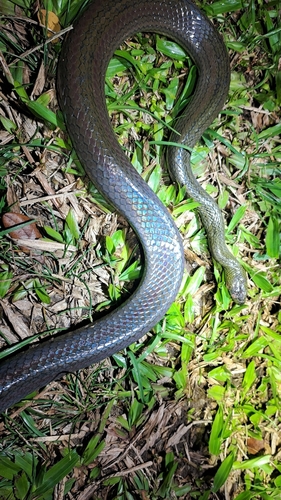 Rainbow Mud SnakeEnhydris enhydris
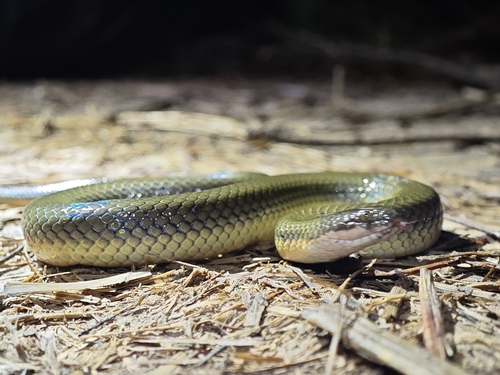 Murphy's Mud SnakeHypsiscopus murphyi
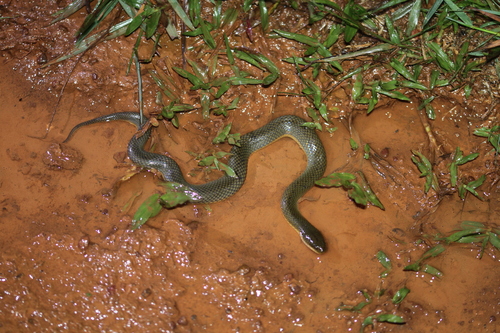 Rice Paddy SnakeHypsiscopus plumbeus
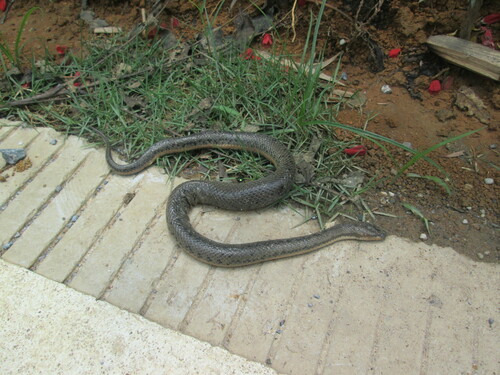 Chinese Water SnakeMyrrophis chinensis
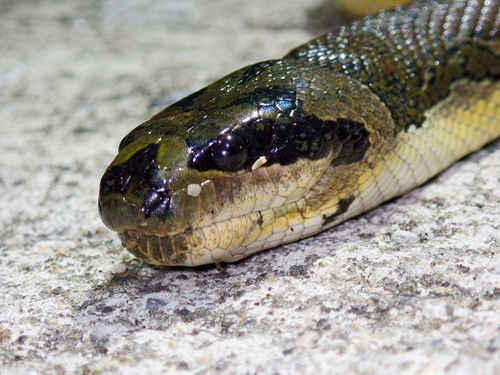 Jack's Water SnakeHomalopsis mereljcoxi
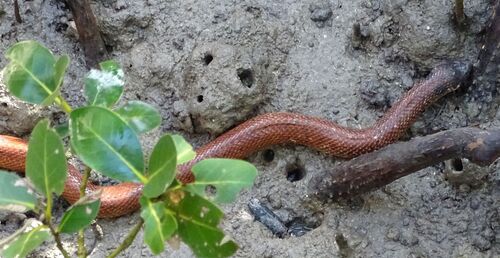 White-bellied Mangrove SnakeFordonia leucobalia
Classification
How scientists group this snake, from the broadest category down to the exact species. Each step narrows to its closest relatives.
- OrderThe broad group of scaled reptiles: all snakes and lizards
- Squamata
- FamilyA group of related snakes that share key traits
- Homalopsidae
- GenusA close-knit group of very similar species
- Gerarda
- SpeciesThis exact snake, named in the two-part scientific name
- Gerarda prevostiana
Keep learning
- What to Do If You Find a SnakeFound a snake at home or on a trail? Here is how to stay calm, give it space, identify it safely, and know when to call a professional.
- Venomous vs Nonvenomous: How to Tell the DifferenceThe folk rules for telling venomous snakes apart, where each one fails, and why location-based identification beats guessing by sight.
- What Is a Snake? Anatomy and the BasicsA clear overview of what makes a snake a snake: limbless body plan, anatomy, evolution from lizards, species diversity, and why they are ectothermic.
- How to Keep Snakes Out of Your Yard and HomeA practical guide to keeping snakes out of your yard and home using habitat changes that work, plus what to skip and what to do if one shows up.
Distribution from GBIF & iNaturalist. Venom status per CDC. Background: Wikipedia. Informational only. Never handle a snake to identify it.