
Genus · Boidae
Types of boas
2 species make up the genus Ungaliophis, the snakes commonly called boas. None are considered dangerous to humans.
About dwarf boas
Tiny, secretive Central American boas that spend their lives in leaf litter and trees, not in coils around prey.
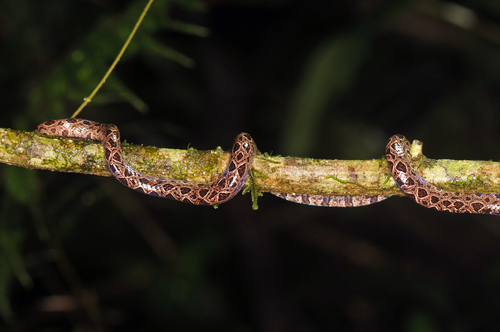
Ungaliophis is a small genus of dwarf boas in the family Boidae, holding just two species: the Panamanian dwarf boa (Ungaliophis panamensis) and the Isthmian or Continental dwarf boa (Ungaliophis continentalis). They belong to a group of diminutive New World boas sometimes placed in their own subfamily, Ungaliophiinae, alongside relatives like the Mexican burrowing boas. As their name suggests, these are among the smallest members of the boa lineage, a world away from the heavy-bodied boa constrictors people usually picture.
The two species range through parts of Mexico and Central America, from southern Mexico through Guatemala and Honduras down into Panama and adjacent regions. They favor humid forest, where they live a hidden life in leaf litter, rotting logs, low vegetation, and the tangle of epiphytes and bromeliads in trees. Recognizing one comes down to a few general traits: a slender body rarely exceeding a half meter to roughly 75 cm, a narrow head only slightly distinct from the neck, and muted brown to grayish coloration often marked with a row of darker blotches that helps them disappear against bark and dead leaves.
Like all boas, Ungaliophis is non-venomous and harmless to people; these snakes kill small prey such as lizards, frogs, and likely small invertebrates by constriction, not by a bite that injects venom. They are nocturnal and reclusive, and as boas they give birth to live young rather than laying eggs. Because they are so small and so seldom encountered, much of their detailed natural history remains poorly studied. There is no first-aid concern with a non-venomous snake, but the general rule still holds: do not handle wild snakes, and if any snakebite ever occurs and you are unsure of the species, seek emergency care and contact US Poison Control at 1-800-222-1222 or your local emergency services.
Ungaliophis belongs to the Boidae family (Boas). Powerful non-venomous constrictors that give birth to live young. Heavy body, smooth scales, and (in many species) heat-sensing pits along the lips. No rattle and no fangs.
Danger: Non-venomous and not dangerous to people. Large individuals are strong and can bite defensively, but they are not a venom threat.
All species (2)
Keep learning
- What Is a Snake? Anatomy and the BasicsA clear overview of what makes a snake a snake: limbless body plan, anatomy, evolution from lizards, species diversity, and why they are ectothermic.
- How Snakes Move, Hunt, and EatHow snakes move without legs, hunt as ambushers or active foragers, kill by constriction or venom, and swallow prey wider than their head.
- What Do Snakes Eat?All snakes are carnivores. Learn what snakes eat, how diet changes with size and age, how often they feed, and how they hunt and swallow prey.
- Venomous vs Nonvenomous: How to Tell the DifferenceThe folk rules for telling venomous snakes apart, where each one fails, and why location-based identification beats guessing by sight.