
Genus · Colubridae
Rhynchocalamus
4 species make up the genus Rhynchocalamus. None are considered dangerous to humans.
About dwarf snakes
Small, secretive burrowing colubrids of the Middle East and North Africa, most easily known by their dark head cap over a pale body.
Rhynchocalamus is a genus of small snakes in the family Colubridae, the largest and most varied snake family in the world. Members are commonly grouped under the name dwarf snakes, a reference to their slim, modest size rather than to any single distinctive trait. They belong to the broad assemblage of ground-dwelling colubrids built for life in dry, rocky, and semi-desert country.
The genus is centered on the Middle East and adjacent North Africa, with species recorded across parts of the Levant, Arabia, and into Turkey and Iran. Typical habitat is arid and semi-arid terrain: rocky hillsides, stony scrub, and sandy or gravelly ground where the snakes can shelter under stones or in soil. Like many small ground snakes, they spend much of their time hidden and are most active in milder hours, which makes them rarely seen even where they occur.
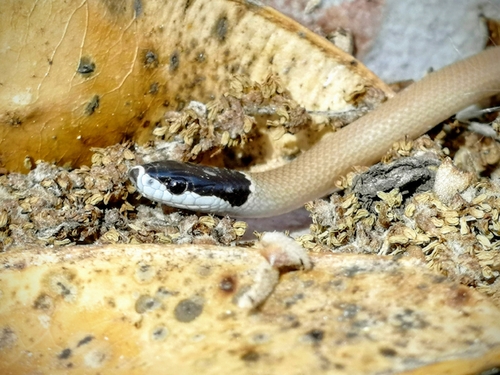
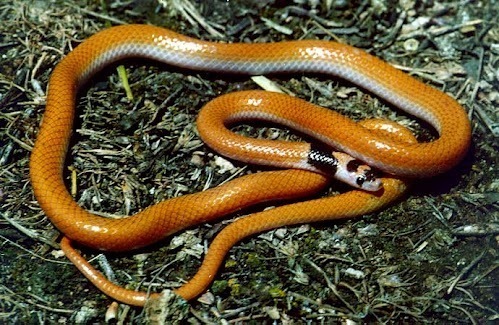
In general terms, members are slender and short, with a smooth, glossy body and a small head that is barely distinct from the neck. A frequent field feature is a dark head and nape marking, sometimes appearing as a black cap or collar, set against a paler, often reddish or pinkish-brown body. Several species carry common names that point straight at this pattern, including the Black-headed Ground Snake, the Hejaz Black-collared Snake, and the Palestine Kukri Snake. Precise coloration and scale counts vary between species, so confident identification usually depends on locality and close examination.
On safety: these are small colubrids regarded as harmless to people. They are not front-fanged venomous snakes like vipers or cobras, and they pose no medical danger in normal circumstances. As with many colubrids, exact venom-gland and tooth details across the genus are not well documented, so the responsible stance is to treat any wild snake as not for handling rather than to assume it is harmless to touch. Do not handle wild snakes. If a bite from any snake occurs and the species is uncertain or symptoms develop, contact emergency services or US Poison Control at 1-800-222-1222.
Ecologically, dwarf snakes fit the role of small ground predators. Like related slender burrowing colubrids, they are understood to feed on small prey such as invertebrates and small lizards, hunting in and around their cover rather than in the open. They are egg-laying, in keeping with most colubrids, and are generally inoffensive and quick to retreat. Their low profile and burrowing habits mean much of their natural history is still only partly known.
Rhynchocalamus belongs to the Colubridae family (Colubrids). The largest snake family, and the one most snakes you meet belong to. Typically round pupils, a head only slightly wider than the neck, and no heat-sensing facial pit or rattle. Scales may be smooth and glossy or keeled and matte depending on the species.
Danger: Almost all colubrids are harmless. A small number are rear-fanged with medically significant venom, the boomslang and the twig (vine) snakes of Africa being the dangerous exceptions. Most colubrids will flee or bluff rather than bite.
All species (4)
Keep learning
- What Is a Snake? Anatomy and the BasicsA clear overview of what makes a snake a snake: limbless body plan, anatomy, evolution from lizards, species diversity, and why they are ectothermic.
- How Snakes Move, Hunt, and EatHow snakes move without legs, hunt as ambushers or active foragers, kill by constriction or venom, and swallow prey wider than their head.
- What Do Snakes Eat?All snakes are carnivores. Learn what snakes eat, how diet changes with size and age, how often they feed, and how they hunt and swallow prey.
- Venomous vs Nonvenomous: How to Tell the DifferenceThe folk rules for telling venomous snakes apart, where each one fails, and why location-based identification beats guessing by sight.