
Genus · Colubridae
Types of long-nosed snakes
3 species make up the genus Rhinocheilus, the snakes commonly called long-nosed snakes. None are considered dangerous to humans.
About long-nosed snakes
Slender, burrowing colubrids of North American deserts and grasslands, named for the upturned, slightly overhanging snout they use to dig.
Rhinocheilus is a small genus in the family Colubridae, the largest snake family and the group that contains most of the world's harmless snakes. The genus is best known by its single widespread species, the Long-nosed Snake, along with closely related forms recognized in Mexico and on islands in the Gulf of California. The name comes from the pointed, gently upturned rostral scale at the tip of the snout, a feature that gives these snakes their characteristic profile and aids in pushing through loose soil.
These are snakes of dry, open country. Their range centers on the southwestern United States and Mexico, including the Great Basin, Mojave, Sonoran, and Chihuahuan deserts, as well as arid grasslands, scrub, and rocky flats. They favor sandy or loose substrates where they can burrow, and they are largely nocturnal or active at dusk, spending the heat of the day underground or beneath cover. Members reach a moderate adult size, roughly 0.6 to 1 meter, and have a slim build suited to slipping through sparse vegetation and into rodent burrows.
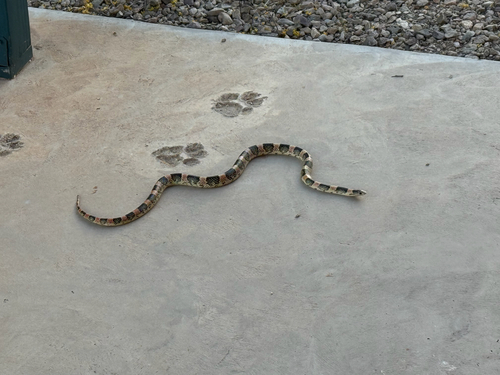
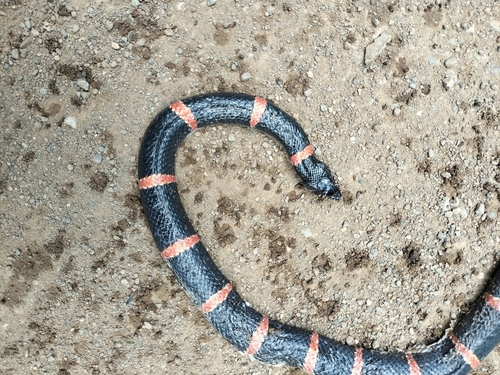
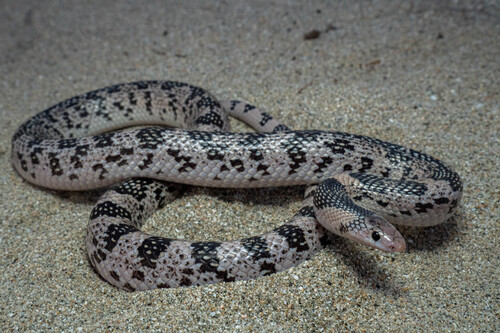
In general terms, members of this genus are recognized by the slender body, the pointed and slightly projecting snout, and a banded or saddled color pattern. The Long-nosed Snake often shows black and red saddles over a pale or cream ground, with fine flecking of light scales within the dark bands, a look that can superficially recall a kingsnake or even prompt a glance for coral snake coloration. A useful general field trait for this group is the largely single (undivided) row of scales beneath the tail, which differs from many similar colubrids.
Long-nosed snakes are nonvenomous and harmless to people. As colubrids of this type, they have no medically significant venom and are not dangerous to handle, though as with any wild animal the better practice is to observe and leave them be rather than pick them up. When threatened they may writhe, hide the head, vibrate the tail, and discharge musk or even blood from the cloaca as a defense, a startling display that is not a sign of any danger to humans.
Ecologically they are active predators that hunt by scent and burrowing. The diet includes lizards and their eggs, small rodents, smaller snakes, and amphibians, with prey often dug from burrows or taken at rest. Reproduction is by eggs (oviparous), with females laying a clutch in summer that hatches later in the season. Their secretive, fossorial habits mean they are encountered far less often than their broad range would suggest, frequently turning up only as nighttime road crossings in desert country.
Rhinocheilus belongs to the Colubridae family (Colubrids). The largest snake family, and the one most snakes you meet belong to. Typically round pupils, a head only slightly wider than the neck, and no heat-sensing facial pit or rattle. Scales may be smooth and glossy or keeled and matte depending on the species.
Danger: Almost all colubrids are harmless. A small number are rear-fanged with medically significant venom, the boomslang and the twig (vine) snakes of Africa being the dangerous exceptions. Most colubrids will flee or bluff rather than bite.
All species (3)
Keep learning
- What Is a Snake? Anatomy and the BasicsA clear overview of what makes a snake a snake: limbless body plan, anatomy, evolution from lizards, species diversity, and why they are ectothermic.
- How Snakes Move, Hunt, and EatHow snakes move without legs, hunt as ambushers or active foragers, kill by constriction or venom, and swallow prey wider than their head.
- What Do Snakes Eat?All snakes are carnivores. Learn what snakes eat, how diet changes with size and age, how often they feed, and how they hunt and swallow prey.
- Venomous vs Nonvenomous: How to Tell the DifferenceThe folk rules for telling venomous snakes apart, where each one fails, and why location-based identification beats guessing by sight.