
Genus · Colubridae
Types of corals
2 species make up the genus Rhinobothryum, the snakes commonly called corals. None are considered dangerous to humans.
About false coral snakes
A small genus of slender, brilliantly banded tree snakes that mimic the warning colors of true coral snakes.
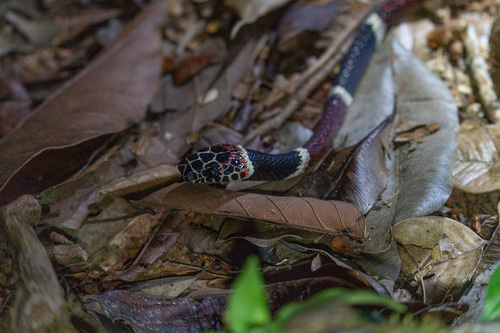
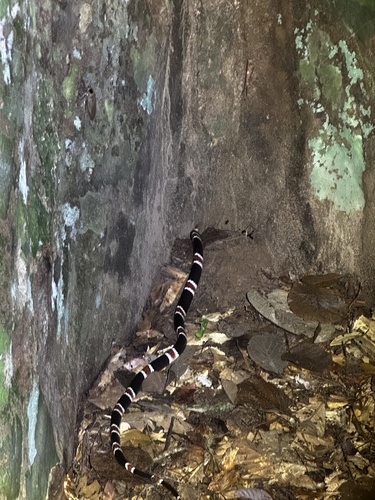
Rhinobothryum is a tiny genus in the family Colubridae, the largest snake family on earth, containing just two recognized species: the False Tree Coral (Rhinobothryum bovallii) of Central America and northwestern South America, and the Amazon Banded Snake (Rhinobothryum lentiginosum) of the Amazon Basin. Both are arboreal, meaning they spend much of their lives climbing through trees and shrubs rather than on the ground. Their most striking feature is bold banding in red, black, and pale yellow or white, a pattern that closely resembles the genuinely dangerous true coral snakes (genus Micrurus) that share their range. This is a textbook case of mimicry: the harmless or weakly venomous mimic gains protection by looking like a model that predators have learned to avoid.
These snakes range across humid lowland and foothill tropical forest from Honduras and Nicaragua down through Costa Rica, Panama, and into Colombia, Ecuador, and the wider Amazon Basin. They favor dense, wet forest where they move through vegetation at night, which makes them rarely seen even within their range. In general terms you recognize a Rhinobothryum by the combination of a slender body, a relatively long form built for climbing, large eyes suited to a nocturnal life, and the high-contrast red, black, and light banding that wraps the body. Telling a harmless mimic from a true coral snake by color alone is unreliable, because the patterns overlap and vary between regions.
Like many colubrids, Rhinobothryum snakes are rear-fanged, carrying enlarged grooved teeth at the back of the upper jaw and a mild venom used to subdue small prey such as lizards. They are not considered dangerous to people and there is no record of medically significant envenomation from this genus, but rear-fanged is not the same as harmless, and the close resemblance to true coral snakes is the real hazard. Because a banded red, black, and yellow snake in this region could be a deadly Micrurus, you should never handle a wild banded snake to identify it. If anyone is bitten by a snake they cannot positively identify as harmless, treat it as a medical emergency: keep the person calm and still, do not cut, suck, or apply a tourniquet, and call US Poison Control at 1-800-222-1222 or local emergency services right away. Beyond their diet of small reptiles and their nocturnal, tree-dwelling habits, these are egg-laying snakes typical of the colubrid family, and they are best appreciated from a respectful distance.
Rhinobothryum belongs to the Colubridae family (Colubrids). The largest snake family, and the one most snakes you meet belong to. Typically round pupils, a head only slightly wider than the neck, and no heat-sensing facial pit or rattle. Scales may be smooth and glossy or keeled and matte depending on the species.
Danger: Almost all colubrids are harmless. A small number are rear-fanged with medically significant venom, the boomslang and the twig (vine) snakes of Africa being the dangerous exceptions. Most colubrids will flee or bluff rather than bite.
All species (2)
Keep learning
- What Is a Snake? Anatomy and the BasicsA clear overview of what makes a snake a snake: limbless body plan, anatomy, evolution from lizards, species diversity, and why they are ectothermic.
- How Snakes Move, Hunt, and EatHow snakes move without legs, hunt as ambushers or active foragers, kill by constriction or venom, and swallow prey wider than their head.
- What Do Snakes Eat?All snakes are carnivores. Learn what snakes eat, how diet changes with size and age, how often they feed, and how they hunt and swallow prey.
- Venomous vs Nonvenomous: How to Tell the DifferenceThe folk rules for telling venomous snakes apart, where each one fails, and why location-based identification beats guessing by sight.