
Genus · Pseudaspididae
Pseudaspis
The genus Pseudaspis contains a single species. It is not considered dangerous to humans.
About mole snakes
A powerful, burrowing African constrictor that lives a near-subterranean life chasing rodents through their own tunnels.
Pseudaspis is a small genus in the family Pseudaspididae, a group of non-front-fanged African snakes. The genus is best known for a single widely recognized species, the mole snake (Pseudaspis cana), which ranges across much of southern Africa and into parts of East Africa. The family Pseudaspididae was split out from the broader colubroid snakes to group several African lineages that share a similar evolutionary history, and Pseudaspis sits alongside relatives such as the slug-eating snakes in that family. Mole snakes are robust, thick-bodied animals that can reach roughly 1.5 to 2 meters, making them one of the larger constrictors of the region.
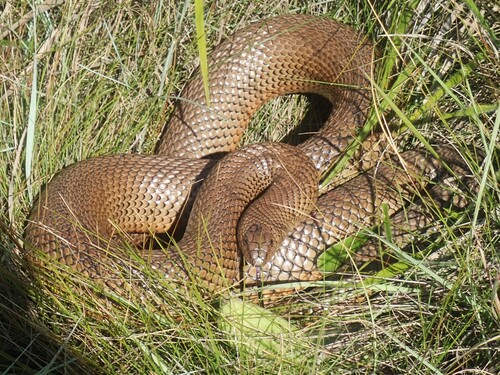
In general terms, mole snakes are heavy, smooth-scaled snakes with a small pointed head and a body color that varies widely from yellowish brown to gray, olive, or nearly black, with juveniles often patterned and adults usually plain. The pointed snout reflects their lifestyle. They spend much of their time underground in rodent burrows and loose soil across grassland, scrub, fynbos, and farmland habitats, where they hunt by following prey into tunnels. They are not venomous and kill by constriction, which makes them harmless in the medical sense, though a large mole snake can deliver a strong, painful bite when handled or cornered and should be left alone in the wild.
Ecologically, mole snakes are valued as rodent control because their diet centers on moles, mole-rats, and other small mammals, along with the occasional bird or reptile. They are notable among African snakes for giving live birth, producing large litters of young. Behaviorally they can be defensive when threatened, hissing and striking, but they pose no venom risk to people. As with any unfamiliar wild snake, the safe choice is to observe from a distance rather than handle it, and any serious bite or uncertainty about a snake's identity should be directed to local emergency services or a poison control center such as US Poison Control at 1-800-222-1222.
Pseudaspis belongs to the Pseudaspididae family (Mole snakes & allies). Robust African burrowers and their relatives. Mole snakes are heavy-bodied with a pointed snout; coloration varies widely.
Danger: Non-venomous, though a large mole snake can deliver a strong bite if cornered.
All species (1)
Keep learning
- What Is a Snake? Anatomy and the BasicsA clear overview of what makes a snake a snake: limbless body plan, anatomy, evolution from lizards, species diversity, and why they are ectothermic.
- How Snakes Move, Hunt, and EatHow snakes move without legs, hunt as ambushers or active foragers, kill by constriction or venom, and swallow prey wider than their head.
- What Do Snakes Eat?All snakes are carnivores. Learn what snakes eat, how diet changes with size and age, how often they feed, and how they hunt and swallow prey.
- Venomous vs Nonvenomous: How to Tell the DifferenceThe folk rules for telling venomous snakes apart, where each one fails, and why location-based identification beats guessing by sight.