
Genus · Pythonidae
Nyctophilopython
The genus Nyctophilopython contains a single species. It is not considered dangerous to humans.
About Oenpelli python
A single giant, secretive Australian python so distinct it sits in a genus of its own.
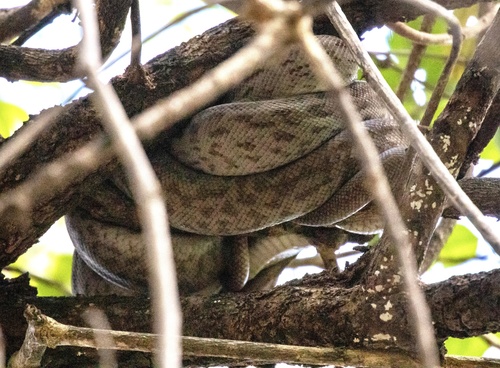
Nyctophilopython is a genus in the family Pythonidae that contains the Oenpelli rock python, a large nonvenomous python native to the rocky escarpment country of western Arnhem Land in Australia's Northern Territory. The name points to its night-loving habits, and the animal was only described by science in 1977, late even by python standards, because it lives in remote, rugged terrain and is rarely encountered. Some authorities place this species within the broader genus Morelia alongside the carpet and tree pythons, while others recognize Nyctophilopython as a separate genus; this disagreement reflects how isolated and unusual the species is rather than any doubt about its identity.
Like all pythons it is a constrictor, not a venomous snake. It has no venom, no fangs designed for delivering it, and is not dangerous to people in the way a venomous snake would be. It kills prey by gripping with backward-curving teeth and coiling to restrict breathing and circulation. As one of the longest snakes in Australia, a large adult can exceed several meters, and any big constrictor commands respect and careful handling, but the medical risk is mechanical rather than toxic. It is a nocturnal ambush and active hunter that climbs well among the sandstone outcrops it calls home, taking mammals, birds, and other vertebrates, and it changes color noticeably between day and night.
As a python, Nyctophilopython belongs to the Old World group of egg-laying constrictors centered on Africa, Asia, and Australasia, distinct from the live-bearing boas. The female lays a clutch of eggs and coils around them to incubate, a hallmark of pythons. Within Pythonidae this genus represents the extreme end of Australian python diversity, a single rock-country specialist adapted to a narrow range. Because it is so localized and seldom seen, treat any large wild python with caution and respect, leave it undisturbed, and contact local wildlife authorities rather than handling it. If anyone is bitten by a large snake and the species is uncertain, seek medical care; in the US call Poison Control at 1-800-222-1222, and elsewhere contact local emergency services.
Nyctophilopython belongs to the Pythonidae family (Pythons). Old-World egg-laying constrictors, including the longest snakes on Earth. Large and heavy-bodied with blotched or banded patterns, smooth scales, and heat-sensing pits along the lips. No rattle or fangs.
Danger: Non-venomous. Only the very largest species could be a physical danger, and bites are defensive, not venomous.
All species (1)
Keep learning
- What Is a Snake? Anatomy and the BasicsA clear overview of what makes a snake a snake: limbless body plan, anatomy, evolution from lizards, species diversity, and why they are ectothermic.
- How Snakes Move, Hunt, and EatHow snakes move without legs, hunt as ambushers or active foragers, kill by constriction or venom, and swallow prey wider than their head.
- What Do Snakes Eat?All snakes are carnivores. Learn what snakes eat, how diet changes with size and age, how often they feed, and how they hunt and swallow prey.
- Venomous vs Nonvenomous: How to Tell the DifferenceThe folk rules for telling venomous snakes apart, where each one fails, and why location-based identification beats guessing by sight.