
Genus · Loxocemidae
Loxocemus
The genus Loxocemus contains a single species. It is not considered dangerous to humans.
About Mexican burrowing python
A single secretive, iridescent digging snake that is the only living member of its entire family.
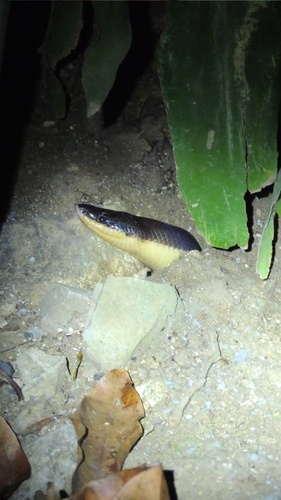
Loxocemus is a genus of just one species, the Mexican burrowing python (Loxocemus bicolor), and it is the sole living member of the family Loxocemidae. Despite the common name, it is not a true python. It sits on its own ancient branch of the snake family tree, near the boundary of the pythons and the New World burrowing pythonoids, which is why it gets a family all to itself. It ranges along the Pacific lowlands of Mexico through Central America to about Costa Rica, where it favors dry forest, scrub, and disturbed ground that it can dig into.
These are stout, smooth-scaled, medium-sized snakes, usually well under about 1.5 meters, with a noticeably pointed and reinforced snout suited to pushing through soil and leaf litter. The body is iridescent, often gray to brown above and paler below, frequently flecked with scattered white scales that increase with age. Like other primitive snakes, it retains small pelvic spurs near the vent, a vestige of hind limbs. Most people will never see one, because it spends much of its life underground or under cover and is most active at night.
The Mexican burrowing python is nonvenomous and harmless to people. It is a constrictor that eats small mammals, reptiles, and is notable for raiding the buried egg clutches of other reptiles, including iguanas and sea turtles. It lays eggs rather than bearing live young. It poses no danger and is not a snake anyone needs to handle, and like any wild animal it is best observed and left alone. If a bite from any snake ever causes concern, contact local emergency services or US Poison Control at 1-800-222-1222.
Loxocemus belongs to the Loxocemidae family (Mexican burrowing python). A single primitive, non-venomous burrowing snake of Central America. Heavy-bodied and iridescent, with a pointed snout adapted for burrowing.
Danger: Harmless. Non-venomous.
All species (1)
Keep learning
- What Is a Snake? Anatomy and the BasicsA clear overview of what makes a snake a snake: limbless body plan, anatomy, evolution from lizards, species diversity, and why they are ectothermic.
- How Snakes Move, Hunt, and EatHow snakes move without legs, hunt as ambushers or active foragers, kill by constriction or venom, and swallow prey wider than their head.
- What Do Snakes Eat?All snakes are carnivores. Learn what snakes eat, how diet changes with size and age, how often they feed, and how they hunt and swallow prey.
- Venomous vs Nonvenomous: How to Tell the DifferenceThe folk rules for telling venomous snakes apart, where each one fails, and why location-based identification beats guessing by sight.