
Genus · Leptotyphlopidae
Types of thread snakes
10 species make up the genus Leptotyphlops, the snakes commonly called thread snakes. None are considered dangerous to humans.
About slender blind snakes (thread snakes)
Tiny, worm-like burrowers so thin and smooth they look more like a strand of thread than a snake.
Leptotyphlops is a genus in the family Leptotyphlopidae, the slender blind snakes or thread snakes. This family sits among the scolecophidians, the small fossorial snakes that branched off early in snake evolution. Members are among the smallest snakes on Earth, and the genus name itself points to the look: thin, blind, and burrowing. Our database holds 10 species in this group, including the Black Thread Snake, Peter's Thread Snake, Merker's Thread Snake, and the Forest Thread Snake.
These snakes live in warm regions, with thread snakes broadly distributed across Africa and parts of the Middle East and Asia depending on how the family is split. They are fossorial, meaning they spend almost their entire lives underground or under cover. Typical habitat is loose soil, sand, leaf litter, rotting logs, and the chambers of ant and termite nests, where the soil is soft enough to push through and prey is abundant.
Recognizing a thread snake is mostly about size and shape. They are extremely small and slender, often only a few centimeters to around 20 to 30 centimeters long and no thicker than a pencil lead or a piece of spaghetti. The body is a smooth, near-uniform cylinder with a blunt tail and a rounded head that is hard to tell apart from the tail at a glance. The eyes are reduced to dark spots under the head scales, and tiny tight scales cover the whole body in a glossy sheen. People often mistake them for earthworms.
Thread snakes are harmless to people. They are not venomous, they are not rear-fanged, and their tiny mouths and bodies cannot meaningfully bite or injure a human. They do not pose a danger and are not aggressive; a thread snake's defense is to wriggle, burrow away, and sometimes release a musky fluid. None of this means any unfamiliar snake should be handled, but as a group these animals are among the least threatening snakes that exist.
Ecologically they are specialist hunters of soft-bodied invertebrates, feeding heavily on ants and termites, including the eggs, larvae, and pupae inside the nest. They use chemical cues to follow insect trails and can move through colonies without triggering full defensive swarms. Reproduction is by laying eggs, and clutches are very small, often just a few eggs, which fits their tiny body size. Behavior is secretive and largely nocturnal or restricted to times when the soil is moist, so most people only encounter them after rain or when turning over a log or stone.
Leptotyphlops belongs to the Leptotyphlopidae family (Slender blindsnakes (threadsnakes)). Among the smallest snakes in the world, thin as a thread. Extremely thin and worm-like, uniformly colored, with vestigial eyes. Resembles a shiny piece of string.
Danger: Harmless. No venom and far too small to harm a person.
All species (10)
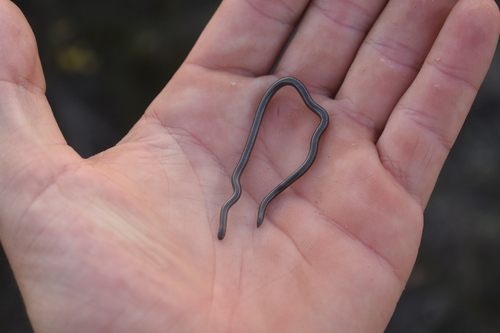 Black Thread SnakeLeptotyphlops nigricansHarmless
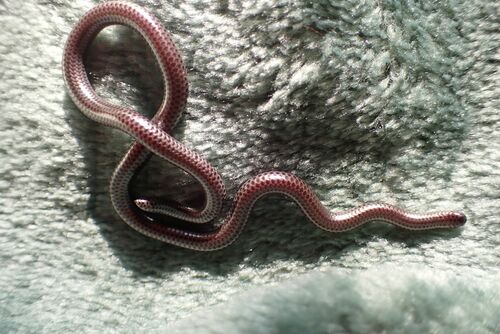 Peter's Thread SnakeLeptotyphlops scutifronsHarmless
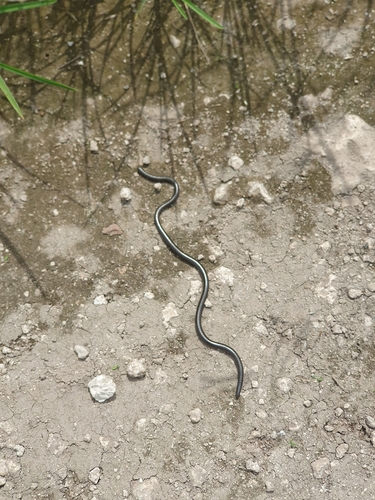 Merker's thread SnakeLeptotyphlops merkeriHarmless
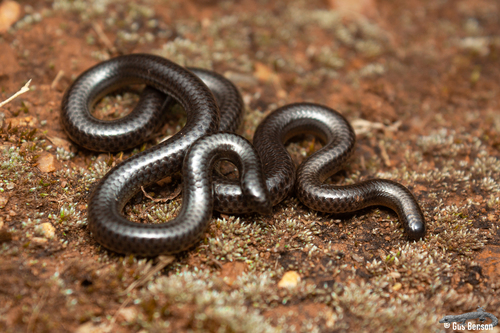 Forest Thread SnakeLeptotyphlops sylvicolusHarmless
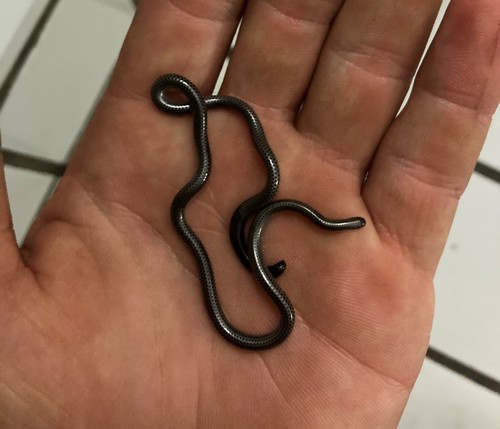 Incognito Thread SnakeLeptotyphlops incognitusHarmless
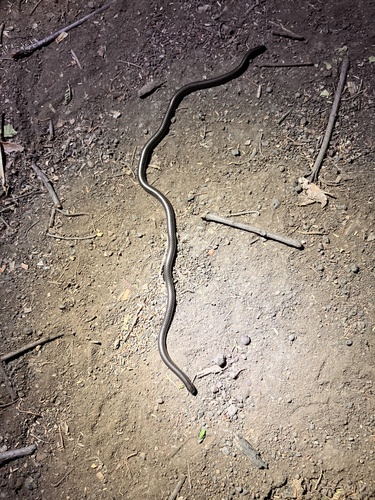 Distant's Thread SnakeLeptotyphlops distantiHarmless
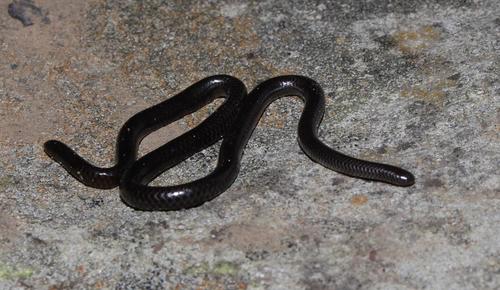 Cape Thread SnakeLeptotyphlops conjunctusHarmless
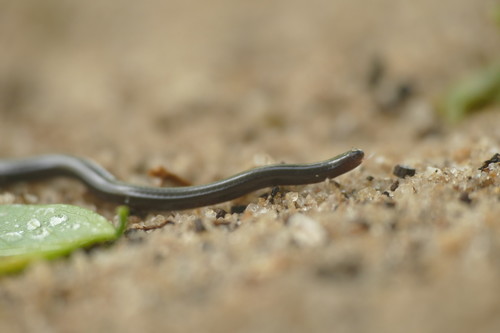 Goggle-eyed worm snakeLeptotyphlops macropsHarmless
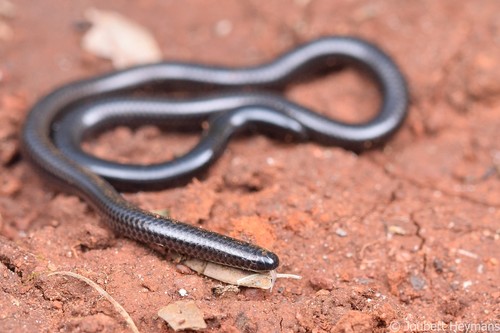 Jacobsen's Thread SnakeLeptotyphlops jacobseniHarmless
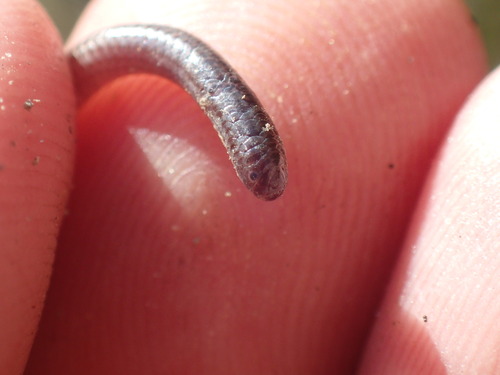 Shaba thread snakeLeptotyphlops kafubiHarmless
Keep learning
- What Is a Snake? Anatomy and the BasicsA clear overview of what makes a snake a snake: limbless body plan, anatomy, evolution from lizards, species diversity, and why they are ectothermic.
- How Snakes Move, Hunt, and EatHow snakes move without legs, hunt as ambushers or active foragers, kill by constriction or venom, and swallow prey wider than their head.
- What Do Snakes Eat?All snakes are carnivores. Learn what snakes eat, how diet changes with size and age, how often they feed, and how they hunt and swallow prey.
- Venomous vs Nonvenomous: How to Tell the DifferenceThe folk rules for telling venomous snakes apart, where each one fails, and why location-based identification beats guessing by sight.