
Genus · Colubridae
Types of hook-nosed snakes
2 species make up the genus Gyalopion, the snakes commonly called hook-nosed snakes. None are considered dangerous to humans.
About hook-nosed snakes
Tiny, harmless burrowers of the desert Southwest named for the upturned, hooked scale on the tip of the snout.
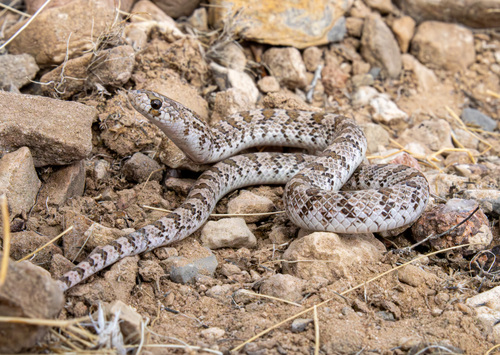
Gyalopion is a small North American genus in the family Colubridae, the largest and most diverse snake family in the world. The genus holds just two species, the Chihuahuan Hook-nosed Snake (Gyalopion canum) and the Thornscrub Hook-nosed Snake (Gyalopion quadrangulare). Both are tiny, secretive ground-dwellers of the arid and semi-arid borderlands. The defining feature is the sharply upturned, hook-like rostral scale at the tip of the snout, an adaptation for pushing through loose desert soil. They reach the northern edge of their range in the southwestern United States, mostly Arizona, New Mexico, and Texas, and extend south into northern and central Mexico, favoring desert grassland, rocky slopes, and thornscrub.
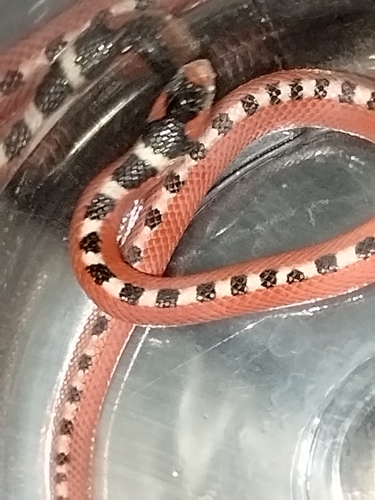
These are short, stout snakes, generally under about 15 inches long, with smooth scales and a blunt, shovel-like head. The Chihuahuan species tends toward a gray to tan ground color crossed by many narrow dark bands, while the Thornscrub species is more boldly patterned. Their small size, the distinctive upturned snout scale, and a habit of staying hidden underground make them easy to overlook. Like many fossorial colubrids, they spend most of their lives below the surface or under rocks and debris, emerging mainly at night or after warm-season rains.
Hook-nosed snakes are harmless to people. They are not front-fanged venomous snakes and pose no medical danger; their tiny mouths feed on small invertebrates such as spiders, centipedes, and scorpions rather than anything that would threaten a human. When alarmed they may writhe, evert the cloacal lining, and make a popping sound, a bluff display that is startling but entirely defensive. As with any wild snake, the responsible approach is to observe and leave it be rather than handle it. If a snakebite from any species ever causes concern, contact emergency services or US Poison Control at 1-800-222-1222.
Gyalopion belongs to the Colubridae family (Colubrids). The largest snake family, and the one most snakes you meet belong to. Typically round pupils, a head only slightly wider than the neck, and no heat-sensing facial pit or rattle. Scales may be smooth and glossy or keeled and matte depending on the species.
Danger: Almost all colubrids are harmless. A small number are rear-fanged with medically significant venom, the boomslang and the twig (vine) snakes of Africa being the dangerous exceptions. Most colubrids will flee or bluff rather than bite.
All species (2)
Keep learning
- What Is a Snake? Anatomy and the BasicsA clear overview of what makes a snake a snake: limbless body plan, anatomy, evolution from lizards, species diversity, and why they are ectothermic.
- How Snakes Move, Hunt, and EatHow snakes move without legs, hunt as ambushers or active foragers, kill by constriction or venom, and swallow prey wider than their head.
- What Do Snakes Eat?All snakes are carnivores. Learn what snakes eat, how diet changes with size and age, how often they feed, and how they hunt and swallow prey.
- Venomous vs Nonvenomous: How to Tell the DifferenceThe folk rules for telling venomous snakes apart, where each one fails, and why location-based identification beats guessing by sight.