
Genus · Colubridae
Types of ratsnakes
3 species make up the genus Euprepiophis, the snakes commonly called ratsnakes. None are considered dangerous to humans.
About Asian forest and mandarin ratsnakes
A small group of slender, harmless East Asian ratsnakes, best known for the strikingly patterned Mandarin Ratsnake.
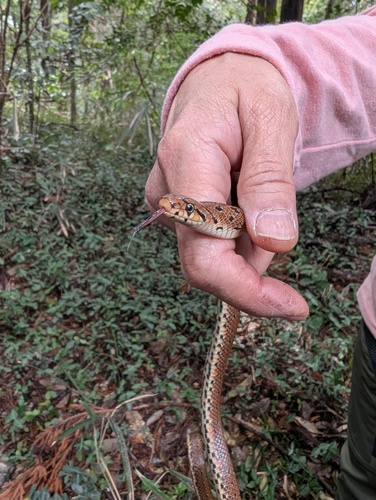
Euprepiophis is a genus in the family Colubridae, the largest snake family and the one that contains most of the world's typical, non-venomous, egg-laying snakes. The genus belongs to the ratsnake group, a loose assemblage of medium-bodied constrictors that were once all lumped into the catch-all genus Elaphe. As studies of anatomy and genetics refined that group, several distinct lineages were split out, and Euprepiophis became the home for a handful of East Asian species that share a particular body form and scale arrangement. Our database includes three species: the Japanese Forest Ratsnake, the Mandarin Ratsnake, and the Pearl-banded Rat Snake.
These are snakes of cooler, forested, and often upland country across East Asia, with a range spanning parts of China, Japan, Korea, and nearby regions, extending into the Himalayan foothills and Southeast Asian highlands for some species. They favor montane forest, wooded valleys, rocky slopes, and the moist leaf litter and burrows found there. As a group they tend toward secretive, ground-dwelling habits, spending much of their time hidden under logs, stones, and in rodent runs rather than basking in the open.
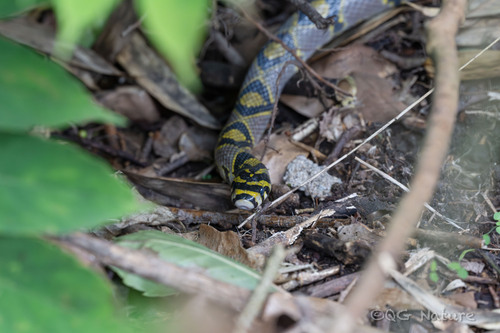
Members are recognizable as fairly slender ratsnakes of modest size, generally well under two meters and often closer to one meter, with smooth or weakly keeled scales and a head only slightly distinct from the neck. The most famous member, the Mandarin Ratsnake, is unmistakable: a gray to tan body crossed by bold black-edged yellow or orange saddles, a pattern that makes it a prized and distinctive snake. Other members are more subdued. Identifying any wild snake to genus from a photo alone is difficult, so treat general descriptions as guidance rather than a positive field key.
Euprepiophis snakes are non-venomous and harmless to people. Like other ratsnakes they are constrictors, subduing prey by coiling rather than by venom, and they pose no medical threat. They are not aggressive and will typically flee or hide; a cornered individual may musk or deliver a harmless bite, but there is no venom involved. Even with harmless species, the responsible practice with any wild snake is to observe and leave it alone rather than handle it, both for your safety and the animal's welfare.
Ecologically these are typical ratsnakes. They feed mainly on small mammals such as rodents, and depending on the species and habitat may also take other small vertebrates and, in cooler montane settings, prey adapted to those zones. They reproduce by laying eggs, with females depositing a clutch that incubates in a sheltered, humid spot. Behaviorally they are largely shy and crepuscular to nocturnal in warm weather, becoming inactive during cold montane winters. As rodent predators they play a useful role in the forest ecosystems they inhabit.
Euprepiophis belongs to the Colubridae family (Colubrids). The largest snake family, and the one most snakes you meet belong to. Typically round pupils, a head only slightly wider than the neck, and no heat-sensing facial pit or rattle. Scales may be smooth and glossy or keeled and matte depending on the species.
Danger: Almost all colubrids are harmless. A small number are rear-fanged with medically significant venom, the boomslang and the twig (vine) snakes of Africa being the dangerous exceptions. Most colubrids will flee or bluff rather than bite.
All species (3)
Keep learning
- What Is a Snake? Anatomy and the BasicsA clear overview of what makes a snake a snake: limbless body plan, anatomy, evolution from lizards, species diversity, and why they are ectothermic.
- How Snakes Move, Hunt, and EatHow snakes move without legs, hunt as ambushers or active foragers, kill by constriction or venom, and swallow prey wider than their head.
- What Do Snakes Eat?All snakes are carnivores. Learn what snakes eat, how diet changes with size and age, how often they feed, and how they hunt and swallow prey.
- Venomous vs Nonvenomous: How to Tell the DifferenceThe folk rules for telling venomous snakes apart, where each one fails, and why location-based identification beats guessing by sight.