
Genus · Colubridae
Types of racers
4 species make up the genus Dolichophis, the snakes commonly called racers. None are considered dangerous to humans.
About whip snakes
Fast, slender, day-active whip snakes of the Old World that bolt rather than bite.
Dolichophis is a genus of whip snakes in the family Colubridae, the largest and most diverse snake family. The genus was split out from the broader racer and whipsnake group to hold a handful of large, long-bodied Eurasian species. Our database lists 4 species, including the Caspian Whipsnake, the Large Whip Snake, the Red-Bellied Racer, and Andreas' Racer. As colubrids, these snakes share the family's general blueprint: a slim build, smooth or weakly keeled scales, large eyes, and a non-venomous bite in the medical sense.
These snakes range across southeastern Europe, the Balkans, Anatolia, the Caucasus, and parts of the Middle East and Central Asia. They favor warm, open, sun-exposed country: dry grassland, rocky hillsides, scrub, vineyards, field edges, and stone walls. This is habitat that offers both basking spots and quick cover, which suits an animal that relies on speed and alertness rather than camouflage or venom.
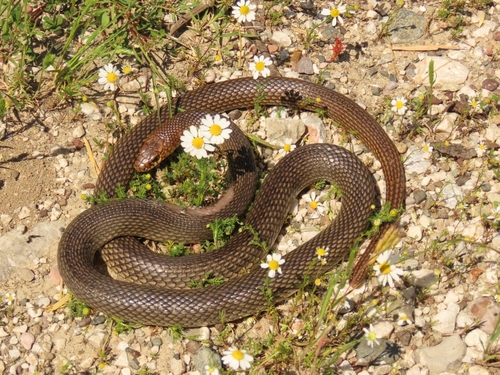
In general terms you recognize members of Dolichophis by their length and proportions. They are among the longer colubrids in their range, with some adults stretching well past a meter and a half, paired with a notably slender body and a long tapering tail. The head is fairly distinct from the neck, the eyes are large with round pupils, and the scales tend to be smooth and glossy. Coloration varies by species and age, often shifting from patterned or blotched juveniles to more uniform adults.
On safety: Dolichophis snakes are not venomous and are not considered dangerous to people. They are fast, nervous animals whose first response is to flee at speed; if cornered they may strike and bite defensively, which can break skin but does not deliver venom. As with any wild animal, the right approach is to observe from a distance and leave it alone rather than handle it. A wild snake bite of any kind should be cleaned and watched for infection, and if you are ever unsure whether a snake is venomous, treat the encounter as serious and contact emergency services or, in the US, Poison Control at 1-800-222-1222.
Ecologically these are active, visually hunting predators. They forage by day across open ground, using speed and good eyesight to run down lizards, small mammals, birds, eggs, and other snakes, subduing prey by pinning and swallowing rather than constricting tightly. Like most colubrids in their region they are egg-laying, with females depositing a clutch in summer that hatches later in the warm season. Their alert, flighty behavior and strong escape response are the hallmarks that define how people most often experience them.
Dolichophis belongs to the Colubridae family (Colubrids). The largest snake family, and the one most snakes you meet belong to. Typically round pupils, a head only slightly wider than the neck, and no heat-sensing facial pit or rattle. Scales may be smooth and glossy or keeled and matte depending on the species.
Danger: Almost all colubrids are harmless. A small number are rear-fanged with medically significant venom, the boomslang and the twig (vine) snakes of Africa being the dangerous exceptions. Most colubrids will flee or bluff rather than bite.
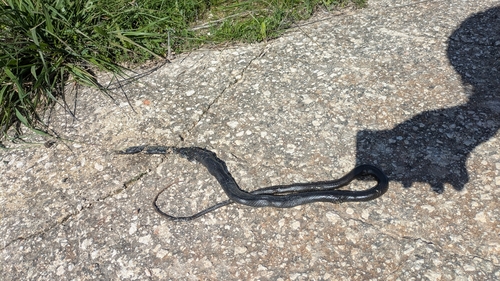
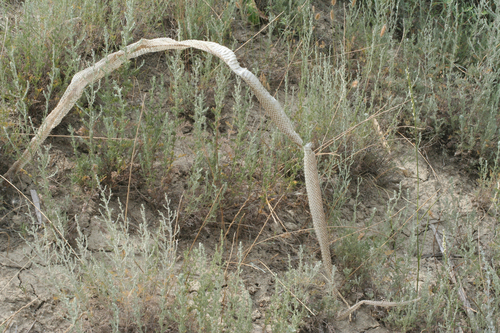
All species (4)
Keep learning
- What Is a Snake? Anatomy and the BasicsA clear overview of what makes a snake a snake: limbless body plan, anatomy, evolution from lizards, species diversity, and why they are ectothermic.
- How Snakes Move, Hunt, and EatHow snakes move without legs, hunt as ambushers or active foragers, kill by constriction or venom, and swallow prey wider than their head.
- What Do Snakes Eat?All snakes are carnivores. Learn what snakes eat, how diet changes with size and age, how often they feed, and how they hunt and swallow prey.
- Venomous vs Nonvenomous: How to Tell the DifferenceThe folk rules for telling venomous snakes apart, where each one fails, and why location-based identification beats guessing by sight.