
Genus · Lamprophiidae
Bothrolycus
The genus Bothrolycus contains a single species. It is not considered dangerous to humans.
About Günther's black snakes
A single secretive African forest snake that hides in the leaf litter of the Congo Basin and rarely meets human eyes.
Bothrolycus is a monotypic genus, meaning it holds just one recognized species: Bothrolycus ater, often called Günther's black snake. It belongs to the family Lamprophiidae, a large group of mostly African and Madagascan snakes that also includes the house snakes, wolf snakes, and many other ground-dwelling forms. Within that family it sits among the African members adapted to terrestrial and leaf-litter life rather than to trees or water, and it is grouped with other small, dark, secretive snakes of the equatorial forests.
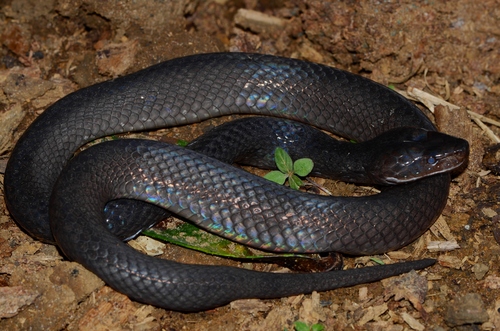
The single species is found in the rainforests of Central and West Africa, including parts of Cameroon, Gabon, Equatorial Guinea, and the broader Congo Basin region. As the name suggests, it is a dark, often blackish snake of modest size, typically well under a meter long. Like many forest-floor lamprophiids it has a smooth, glossy body and a head not strongly distinct from the neck, traits that suit a life spent burrowing through damp soil and pushing under fallen leaves. Because it is rarely seen and poorly studied, most of what can be said about it comes from the general biology of similar litter-dwelling snakes in its family.
This is not a snake of medical concern to people. Lamprophiids in this group are not front-fanged vipers or cobras, and Bothrolycus is regarded as harmless to humans, taking small prey such as amphibians, lizards, and invertebrates that it encounters on the forest floor. Most family members lay eggs and live quiet, hidden lives. Even so, no wild snake should be picked up or handled, since any bite from an unfamiliar animal can cause injury or infection. If a bite occurs and you are unsure of the species, treat it seriously and contact emergency care or, in the United States, Poison Control at 1-800-222-1222.
Bothrolycus belongs to the Lamprophiidae family (African house snakes & allies). Common African snakes, including the familiar house snakes. Variable; many are smooth-scaled, secretive, and active at night.
Danger: Mostly harmless. A few are rear-fanged with mild venom of no medical significance.
All species (1)
Keep learning
- What Is a Snake? Anatomy and the BasicsA clear overview of what makes a snake a snake: limbless body plan, anatomy, evolution from lizards, species diversity, and why they are ectothermic.
- How Snakes Move, Hunt, and EatHow snakes move without legs, hunt as ambushers or active foragers, kill by constriction or venom, and swallow prey wider than their head.
- What Do Snakes Eat?All snakes are carnivores. Learn what snakes eat, how diet changes with size and age, how often they feed, and how they hunt and swallow prey.
- Venomous vs Nonvenomous: How to Tell the DifferenceThe folk rules for telling venomous snakes apart, where each one fails, and why location-based identification beats guessing by sight.