
Genus · Colubridae
Types of rough-sided snakes
9 species make up the genus Aspidura, the snakes commonly called rough-sided snakes. None are considered dangerous to humans.
About Rough-sided snakes
Small, secretive ground snakes found almost entirely in Sri Lanka, harmless to people and rarely seen above the leaf litter.
Aspidura is a genus of small, burrowing snakes in the family Colubridae, the largest and most diverse family of living snakes. Like most colubrids they are slender, smooth-scaled animals built for moving through soil and leaf litter rather than for confronting larger animals. The common name rough-sided snake comes from the keeled (ridged) scales along the body of several species, which give the skin a slightly textured feel.
The genus is famously narrow in its distribution. Aspidura is largely endemic to Sri Lanka, where its species occupy forests, plantations, gardens, and the cool, damp highlands of the island. A few populations reach nearby parts of southern India, but Sri Lanka is the true center of the genus. This tight range is part of why these snakes are of strong interest to herpetologists studying island evolution, even though they are easy for the general public to overlook.
Recognizing an Aspidura in general terms: expect a small snake, often under a foot in length, with a cylindrical body, a short tail, small eyes, and a head that is barely wider than the neck, all consistent with a life spent underground. Coloration is usually plain brown or grayish with darker stripes or a darker line down the back, blending into soil and forest floor. They are not banded, hooded, or brightly warning-colored. Because several small Sri Lankan snakes look alike, confident species identification is best left to a local expert.
These snakes are harmless to humans. They are non-venomous colubrids with no medically significant bite, and they are not aggressive; their defense is to hide and burrow rather than to strike. That said, the responsible practice with any wild snake is to observe and leave it alone rather than handle it, since misidentification of small snakes is common. If anyone is ever bitten by an unknown snake and there is any uncertainty, treat it as a medical situation and contact local emergency services, or in the United States call Poison Control at 1-800-222-1222.
Ecologically, Aspidura snakes are quiet specialists of the forest floor. They feed largely on earthworms and other soft-bodied invertebrates that they find in moist soil and leaf litter, which suits their small size and burrowing habits. Like many colubrids they reproduce by laying eggs, and they spend most of their lives hidden from view, becoming visible mainly after heavy rain or when soil is disturbed. Their dependence on damp forest and undisturbed ground also makes several species useful indicators of healthy habitat in Sri Lanka.
Aspidura belongs to the Colubridae family (Colubrids). The largest snake family, and the one most snakes you meet belong to. Typically round pupils, a head only slightly wider than the neck, and no heat-sensing facial pit or rattle. Scales may be smooth and glossy or keeled and matte depending on the species.
Danger: Almost all colubrids are harmless. A small number are rear-fanged with medically significant venom, the boomslang and the twig (vine) snakes of Africa being the dangerous exceptions. Most colubrids will flee or bluff rather than bite.
All species (9)
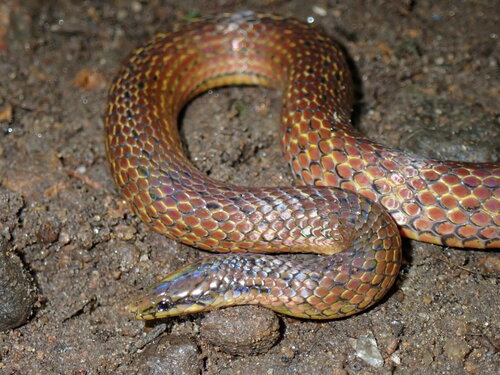 Common Rough-sided SnakeAspidura trachyproctaHarmless
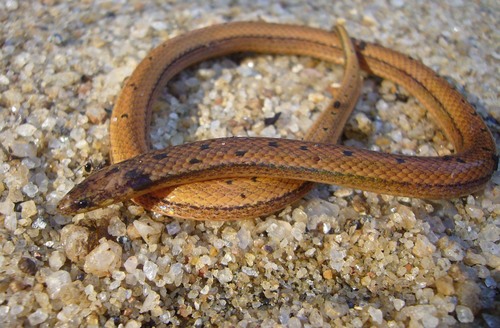 Boie's Rough-sided SnakeAspidura brachyorrhosHarmless
 Günther's Rough-sided SnakeAspidura guentheriHarmless
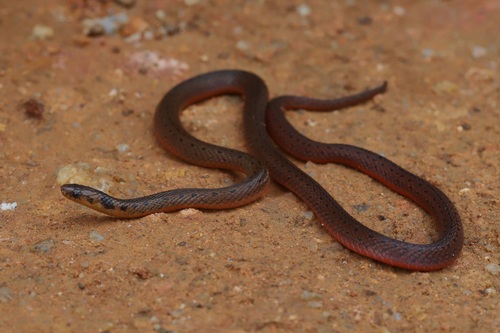 Ceylon KeelbackAspidura ceylonensisHarmless
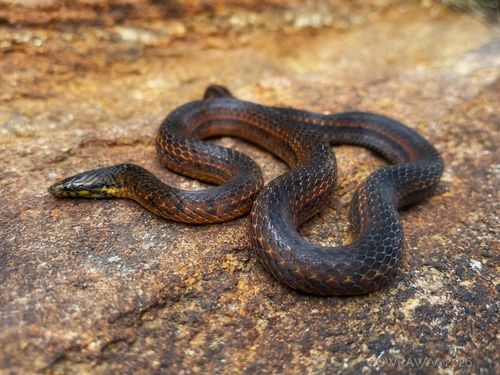 De Silva's Rough-sided SnakeAspidura desilvaiHarmless
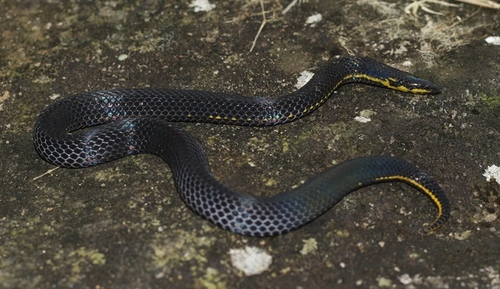 Ravana's Rough-sided SnakeAspidura ravanaiHarmless
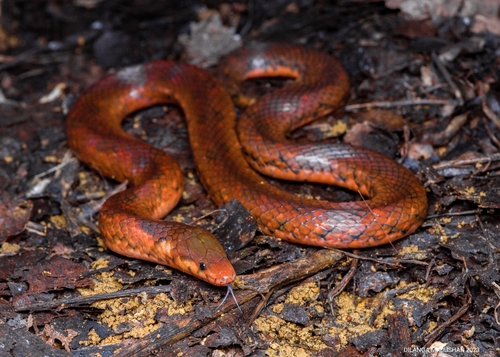 Cope's Rough-sided SnakeAspidura copeiHarmless
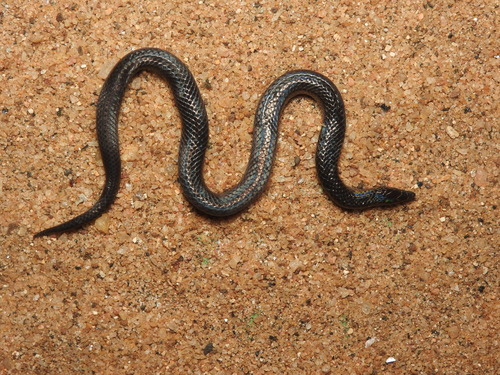 Drummond-Hay's Rough-sided SnakeAspidura drummondhayiHarmless
- No photoSri Lanka Rough-sided SnakeAspidura deraniyagalaeHarmless
Keep learning
- What Is a Snake? Anatomy and the BasicsA clear overview of what makes a snake a snake: limbless body plan, anatomy, evolution from lizards, species diversity, and why they are ectothermic.
- How Snakes Move, Hunt, and EatHow snakes move without legs, hunt as ambushers or active foragers, kill by constriction or venom, and swallow prey wider than their head.
- What Do Snakes Eat?All snakes are carnivores. Learn what snakes eat, how diet changes with size and age, how often they feed, and how they hunt and swallow prey.
- Venomous vs Nonvenomous: How to Tell the DifferenceThe folk rules for telling venomous snakes apart, where each one fails, and why location-based identification beats guessing by sight.